



 Chat with AI
Exam 19: Earnings and Discrimination

Exam 1: Ten Principles of Economics220 Questions
Exam 2: Thinking Like an Economist284 Questions
Exam 3: Interdependence and the Gains From Trade192 Questions
Exam 4: The Market Forces of Supply and Demand277 Questions
Exam 5: Elasticity and Its Application222 Questions
Exam 6: Supply, Demand, and Government Policies321 Questions
Exam 7: Consumers, Producers, and the Efficiency of Markets218 Questions
Exam 8: Applications: The Costs of Taxation203 Questions
Exam 9: Application: International Trade214 Questions
Exam 10: Externalities204 Questions
Exam 11: Public Goods and Common Resources182 Questions
Exam 12: The Design of the Tax System225 Questions
Exam 13: The Costs of Production261 Questions
Exam 14: Firms in Competitive Markets243 Questions
Exam 15: Monopoly231 Questions
Exam 16: Monopolistic Competition246 Questions
Exam 17: Oligopoly204 Questions
Exam 18: The Markets for the Factors of Production232 Questions
Exam 19: Earnings and Discrimination230 Questions
Exam 20: Income Inequality and Poverty194 Questions
Exam 21: The Theory of Consumer Choice209 Questions
Exam 22: Frontiers in Microeconomics185 Questions
Exam 23: Measuring a Nations Income231 Questions
Exam 24: Measuring the Cost of Living214 Questions
Exam 25: Production and Growth187 Questions
Exam 26: Saving, Investment, and the Financial System225 Questions
Exam 27: Tools of Finance198 Questions
Exam 28: Unemployment and Its Natural Rate361 Questions
Exam 29: The Monetary System210 Questions
Exam 30: Money Growth and Inflation201 Questions
Exam 31: Open-Economy Macroeconomics: Basic Concepts194 Questions
Exam 32: A Macroeconomic Theory of the Open Economy188 Questions
Exam 33: Aggregate Demand and Aggregate Supply189 Questions
Exam 34: The Influence of Monetary and Fiscal Policy on Aggregate Demand207 Questions
Exam 35: The Short-Run Tradeoff Between Inflation and Unemployment223 Questions
Exam 36: Six Debates Over Macroeconomic Policy154 Questions
Select questions type


Figure 19-5  -Refer to Figure 19-5. Given demand for labor, D1, and supply of labor, S1, what is the quantity demanded of labor if a minimum wage of $8 per hour is imposed on this market?
 (Multiple Choice)
4.9/5  (88)
(88) If people with blue eyes earn more than people with brown eyes, we have proof of discrimination against people with brown eyes.
(True/False)
5.0/5 (76)
(76) Assuming that all other things are equal, including the wage, which of the following statements is correct?
(Multiple Choice)
4.9/5 (84)
(84) A cutting-edge biotech firm is hiring recent college graduates. To attract the very best applicants and to increase worker effort the firm is paying a wage 20% higher than the market wage for entry level employees in this industry. What is the term for the wage paid in this example?
(Short Answer)
4.9/5 (75)
(75) Empirical evidence suggests that ability, effort, and chance are not likely to be significant contributors to wage differences.
(True/False)
4.9/5 (81)
(81) Figure 19-7

-Refer to Figure 19-7. Given demand, D1, and supply, S1, how many workers are unemployed if a minimum wage of $8 per hour is imposed on this market?
-Refer to Figure 19-7. Given demand, D1, and supply, S1, how many workers are unemployed if a minimum wage of $8 per hour is imposed on this market? (Short Answer)
4.7/5 (80)
(80) Workers who work the night shift at factories are paid more than similar workers who work the day shift due to a
(Short Answer)
4.9/5 (79)
(79) When employers sort employment applications into high-ability and low-ability people based on whether or not the applicant has a college degree (irrespective of major), they are providing evidence in support of the
(Multiple Choice)
4.8/5 (79)
(79) Figure 19-1  -Refer to Figure 19-1. What is the change in employment of having the minimum wage at $9 instead of $7?
 (Multiple Choice)
4.8/5 (74)
(74) Figure 19-7
-Refer to Figure 19-7. Given demand, D1, and supply, S2, how much more do the workers with jobs earn per hour if a minimum wage of $8 per hour is imposed on this market?
-Refer to Figure 19-7. Given demand, D1, and supply, S2, how much more do the workers with jobs earn per hour if a minimum wage of $8 per hour is imposed on this market? (Short Answer)
4.9/5 (80)
(80) Which of the following explains why soccer players make millions of dollars in Europe but do not in the United States?
(Multiple Choice)
4.8/5 (81)
(81) List three reasons why wages could be set above the equilibrium wage.
(Essay)
4.9/5 (66)
(66) Figure 19-6 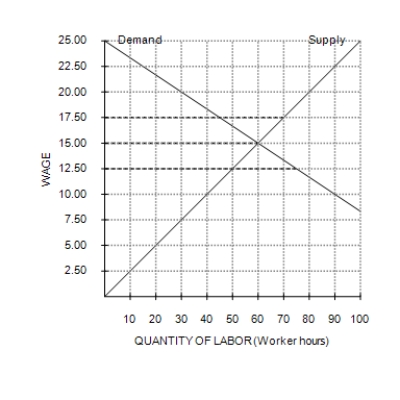 -Refer to Figure 19-6. This figure depicts labor demand and supply for the widget industry. The market equilibrium wage is $15. If the minimum wage in the economy is $12.50, how many hours of labor will be demanded from firms in the widget industry?
 (Multiple Choice)
4.8/5 (64)
(64) The signaling theory of education suggests that when people earn a college degree they do not become more productive, but they do signal their high ability to prospective employers.
(True/False)
4.7/5 (80)
(80) Figure 19-6
-Refer to Figure 19-6. This figure depicts labor demand and supply for the widget industry. The equilibrium market wage is $15. If a labor union forms within the widget industry and subsequently negotiates an hourly wage of $17.50, then there will be an
-Refer to Figure 19-6. This figure depicts labor demand and supply for the widget industry. The equilibrium market wage is $15. If a labor union forms within the widget industry and subsequently negotiates an hourly wage of $17.50, then there will be an (Multiple Choice)
5.0/5 (83)
(83) Figure 19-3 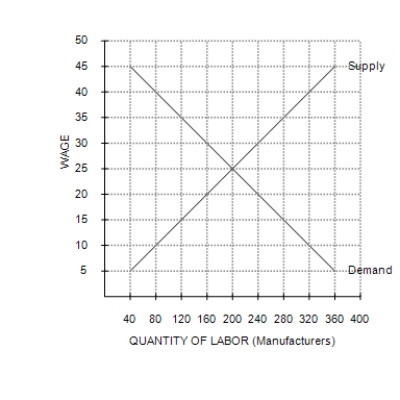 -Refer to Figure 19-3. Suppose the manufacturing labor market, which is nonunionized, is in equilibrium at a wage equal to $25. Suppose now that the AFL-CIO (a labor organization) organizes the workers in the manufacturing market and negotiates a wage of $30 per hour. After the workers become unionized, how many workers do manufacturing firms collectively hire?
 (Multiple Choice)
4.8/5 (78)
(78) Which theory is supportive of the idea that increasing educational levels for all workers would raise all workers' productivity and therefore their wages?
(Multiple Choice)
4.9/5 (87)
(87) Figure 19-6
-Refer to Figure 19-6. This figure depicts labor demand and supply for the widget industry. The equilibrium market wage is $15. Suppose a labor union forms and subsequently negotiates an hourly wage of $25.00. Which of the following statements is true?
-Refer to Figure 19-6. This figure depicts labor demand and supply for the widget industry. The equilibrium market wage is $15. Suppose a labor union forms and subsequently negotiates an hourly wage of $25.00. Which of the following statements is true? (Multiple Choice)
4.9/5 (85)
(85) According to economic historians, streetcars in southern cities in the early 1900s were racially segregated because the owners of the firms believed that segregation raised the firms' profits.
(True/False)
4.7/5 (71)
(71) 
Filters
- Essay(0)
- Multiple Choice(0)
- Short Answer(0)
- True False(0)
- Matching(0)