



 Chat with AI
Exam 19: Earnings and Discrimination

Exam 1: Ten Principles of Economics220 Questions
Exam 2: Thinking Like an Economist284 Questions
Exam 3: Interdependence and the Gains From Trade192 Questions
Exam 4: The Market Forces of Supply and Demand277 Questions
Exam 5: Elasticity and Its Application222 Questions
Exam 6: Supply, Demand, and Government Policies321 Questions
Exam 7: Consumers, Producers, and the Efficiency of Markets218 Questions
Exam 8: Applications: The Costs of Taxation203 Questions
Exam 9: Application: International Trade214 Questions
Exam 10: Externalities204 Questions
Exam 11: Public Goods and Common Resources182 Questions
Exam 12: The Design of the Tax System225 Questions
Exam 13: The Costs of Production261 Questions
Exam 14: Firms in Competitive Markets243 Questions
Exam 15: Monopoly231 Questions
Exam 16: Monopolistic Competition246 Questions
Exam 17: Oligopoly204 Questions
Exam 18: The Markets for the Factors of Production232 Questions
Exam 19: Earnings and Discrimination230 Questions
Exam 20: Income Inequality and Poverty194 Questions
Exam 21: The Theory of Consumer Choice209 Questions
Exam 22: Frontiers in Microeconomics185 Questions
Exam 23: Measuring a Nations Income231 Questions
Exam 24: Measuring the Cost of Living214 Questions
Exam 25: Production and Growth187 Questions
Exam 26: Saving, Investment, and the Financial System225 Questions
Exam 27: Tools of Finance198 Questions
Exam 28: Unemployment and Its Natural Rate361 Questions
Exam 29: The Monetary System210 Questions
Exam 30: Money Growth and Inflation201 Questions
Exam 31: Open-Economy Macroeconomics: Basic Concepts194 Questions
Exam 32: A Macroeconomic Theory of the Open Economy188 Questions
Exam 33: Aggregate Demand and Aggregate Supply189 Questions
Exam 34: The Influence of Monetary and Fiscal Policy on Aggregate Demand207 Questions
Exam 35: The Short-Run Tradeoff Between Inflation and Unemployment223 Questions
Exam 36: Six Debates Over Macroeconomic Policy154 Questions
Select questions type


Since measurable factors such as years of experience and years of education explain less than half of the variation in wages, ability, effort, and chance must play a significant role in determining wages.
(True/False)
4.9/5  (74)
(74) Figure 19-5  -Refer to Figure 19-5. Given demand for labor, D1, and supply of labor, S2, what is the surplus of labor if a minimum wage of $8 per hour is imposed on this market?
 (Multiple Choice)
4.9/5 (73)
(73) Scenario 19-4
Assume that the labor market for barbers is competitive and that it is differentiated into two groups: barbers who are bald (or going bald) and those who have a full head of hair. Assume that the barbers in this market have identical hair-cutting ability, regardless of whether they are bald or not. Currently, the equilibrium wage in the bald barber market is lower than that in the nonbald market. Further assume that the market for haircuts is competitive.
-Refer to Scenario 19-4. Competition in the market for haircuts is consistent with which of the following statements?
(Multiple Choice)
4.7/5 (72)
(72) Evidence of discrimination is most apparent when one compares wages among broad groups.
(True/False)
5.0/5 (72)
(72) Figure 19-4 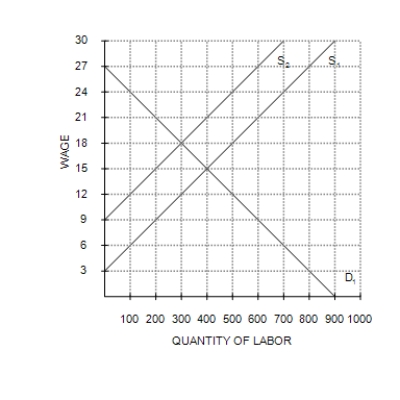 -Refer to Figure 19-4. If a union is successful in reducing supply from S1 to S2, the wage will
 (Multiple Choice)
4.8/5 (80)
(80) Some economists argue that changes in U.S. trade flows have altered the gap between wages of skilled and unskilled workers. Explain.
(Essay)
4.8/5 (63)
(63) Which of the following cannot be used to help explain wage differences among different groups of workers?
(Multiple Choice)
4.8/5 (86)
(86) Kiara is the best eye surgeon in town, and she earns $250,000 a year. Jasmine is an average eye surgeon in town, and she earns $180,000 a year. Kiara's skills as a surgeon are
(Multiple Choice)
4.9/5 (86)
(86) Which of the following scenarios exhibits statistical discrimination?
(Multiple Choice)
4.8/5 (91)
(91) Jen is a waitress, and she gets paid an additional $2.00 per hour for agreeing to work on Valentine's Day. Jamie is also a waitress, but she did not work on Valentine's Day and hence did not get the extra $2.00 per hour. This difference in pay is an example of differences in human capital.
(True/False)
4.8/5 (79)
(79) Which of the following is the most likely outcome of raising the minimum wage?
(Multiple Choice)
4.8/5 (75)
(75) Scenario 19-7
Suppose that in the competitive market for auto repair, firms prefer to hire men rather than women. Assume that the women applying for positions have the same skills, experience, and work ethic as the men. As a result of this discrimination, the demand for women is lower than it otherwise would be.
-Refer to Scenario 19-7. Suppose that consumers prefer to have men work on their auto repairs and are willing to pay higher prices to accommodate these preferences. What will happen to the wage differential between men and women?
(Short Answer)
4.8/5 (85)
(85) One reason why better-looking workers may have higher earnings is that physical attractiveness is correlated with intelligence.
(True/False)
4.8/5 (83)
(83) Figure 19-2 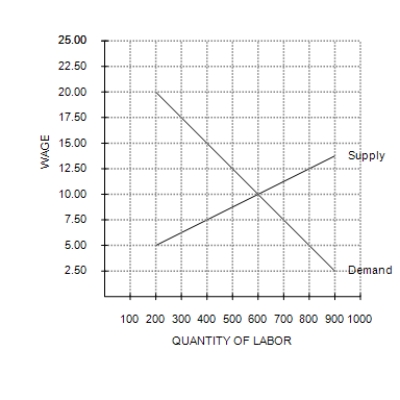 -Refer to Figure 19-2. This figure depicts labor demand and supply in a nonunionized labor market. If the minimum wage were $7.50, employment in this market would be
 (Multiple Choice)
4.9/5 (79)
(79) Figure 19-8
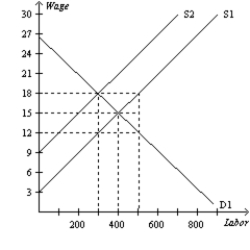
-Refer to Figure 19-8. The figure shows labor demand and labor supply in a non-unionized labor market. Suppose the current labor demand is D1 and the current labor supply is S1. If a firm in this market decided to pay its workers $18 per hour to increase the productivity of its workers, this firm would be paying a(n)
-Refer to Figure 19-8. The figure shows labor demand and labor supply in a non-unionized labor market. Suppose the current labor demand is D1 and the current labor supply is S1. If a firm in this market decided to pay its workers $18 per hour to increase the productivity of its workers, this firm would be paying a(n) (Short Answer)
4.8/5 (69)
(69) Once during a U.S. presidential campaign, a lobbyist for a prominent national women's organization made the claim that women in the United States earn $0.60 for every $1.00 earned by a man. A reporter, who was prepared for this statement, asked the lobbyist why wages paid to the organization's secretarial staff (all of whom were women) were significantly below the national average if they were truly interested in raising the rates of compensation for women. If you were the lobbyist, how would you have answered this question? Do you think your answer is convincing? Explain.
(Essay)
4.9/5 (87)
(87) According to a study of the "beauty premium," how do the wages of people with average looks compare to those of people considered less attractive than average?
(Short Answer)
4.9/5 (88)
(88) 
Filters
- Essay(0)
- Multiple Choice(0)
- Short Answer(0)
- True False(0)
- Matching(0)