



 Chat with AI
Exam 29: The Monetary System

Exam 1: Ten Principles of Economics455 Questions
Exam 2: Thinking Like an Economist643 Questions
Exam 3: Interdependence and the Gains From Trade547 Questions
Exam 4: The Market Forces of Supply and Demand693 Questions
Exam 5: Elasticity and Its Application626 Questions
Exam 6: Supply, Demand, and Government Policies668 Questions
Exam 7: Consumers, Producers, and the Efficiency of Markets547 Questions
Exam 8: Applications: the Costs of Taxation509 Questions
Exam 9: Application: International Trade521 Questions
Exam 10: Externalities543 Questions
Exam 11: Public Goods and Common Resources452 Questions
Exam 12: The Design of the Tax System664 Questions
Exam 13: The Costs of Production649 Questions
Exam 14: Firms in Competitive Markets604 Questions
Exam 15: Monopoly662 Questions
Exam 16: Monopolistic Competition649 Questions
Exam 17: Oligopoly522 Questions
Exam 18: The Markets for the Factors of Production592 Questions
Exam 19: Earnings and Discrimination511 Questions
Exam 20: Income Inequality and Poverty478 Questions
Exam 21: The Theory of Consumer Choice570 Questions
Exam 22: Frontiers in Microeconomics461 Questions
Exam 23: Measuring a Nation S Income547 Questions
Exam 24: Measuring the Cost of Living565 Questions
Exam 25: Production and Growth527 Questions
Exam 26: Saving, Investment, and the Financial System637 Questions
Exam 27: Tools of Finance534 Questions
Exam 28: Unemployment and Its Natural Rate701 Questions
Exam 29: The Monetary System540 Questions
Exam 30: Money Growth and Inflation504 Questions
Exam 31: Open-Economy Macroeconomics: Basic Concepts540 Questions
Exam 32: A Macroeconomic Theory of the Open Economy511 Questions
Exam 33: Aggregate Demand and Aggregate Supply572 Questions
Exam 34: The Influence of Monetary and Fiscal Policy on Aggregate Demand523 Questions
Exam 35: The Short-Run Tradeoff Between Inflation and Unemployment536 Questions
Exam 36: Six Debates Over Macroeconomic Policy354 Questions
Select questions type


Consider five vendors at a swap meet.
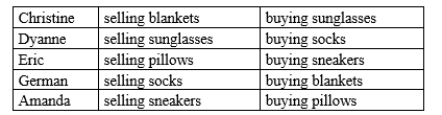
Which of the following pairs of vendors has a double coincidence of wants?
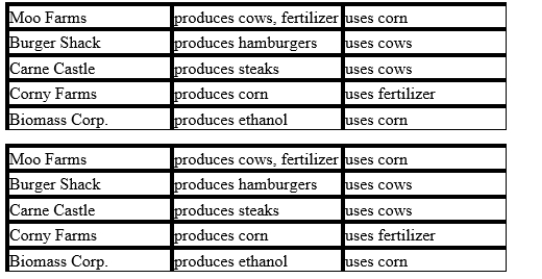
Which of the following pairs of vendors has a double coincidence of wants?
(Multiple Choice)
4.8/5  (77)
(77) Because of the multiple tools at its disposal, the Fed can control the money supply very precisely.
(True/False)
4.8/5 (86)
(86) You believe the dollars you have today will be accepted in the future in exchange for goods and services. Which function of money does this illustrate?
(Short Answer)
4.8/5 (74)
(74) What is the change in the money supply when the Fed purchases $700 worth of bonds and the required reserve ratio is 14 percent assuming banks hold no excess reserves?
(Short Answer)
4.8/5 (94)
(94) Today, bank runs are not a major problem for the U.S. banking system because
(Multiple Choice)
4.7/5 (66)
(66) Money, such as gold, with some intrinsic value is called _____. Money with no intrinsic value is called _____.
(Short Answer)
5.0/5 (80)
(80) Table 29-6.  -Refer to Table 29-6. Assume the Fed's reserve requirement is 5 percent and all banks besides the Bank of Pleasantville are exactly in compliance with the 5 percent requirement. Further assume that people hold only deposits and no currency. Starting from the situation as depicted by the T-account, if the Bank of Pleasantville decides to make new loans so as to end up with no excess reserves, then by how much does the money supply eventually increase?
 (Multiple Choice)
4.8/5 (84)
(84) Members of the Board of Governors are appointed by the president of the U.S. and confirmed by the U.S. Senate.
(True/False)
4.9/5 (85)
(85) For purposes of analyzing the money stock and its relationship to relevant economic variables, money is best thought of as
(Multiple Choice)
4.9/5 (99)
(99) The Fed can increase the money supply by conducting open-market
(Multiple Choice)
4.8/5 (90)
(90) Which of the following is both a store of value and regularly used as a medium of exchange?
(Multiple Choice)
4.9/5 (75)
(75) Economists call an institution designed to oversee the banking system and regulate the quantity of money in the economy
(Multiple Choice)
4.8/5 (86)
(86) 
Filters
- Essay(0)
- Multiple Choice(0)
- Short Answer(0)
- True False(0)
- Matching(0)