



 Chat with AI
Exam 29: The Monetary System

Exam 1: Ten Principles of Economics455 Questions
Exam 2: Thinking Like an Economist643 Questions
Exam 3: Interdependence and the Gains From Trade547 Questions
Exam 4: The Market Forces of Supply and Demand693 Questions
Exam 5: Elasticity and Its Application626 Questions
Exam 6: Supply, Demand, and Government Policies668 Questions
Exam 7: Consumers, Producers, and the Efficiency of Markets547 Questions
Exam 8: Applications: the Costs of Taxation509 Questions
Exam 9: Application: International Trade521 Questions
Exam 10: Externalities543 Questions
Exam 11: Public Goods and Common Resources452 Questions
Exam 12: The Design of the Tax System664 Questions
Exam 13: The Costs of Production649 Questions
Exam 14: Firms in Competitive Markets604 Questions
Exam 15: Monopoly662 Questions
Exam 16: Monopolistic Competition649 Questions
Exam 17: Oligopoly522 Questions
Exam 18: The Markets for the Factors of Production592 Questions
Exam 19: Earnings and Discrimination511 Questions
Exam 20: Income Inequality and Poverty478 Questions
Exam 21: The Theory of Consumer Choice570 Questions
Exam 22: Frontiers in Microeconomics461 Questions
Exam 23: Measuring a Nation S Income547 Questions
Exam 24: Measuring the Cost of Living565 Questions
Exam 25: Production and Growth527 Questions
Exam 26: Saving, Investment, and the Financial System637 Questions
Exam 27: Tools of Finance534 Questions
Exam 28: Unemployment and Its Natural Rate701 Questions
Exam 29: The Monetary System540 Questions
Exam 30: Money Growth and Inflation504 Questions
Exam 31: Open-Economy Macroeconomics: Basic Concepts540 Questions
Exam 32: A Macroeconomic Theory of the Open Economy511 Questions
Exam 33: Aggregate Demand and Aggregate Supply572 Questions
Exam 34: The Influence of Monetary and Fiscal Policy on Aggregate Demand523 Questions
Exam 35: The Short-Run Tradeoff Between Inflation and Unemployment536 Questions
Exam 36: Six Debates Over Macroeconomic Policy354 Questions
Select questions type


Table 29-5. 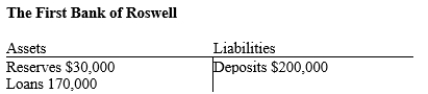 -Refer to Table 29-5. If the bank faces a reserve requirement of 6 percent, then the bank
 (Multiple Choice)
4.8/5  (86)
(86) If R represents the reserve ratio for all banks in the economy, then the money multiplier is
(Multiple Choice)
4.7/5 (82)
(82) The 2008 credit crunch occurred when banks reduced lending in response to
(Multiple Choice)
4.9/5 (76)
(76) In many circumstances, prisoners are not allowed to possess cash. Does this mean there is no money in prison? Explain.
(Essay)
5.0/5 (88)
(88) Diana tutors Tiago for two hours before his economics final exam. Tiago pays Diana through a direct transfer from his bank on a payment app. Diana then uses her debit card to buy pizza for dinner from the local pizza parlor. This is an example of
(Multiple Choice)
4.8/5 (77)
(77) The agency responsible for regulating the U.S. monetary system is the
(Multiple Choice)
4.8/5 (64)
(64) Which of the following is not included in either M1 or M2?
(Multiple Choice)
4.8/5 (83)
(83) The president of each regional Federal Reserve Bank is appointed by
(Multiple Choice)
4.8/5 (92)
(92) If the reserve requirement is 10 percent, a bank desires to hold no excess reserves, and it receives a new deposit of $500, it
(Multiple Choice)
4.8/5 (67)
(67) Monetary policy has an important influence on _____ and _____ in the short run.
(Short Answer)
4.9/5 (80)
(80) Scenario 29-2.
The Monetary Policy of Tazi is controlled by the country's central bank known as the Bank of Tazi. The local unit of currency is the taz. Aggregate banking statistics show that collectively the banks of Tazi hold 300 million tazes of required reserves, 75 million tazes of excess reserves, have issued 7,500 million tazes of deposits, and hold 225 million tazes of Tazian Treasury bonds. Tazians prefer to use only demand deposits and so all money is on deposit at the bank.
-Refer to Scenario 29-2. Assume that banks desire to continue holding the same ratio of excess reserves to deposits. What is the reserve requirement and the reserve ratio for Tazian Banks?
(Multiple Choice)
4.9/5 (72)
(72) If the reserve requirement is 5 percent, a bank desires to hold no excess reserves, and it receives a new deposit of $10, then this bank
(Multiple Choice)
4.8/5 (72)
(72) Consider five high school students working on homework in study hall.  Which of the following pairs of students has a double coincidence of wants?
 (Multiple Choice)
5.0/5 (77)
(77) 
Filters
- Essay(0)
- Multiple Choice(0)
- Short Answer(0)
- True False(0)
- Matching(0)