



 Chat with AI
Exam 29: The Monetary System

Exam 1: Ten Principles of Economics455 Questions
Exam 2: Thinking Like an Economist643 Questions
Exam 3: Interdependence and the Gains From Trade547 Questions
Exam 4: The Market Forces of Supply and Demand693 Questions
Exam 5: Elasticity and Its Application626 Questions
Exam 6: Supply, Demand, and Government Policies668 Questions
Exam 7: Consumers, Producers, and the Efficiency of Markets547 Questions
Exam 8: Applications: the Costs of Taxation509 Questions
Exam 9: Application: International Trade521 Questions
Exam 10: Externalities543 Questions
Exam 11: Public Goods and Common Resources452 Questions
Exam 12: The Design of the Tax System664 Questions
Exam 13: The Costs of Production649 Questions
Exam 14: Firms in Competitive Markets604 Questions
Exam 15: Monopoly662 Questions
Exam 16: Monopolistic Competition649 Questions
Exam 17: Oligopoly522 Questions
Exam 18: The Markets for the Factors of Production592 Questions
Exam 19: Earnings and Discrimination511 Questions
Exam 20: Income Inequality and Poverty478 Questions
Exam 21: The Theory of Consumer Choice570 Questions
Exam 22: Frontiers in Microeconomics461 Questions
Exam 23: Measuring a Nation S Income547 Questions
Exam 24: Measuring the Cost of Living565 Questions
Exam 25: Production and Growth527 Questions
Exam 26: Saving, Investment, and the Financial System637 Questions
Exam 27: Tools of Finance534 Questions
Exam 28: Unemployment and Its Natural Rate701 Questions
Exam 29: The Monetary System540 Questions
Exam 30: Money Growth and Inflation504 Questions
Exam 31: Open-Economy Macroeconomics: Basic Concepts540 Questions
Exam 32: A Macroeconomic Theory of the Open Economy511 Questions
Exam 33: Aggregate Demand and Aggregate Supply572 Questions
Exam 34: The Influence of Monetary and Fiscal Policy on Aggregate Demand523 Questions
Exam 35: The Short-Run Tradeoff Between Inflation and Unemployment536 Questions
Exam 36: Six Debates Over Macroeconomic Policy354 Questions
Select questions type


As opposed to a payments system based on barter, a payments system based on money
(Multiple Choice)
4.8/5  (83)
(83) The discount rate is the rate the Federal Reserve charges banks for loans. By lowering this rate, the Fed provides banks with a greater incentive to borrow from it.
(True/False)
4.9/5 (77)
(77) Dollar bills, rare paintings, and emerald necklaces are all
(Multiple Choice)
4.9/5 (82)
(82) The manager of the bank where you work tells you that the bank has $400 million in deposits and $340 million dollars in loans. The Fed then raises the reserve requirement from 5 percent to 10 percent. Assuming everything else stays the same, how much is the bank holding in excess reserves after the increase in the reserve requirement?
(Multiple Choice)
4.9/5 (75)
(75) A bank's reserve ratio is 5 percent and the bank has $2,280 in reserve. Its deposits amount to
(Multiple Choice)
4.9/5 (82)
(82) Given the following information, what are the values of M1 and M2? 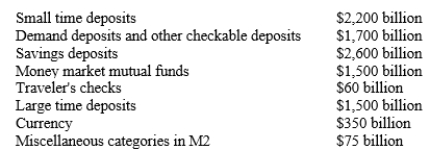
(Multiple Choice)
4.9/5 (80)
(80) A decrease in the money supply might indicate that the Fed had
(Multiple Choice)
4.9/5 (78)
(78) In December 1999 people feared that there might be computer problems at banks as the century changed. Consequently, people wanted to hold relatively more in currency and relatively less in deposits. In anticipation banks raised their reserve ratios to have enough cash on hand to meet depositors' demands. These actions by the public
(Multiple Choice)
4.7/5 (84)
(84) Table 29-4.
The First Bank of Fairfield  -Refer to Table 29-4. The reserve ratio for this bank is
 (Multiple Choice)
4.9/5 (76)
(76) Banks cannot influence the money supply if they are required to hold all deposits in reserve.
(True/False)
4.8/5 (95)
(95) During the early 1930s there were a number of bank failures in the United States. What did this do to the money supply? The New York Federal Reserve Bank advocated open market purchases. Would these purchases have reversed the change in the money supply and helped banks? Explain.
(Essay)
4.7/5 (70)
(70) The _____ is the interest rate at which banks make overnight loans to other banks.
(Short Answer)
4.7/5 (81)
(81) A bank's reserve ratio is 10 percent and the bank has $5,000 in deposits. Its reserves amount to
(Multiple Choice)
4.9/5 (73)
(73) If the Fed raised the reserve requirement, the demand for reserves would
(Multiple Choice)
4.9/5 (98)
(98) Which of the following does the U.S. president appoint and the U.S. Senate confirm?
(Multiple Choice)
4.9/5 (65)
(65) 
Filters
- Essay(0)
- Multiple Choice(0)
- Short Answer(0)
- True False(0)
- Matching(0)