



 Chat with AI
Exam 29: The Monetary System

Exam 1: Ten Principles of Economics455 Questions
Exam 2: Thinking Like an Economist643 Questions
Exam 3: Interdependence and the Gains From Trade547 Questions
Exam 4: The Market Forces of Supply and Demand693 Questions
Exam 5: Elasticity and Its Application626 Questions
Exam 6: Supply, Demand, and Government Policies668 Questions
Exam 7: Consumers, Producers, and the Efficiency of Markets547 Questions
Exam 8: Applications: the Costs of Taxation509 Questions
Exam 9: Application: International Trade521 Questions
Exam 10: Externalities543 Questions
Exam 11: Public Goods and Common Resources452 Questions
Exam 12: The Design of the Tax System664 Questions
Exam 13: The Costs of Production649 Questions
Exam 14: Firms in Competitive Markets604 Questions
Exam 15: Monopoly662 Questions
Exam 16: Monopolistic Competition649 Questions
Exam 17: Oligopoly522 Questions
Exam 18: The Markets for the Factors of Production592 Questions
Exam 19: Earnings and Discrimination511 Questions
Exam 20: Income Inequality and Poverty478 Questions
Exam 21: The Theory of Consumer Choice570 Questions
Exam 22: Frontiers in Microeconomics461 Questions
Exam 23: Measuring a Nation S Income547 Questions
Exam 24: Measuring the Cost of Living565 Questions
Exam 25: Production and Growth527 Questions
Exam 26: Saving, Investment, and the Financial System637 Questions
Exam 27: Tools of Finance534 Questions
Exam 28: Unemployment and Its Natural Rate701 Questions
Exam 29: The Monetary System540 Questions
Exam 30: Money Growth and Inflation504 Questions
Exam 31: Open-Economy Macroeconomics: Basic Concepts540 Questions
Exam 32: A Macroeconomic Theory of the Open Economy511 Questions
Exam 33: Aggregate Demand and Aggregate Supply572 Questions
Exam 34: The Influence of Monetary and Fiscal Policy on Aggregate Demand523 Questions
Exam 35: The Short-Run Tradeoff Between Inflation and Unemployment536 Questions
Exam 36: Six Debates Over Macroeconomic Policy354 Questions
Select questions type


Table 29-5. 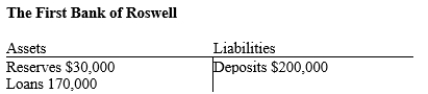 -Refer to Table 29-5. Suppose the bank faces a reserve requirement of 10 percent. Starting from the situation as depicted by the T-account, a customer deposits an additional $60,000 into his account at the bank. If the bank takes no other action it will
 (Multiple Choice)
4.7/5  (91)
(91) When we measure and record economic value, we use money as the
(Multiple Choice)
4.8/5 (80)
(80) The Fed purchases $200 worth of government bonds from the public. The reserve requirement is 12.5 percent, people hold no currency, and the banking system keeps no excess reserves. The U.S. money supply eventually increases by
(Multiple Choice)
4.9/5 (77)
(77) In a fractional reserve economy where the required reserve ratio is 10%, must it be the case that an initial deposit of $100 increases the total money supply by $1,000? Explain.
(Essay)
5.0/5 (76)
(76) Over one time horizon or another, Fed policy decisions influence
(Multiple Choice)
4.8/5 (89)
(89) Consider four survivors on an island.  Which of the following pairs of survivors has a double-coincidence of wants?
 (Multiple Choice)
4.8/5 (97)
(97) If the Fed decreases reserve requirements, the money supply will increase.
(True/False)
4.9/5 (86)
(86) If the reserve ratio is 15 percent, the money multiplier is
(Multiple Choice)
4.8/5 (79)
(79) According to economists, "money" means the same thing as "wealth".
(True/False)
4.9/5 (80)
(80) Gary's wealth is $1 million. Economists would say that Gary has $1 million worth of money.
(True/False)
4.9/5 (70)
(70) The primary difference between commodity money and fiat money is that
(Multiple Choice)
4.9/5 (80)
(80) The most common method employed by the Fed to increase the money supply is the
(Multiple Choice)
4.8/5 (74)
(74) 
Filters
- Essay(0)
- Multiple Choice(0)
- Short Answer(0)
- True False(0)
- Matching(0)