



 Chat with AI
Exam 29: The Monetary System

Exam 1: Ten Principles of Economics455 Questions
Exam 2: Thinking Like an Economist643 Questions
Exam 3: Interdependence and the Gains From Trade547 Questions
Exam 4: The Market Forces of Supply and Demand693 Questions
Exam 5: Elasticity and Its Application626 Questions
Exam 6: Supply, Demand, and Government Policies668 Questions
Exam 7: Consumers, Producers, and the Efficiency of Markets547 Questions
Exam 8: Applications: the Costs of Taxation509 Questions
Exam 9: Application: International Trade521 Questions
Exam 10: Externalities543 Questions
Exam 11: Public Goods and Common Resources452 Questions
Exam 12: The Design of the Tax System664 Questions
Exam 13: The Costs of Production649 Questions
Exam 14: Firms in Competitive Markets604 Questions
Exam 15: Monopoly662 Questions
Exam 16: Monopolistic Competition649 Questions
Exam 17: Oligopoly522 Questions
Exam 18: The Markets for the Factors of Production592 Questions
Exam 19: Earnings and Discrimination511 Questions
Exam 20: Income Inequality and Poverty478 Questions
Exam 21: The Theory of Consumer Choice570 Questions
Exam 22: Frontiers in Microeconomics461 Questions
Exam 23: Measuring a Nation S Income547 Questions
Exam 24: Measuring the Cost of Living565 Questions
Exam 25: Production and Growth527 Questions
Exam 26: Saving, Investment, and the Financial System637 Questions
Exam 27: Tools of Finance534 Questions
Exam 28: Unemployment and Its Natural Rate701 Questions
Exam 29: The Monetary System540 Questions
Exam 30: Money Growth and Inflation504 Questions
Exam 31: Open-Economy Macroeconomics: Basic Concepts540 Questions
Exam 32: A Macroeconomic Theory of the Open Economy511 Questions
Exam 33: Aggregate Demand and Aggregate Supply572 Questions
Exam 34: The Influence of Monetary and Fiscal Policy on Aggregate Demand523 Questions
Exam 35: The Short-Run Tradeoff Between Inflation and Unemployment536 Questions
Exam 36: Six Debates Over Macroeconomic Policy354 Questions
Select questions type


Given the following information, what are the values of M1 and M2? 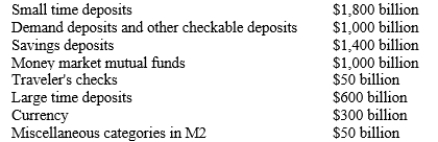
(Multiple Choice)
5.0/5  (66)
(66) Table 29-7.  -Refer to Table 29-7. If the Bank of Springfield has lent out all the money it can given its level of deposits, then what is the reserve requirement?
 (Multiple Choice)
5.0/5 (75)
(75) Which of the following can the Fed do to change the money supply?
(Multiple Choice)
4.7/5 (78)
(78) Suppose banks desire to hold no excess reserves and that the Fed has set a reserve requirement of 6 percent. If you deposit $8,000 into First Raven Bank,
(Multiple Choice)
4.9/5 (82)
(82) A problem that the Fed faces when it attempts to control the money supply is that
(Multiple Choice)
4.9/5 (56)
(56) The primary tool used by the Federal Reserve to change the money supply is _____.
(Short Answer)
4.9/5 (85)
(85) If the reserve ratio is 100-percent, then a new deposit of $1000 into a bank account
(Multiple Choice)
5.0/5 (69)
(69) Are credit cards and debit cards money? What's the difference between credit and debit cards?
(Essay)
4.7/5 (65)
(65) Assume that when $100 of new reserves enter the banking system, the money supply ultimately increases by $800. Assume also that no banks hold excess reserves and that the entire money supply consists of bank deposits. If, at a point in time, reserves for all banks amount to $750, then at that same point in time, loans for all banks amount to $6,000.
(True/False)
4.8/5 (92)
(92) On a bank's T-account, which are part of the banks liabilities?
(Multiple Choice)
4.8/5 (84)
(84) Table 29-5. 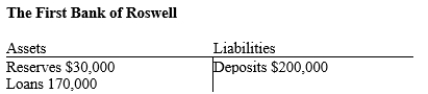 -Refer to Table 29-5. If the bank faces a reserve requirement of 8 percent, then the bank
 (Multiple Choice)
4.8/5 (97)
(97) During wars the public tends to hold relatively more currency and relatively fewer deposits. This decision makes reserves
(Multiple Choice)
4.7/5 (89)
(89) One plausible explanation for the large amount of U.S. currency outstanding is that many dollars are held abroad.
(True/False)
4.9/5 (88)
(88) 
Filters
- Essay(0)
- Multiple Choice(0)
- Short Answer(0)
- True False(0)
- Matching(0)