



 Chat with AI
Exam 29: The Monetary System

Exam 1: Ten Principles of Economics455 Questions
Exam 2: Thinking Like an Economist643 Questions
Exam 3: Interdependence and the Gains From Trade547 Questions
Exam 4: The Market Forces of Supply and Demand693 Questions
Exam 5: Elasticity and Its Application626 Questions
Exam 6: Supply, Demand, and Government Policies668 Questions
Exam 7: Consumers, Producers, and the Efficiency of Markets547 Questions
Exam 8: Applications: the Costs of Taxation509 Questions
Exam 9: Application: International Trade521 Questions
Exam 10: Externalities543 Questions
Exam 11: Public Goods and Common Resources452 Questions
Exam 12: The Design of the Tax System664 Questions
Exam 13: The Costs of Production649 Questions
Exam 14: Firms in Competitive Markets604 Questions
Exam 15: Monopoly662 Questions
Exam 16: Monopolistic Competition649 Questions
Exam 17: Oligopoly522 Questions
Exam 18: The Markets for the Factors of Production592 Questions
Exam 19: Earnings and Discrimination511 Questions
Exam 20: Income Inequality and Poverty478 Questions
Exam 21: The Theory of Consumer Choice570 Questions
Exam 22: Frontiers in Microeconomics461 Questions
Exam 23: Measuring a Nation S Income547 Questions
Exam 24: Measuring the Cost of Living565 Questions
Exam 25: Production and Growth527 Questions
Exam 26: Saving, Investment, and the Financial System637 Questions
Exam 27: Tools of Finance534 Questions
Exam 28: Unemployment and Its Natural Rate701 Questions
Exam 29: The Monetary System540 Questions
Exam 30: Money Growth and Inflation504 Questions
Exam 31: Open-Economy Macroeconomics: Basic Concepts540 Questions
Exam 32: A Macroeconomic Theory of the Open Economy511 Questions
Exam 33: Aggregate Demand and Aggregate Supply572 Questions
Exam 34: The Influence of Monetary and Fiscal Policy on Aggregate Demand523 Questions
Exam 35: The Short-Run Tradeoff Between Inflation and Unemployment536 Questions
Exam 36: Six Debates Over Macroeconomic Policy354 Questions
Select questions type


The Fed's control of the money supply is not precise because
(Multiple Choice)
4.8/5  (72)
(72) Suppose the Federal Reserve increases bank reserves and banks lend out some of these reserves, but at some point banks still have $5 million more they wish to lend out. If the reserve requirement is 10 percent, how much more money can banks create if they lend out the remaining amount?
(Multiple Choice)
4.8/5 (74)
(74) Table 29-6.  -Refer to Table 29-6. If the Fed's reserve requirement is 5 percent, then what quantity of excess reserves does the Bank of Pleasantville now hold?
 (Multiple Choice)
4.9/5 (85)
(85) Which of the following policies is NOT in the Fed's monetary toolbox?
(Multiple Choice)
4.8/5 (78)
(78) Table 29-2. The information in the table pertains to an imaginary economy. 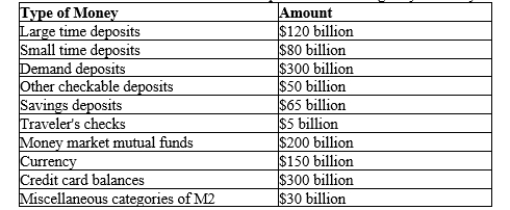 -Refer to Table 29-2. What is the M2 money supply?
 (Multiple Choice)
4.9/5 (87)
(87) A bank operates with reserves of $100, loans of $300 and securities of $100. The bank's only liability is deposits of $400 since it has zero debt. Calculate the bank's leverage ratio.
(Essay)
4.8/5 (74)
(74) If traveler's checks were $1000 higher and saving deposits were $500 higher, M1 would be
(Multiple Choice)
4.8/5 (79)
(79) A problem that the Fed faces when it attempts to control the money supply is that
(Multiple Choice)
4.8/5 (77)
(77) If the reserve ratio is 8 percent, then a decrease in reserves of $6,000 can cause the money supply to fall by as much as
(Multiple Choice)
4.9/5 (75)
(75) A central bank's setting (or altering) of the money supply is known as
(Multiple Choice)
4.8/5 (76)
(76) Table 29-4.
The First Bank of Fairfield  -Refer to Table 29-4. If $800 is deposited into the First Bank of Fairfield, and the bank takes no other actions, its
 (Multiple Choice)
4.9/5 (66)
(66) Table 29-1. The information in the table pertains to an imaginary economy. 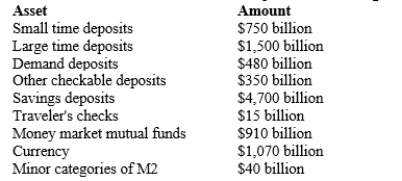 -Refer to Table 29-1. What is the value of M2 in billions of dollars?
 (Multiple Choice)
4.9/5 (70)
(70) The money multiplier equals 1/(1 - R), where R represents the reserve ratio.
(True/False)
4.8/5 (77)
(77) The Fed can decrease the money supply by conducting open-market
(Multiple Choice)
4.9/5 (75)
(75) Table 29-8  -Refer to Table 29-8. The required reserve ratio is 12 percent and First National Bank sells $120 of its short-term securities to the Federal Reserve. This action will
 (Multiple Choice)
4.8/5 (77)
(77) Suppose a bank has $3,000 in reserves, $25,000 of deposits, and a 10 percent reserve requirement. What is the amount of excess reserves?
(Short Answer)
4.9/5 (78)
(78) 
Filters
- Essay(0)
- Multiple Choice(0)
- Short Answer(0)
- True False(0)
- Matching(0)