



 Chat with AI
Exam 20: Income Inequality and Poverty

Exam 1: Ten Principles of Economics455 Questions
Exam 2: Thinking Like an Economist645 Questions
Exam 3: Interdependence and the Gains From Trade550 Questions
Exam 4: The Market Forces of Supply and Demand693 Questions
Exam 5: Elasticity and Its Application625 Questions
Exam 6: Supply, Demand, and Government Policies671 Questions
Exam 7: Consumers, Producers, and the Efficiency of Markets547 Questions
Exam 8: Application: The Costs of Taxation507 Questions
Exam 9: Application: International Trade521 Questions
Exam 10: Externalities543 Questions
Exam 11: Public Goods and Common Resources453 Questions
Exam 12: The Design of the Tax System563 Questions
Exam 13: The Costs of Production649 Questions
Exam 14: Firms in Competitive Markets608 Questions
Exam 15: Monopoly662 Questions
Exam 16: Monopolistic Competition649 Questions
Exam 17: Oligopoly522 Questions
Exam 18: The Markets for the Factors of Production592 Questions
Exam 19: Earnings and Discrimination511 Questions
Exam 20: Income Inequality and Poverty478 Questions
Exam 21: The Theory of Consumer Choice568 Questions
Exam 22: Frontiers in Microeconomics461 Questions
Select questions type


If the imposition of a binding minimum wage results in much higher unemployment among workers seeking minimum wage jobs,
(Multiple Choice)
4.9/5  (82)
(82) A disadvantage associated with a minimum wage law to reduce poverty is that it
(Multiple Choice)
5.0/5 (82)
(82) According to a utilitarian, total social utility will be maximized when marginal dollars are distributed to the people with the
(Multiple Choice)
4.9/5 (77)
(77) Since 1970 the United States' income distribution has become more equal.
(True/False)
4.9/5 (92)
(92) Scenario 20-6
Zooey is a single mother of two young children whose husband died in a tragic car accident. She earns $20,000 per year working as a cashier at a grocery store. The government uses a negative income tax system in which
Taxes owed = (1/4 of income) - $15,000.
-Refer to Scenario 20-6. If Zooey decides to quit her job and earns $0 in income annually, how much more or less money will she have compared to continuing to work as a cashier?
(Multiple Choice)
4.7/5 (80)
(80) Scenario 20-5
Suppose the government implemented a negative income tax and used the following formula to compute a family's tax liability:
Taxes owed = (1/4 of income) - $10,000
-Refer to Scenario 20-5. A family earning $110,000 before taxes would have how much after-tax income?
(Multiple Choice)
4.8/5 (74)
(74) According to the doctrine of liberalism, principles of justice are the result of
(Multiple Choice)
4.9/5 (87)
(87) A society consists of three individuals: Larry, Margaret, and Nina. In terms of income and utility, Larry is currently best-off, Margaret ranks in the middle, and Nina is worst-off. Which of the following statements is correct?
(Multiple Choice)
4.9/5 (97)
(97) Figure 20-5 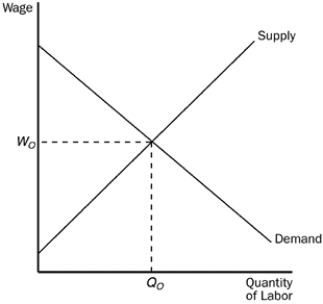 -Refer to Figure 20-5. If the government imposes a minimum wage above Wo, it is likely to
 (Multiple Choice)
4.9/5 (87)
(87) Who said "The inherent vice of capitalism is the unequal sharing of blessings. The inherent virtue of socialism is the equal sharing of miseries"?
(Short Answer)
4.8/5 (76)
(76) Raising the welfare of the worst-off person in society is an important goal of which political philosophy?
(Multiple Choice)
4.8/5 (70)
(70) Scenario 20-3
Suppose that a society is made up of five families whose incomes are as follows:
$120,000; $90,000; $30,000; $30,000; and $18,000.
The federal government is considering two potential income tax plans:
Plan A is a negative income tax plan where the taxes owed equal 1/3 of income minus $20,000.
Plan B is a two-tiered plan where families earning less than $35,000 pay no income tax and families earning more than $35,000 pay 10% of their income in taxes. The income tax revenue collected from those families earning over $35,000 is then redistributed equally to those families earning less than $35,000.
-Refer to Scenario 20-3. Assuming that utility is directly proportional to the cash value of after-tax income, which government policy would an advocate of libertarianism prefer?
(Multiple Choice)
4.9/5 (78)
(78) According to a study by Michael Cox and Richard Alm, consumption per person in the richest 20% of households was only 2.1 times consumption per person in the poorest 20% of households.
(True/False)
4.9/5 (81)
(81) In 2011, the poverty rate in the United States was 15 percent. This means that 15 percent
(Multiple Choice)
4.9/5 (76)
(76) Scenario 20-7
Suppose the government implemented a negative income tax and used the following formula to compute a family's tax liability:
Taxes owed = (1/6 of income) - $24,000
-Refer to Scenario 20-7. A family earning $60,000 before taxes would pay how much in taxes?
(Multiple Choice)
4.9/5 (89)
(89) A utilitarian government has to balance the gains from greater income equality against the losses from distorted work incentives. To maximize total utility, therefore, the government
(Multiple Choice)
4.8/5 (75)
(75) 
Filters
- Essay(0)
- Multiple Choice(0)
- Short Answer(0)
- True False(0)
- Matching(0)