



 Chat with AI
Exam 20: Income Inequality and Poverty

Exam 1: Ten Principles of Economics455 Questions
Exam 2: Thinking Like an Economist645 Questions
Exam 3: Interdependence and the Gains From Trade550 Questions
Exam 4: The Market Forces of Supply and Demand693 Questions
Exam 5: Elasticity and Its Application625 Questions
Exam 6: Supply, Demand, and Government Policies671 Questions
Exam 7: Consumers, Producers, and the Efficiency of Markets547 Questions
Exam 8: Application: The Costs of Taxation507 Questions
Exam 9: Application: International Trade521 Questions
Exam 10: Externalities543 Questions
Exam 11: Public Goods and Common Resources453 Questions
Exam 12: The Design of the Tax System563 Questions
Exam 13: The Costs of Production649 Questions
Exam 14: Firms in Competitive Markets608 Questions
Exam 15: Monopoly662 Questions
Exam 16: Monopolistic Competition649 Questions
Exam 17: Oligopoly522 Questions
Exam 18: The Markets for the Factors of Production592 Questions
Exam 19: Earnings and Discrimination511 Questions
Exam 20: Income Inequality and Poverty478 Questions
Exam 21: The Theory of Consumer Choice568 Questions
Exam 22: Frontiers in Microeconomics461 Questions
Select questions type


The distribution of income for Danville is as follows: 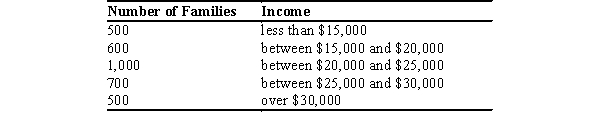 If the poverty rate in Danville is 33.3 percent, what is the poverty line in Danville?
 (Multiple Choice)
4.7/5  (73)
(73) Table 20-8 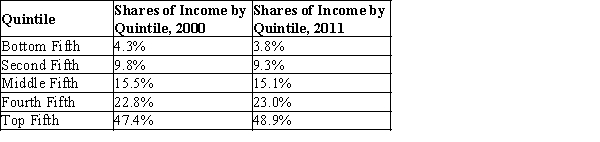 Source: U.S. Bureau of Census
-Refer to Table 20-8. Comparing data from 2000 and 2011, which of the following statements is correct?
Source: U.S. Bureau of Census
-Refer to Table 20-8. Comparing data from 2000 and 2011, which of the following statements is correct? (Multiple Choice)
4.7/5 (78)
(78) Whether or not policymakers should try to make our society more egalitarian is largely a matter of
(Multiple Choice)
4.9/5 (79)
(79) Which of the following does not explain the rise in income inequality in the United States from 1970 to 2011?
(Multiple Choice)
4.8/5 (77)
(77) Of the following groups, which group is least likely to live in poverty - whites, blacks, Hispanics, Asians?
(Short Answer)
4.8/5 (85)
(85) If the value of in-kind transfers are taken into account, the number of families living in poverty in the United States would
(Multiple Choice)
4.9/5 (87)
(87) The percentage of the population whose family income falls below an absolute level is call the
(Short Answer)
4.9/5 (81)
(81) Which two of the Ten Principles of Economics are illustrated in this chapter?
(Multiple Choice)
4.8/5 (93)
(93) In 2011, the top 20% of US families had more than times as much income as the bottom 20%.
(Short Answer)
4.9/5 (75)
(75) A disadvantage associated with in-kind transfers to reduce poverty is that they
(Multiple Choice)
4.8/5 (86)
(86) Suppose that a family saves and borrows to buffer itself against changes in income. These actions relate to which problem in measuring inequality?
(Multiple Choice)
4.7/5 (80)
(80) The utilitarian case for redistributing income is based on the assumption of
(Multiple Choice)
4.9/5 (78)
(78) Scenario 20-4
Suppose the government implemented a negative income tax and used the following formula to compute a family's tax liability:
Taxes owed = (1/5 of income) - $15,000
-Refer to Scenario 20-4. Below what level of income would families start to receive a subsidy from this negative income tax?
(Multiple Choice)
4.8/5 (78)
(78) Scenario 20-6
Zooey is a single mother of two young children whose husband died in a tragic car accident. She earns $20,000 per year working as a cashier at a grocery store. The government uses a negative income tax system in which
Taxes owed = (1/4 of income) - $15,000.
-Refer to Scenario 20-6. How much does Zooey owe or receive from the government?
(Multiple Choice)
4.8/5 (74)
(74) When the government enacts policies to make the distribution of income more equitable, it distorts incentives, alters behavior, and makes the allocation of resources less efficient.
(True/False)
4.8/5 (75)
(75) Scenario 20-3
Suppose that a society is made up of five families whose incomes are as follows:
$120,000; $90,000; $30,000; $30,000; and $18,000.
The federal government is considering two potential income tax plans:
Plan A is a negative income tax plan where the taxes owed equal 1/3 of income minus $20,000.
Plan B is a two-tiered plan where families earning less than $35,000 pay no income tax and families earning more than $35,000 pay 10% of their income in taxes. The income tax revenue collected from those families earning over $35,000 is then redistributed equally to those families earning less than $35,000.
-Refer to Scenario 20-3. Assuming that utility is directly proportional to the cash value of after-tax income, which government policy would an advocate of utilitarianism prefer?
(Multiple Choice)
4.8/5 (81)
(81) The distribution of income for Dismal is as follows: 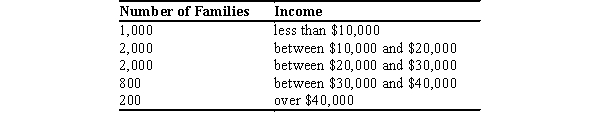 If the poverty rate in Dismal is about 17 percent, what is the poverty line in Dismal?
 (Multiple Choice)
4.8/5 (88)
(88) Table 20-14
James, Luke, Peter, Micah, and Sarah are the only five inhabits of Marketsville. The following table shows their income. 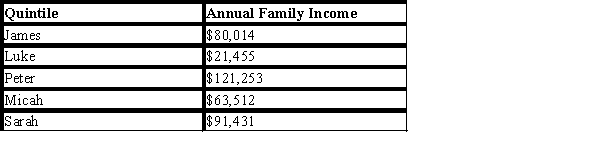
-Refer to Table 20-14. Where would the government of Marketsville set the poverty line to have a poverty rate of 20 percent?
-Refer to Table 20-14. Where would the government of Marketsville set the poverty line to have a poverty rate of 20 percent? (Multiple Choice)
4.9/5 (84)
(84) If society chose to maximize total utility rather than minimum utility,
(Multiple Choice)
4.8/5 (88)
(88) 
Filters
- Essay(0)
- Multiple Choice(0)
- Short Answer(0)
- True False(0)
- Matching(0)