



 Chat with AI
Exam 20: Income Inequality and Poverty

Exam 1: Ten Principles of Economics455 Questions
Exam 2: Thinking Like an Economist645 Questions
Exam 3: Interdependence and the Gains From Trade550 Questions
Exam 4: The Market Forces of Supply and Demand693 Questions
Exam 5: Elasticity and Its Application625 Questions
Exam 6: Supply, Demand, and Government Policies671 Questions
Exam 7: Consumers, Producers, and the Efficiency of Markets547 Questions
Exam 8: Application: The Costs of Taxation507 Questions
Exam 9: Application: International Trade521 Questions
Exam 10: Externalities543 Questions
Exam 11: Public Goods and Common Resources453 Questions
Exam 12: The Design of the Tax System563 Questions
Exam 13: The Costs of Production649 Questions
Exam 14: Firms in Competitive Markets608 Questions
Exam 15: Monopoly662 Questions
Exam 16: Monopolistic Competition649 Questions
Exam 17: Oligopoly522 Questions
Exam 18: The Markets for the Factors of Production592 Questions
Exam 19: Earnings and Discrimination511 Questions
Exam 20: Income Inequality and Poverty478 Questions
Exam 21: The Theory of Consumer Choice568 Questions
Exam 22: Frontiers in Microeconomics461 Questions
Select questions type


Many economists believe that a family bases its spending decisions on its permanent, or average, income rather than on transitory income.
(True/False)
4.9/5  (75)
(75) Scenario 20-7
Suppose the government implemented a negative income tax and used the following formula to compute a family's tax liability:
Taxes owed = (1/6 of income) - $24,000
-Refer to Scenario 20-7. Below what level of income would families start to receive a subsidy from this negative income tax?
(Multiple Choice)
4.8/5 (74)
(74) One existing government program that works much like a negative income tax is the Earned Income Tax Credit.
(True/False)
4.9/5 (74)
(74) Table 20-14
Income Inequality in the United States
The values in the table reflect the percentages of pre-tax-and transfer income. 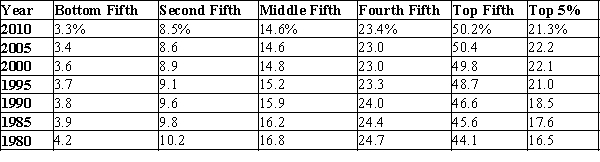 Source: US Census Bureau
-Refer to Table 20-14. In 2010, what percentage of total income in the US did the bottom 20% of families have?
Source: US Census Bureau
-Refer to Table 20-14. In 2010, what percentage of total income in the US did the bottom 20% of families have? (Short Answer)
4.9/5 (75)
(75) Economists Cox and Alm compared the gap between rich and poor and found that the richest 20% was about 2 times better off than the poorest 20% when they compared what data?
(Short Answer)
4.8/5 (84)
(84) The 2011 U.S. distribution of income shows that the top 20 percent of families have approximately what share of income?
(Multiple Choice)
4.9/5 (75)
(75) Economists who study economic mobility have found that, if a father earns 20 percent above his generation's average income, his son will most likely earn
(Multiple Choice)
4.8/5 (68)
(68) A family's ability to buy goods and services depends largely on the family's
(Multiple Choice)
4.7/5 (89)
(89) Which of the following is not a question that economists try to answer when measuring the distribution of income?
(Multiple Choice)
4.8/5 (76)
(76) Government vouchers to purchase food, also known as food stamps, are an example of
(Multiple Choice)
4.9/5 (80)
(80) The poverty line is based on the percentage of people who cannot afford an adequate diet.
(True/False)
4.8/5 (90)
(90) Temporary Assistance for Needy Families (TANF) and Supplemental Security Income (SSI) are examples of .
(Short Answer)
4.8/5 (88)
(88) Relative to direct cash payments, in-kind transfers have the advantage of being
(Multiple Choice)
5.0/5 (79)
(79) Which of the following statements illustrates diminishing marginal utility?
(Multiple Choice)
4.9/5 (81)
(81) Robert Nozick criticizes Rawls's concept of justice by using an example of
(Multiple Choice)
4.9/5 (83)
(83) Table 20-4 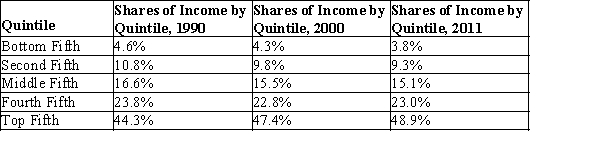 Source: U.S. Bureau of Census
-Refer to Table 20-4. Comparing data from 2000 and 2011, which of the following statements is correct?
Source: U.S. Bureau of Census
-Refer to Table 20-4. Comparing data from 2000 and 2011, which of the following statements is correct? (Multiple Choice)
4.8/5 (73)
(73) Raising total utility is the prime objective of which political philosophy?
(Multiple Choice)
4.8/5 (94)
(94) 
Filters
- Essay(0)
- Multiple Choice(0)
- Short Answer(0)
- True False(0)
- Matching(0)