



 Chat with AI
Exam 20: Income Inequality and Poverty

Exam 1: Ten Principles of Economics455 Questions
Exam 2: Thinking Like an Economist645 Questions
Exam 3: Interdependence and the Gains From Trade550 Questions
Exam 4: The Market Forces of Supply and Demand693 Questions
Exam 5: Elasticity and Its Application625 Questions
Exam 6: Supply, Demand, and Government Policies671 Questions
Exam 7: Consumers, Producers, and the Efficiency of Markets547 Questions
Exam 8: Application: The Costs of Taxation507 Questions
Exam 9: Application: International Trade521 Questions
Exam 10: Externalities543 Questions
Exam 11: Public Goods and Common Resources453 Questions
Exam 12: The Design of the Tax System563 Questions
Exam 13: The Costs of Production649 Questions
Exam 14: Firms in Competitive Markets608 Questions
Exam 15: Monopoly662 Questions
Exam 16: Monopolistic Competition649 Questions
Exam 17: Oligopoly522 Questions
Exam 18: The Markets for the Factors of Production592 Questions
Exam 19: Earnings and Discrimination511 Questions
Exam 20: Income Inequality and Poverty478 Questions
Exam 21: The Theory of Consumer Choice568 Questions
Exam 22: Frontiers in Microeconomics461 Questions
Select questions type


The political philosophy that views the redistribution of income as a form of social insurance is
(Multiple Choice)
4.8/5  (72)
(72) Fewer than three percent of families are poor for eight or more years.
(True/False)
4.8/5 (76)
(76) The maximin criterion is the idea that the government should aim to maximize the well-being of the worst-off person in society.
(True/False)
4.9/5 (76)
(76) Which of the following does not explain why data on income distribution and the poverty rate give an incomplete picture of inequality?
(Multiple Choice)
4.9/5 (76)
(76) Outline the possible work disincentives created by anti-poverty programs. Is there a way to solve this problem without causing other forms of inefficiency to arise? Explain your answer.
(Essay)
4.8/5 (75)
(75) If the U.S. government determines that the cost of feeding an urban family of four is $7,500 per year, then the official poverty line for a family of that type is
(Multiple Choice)
4.9/5 (86)
(86) 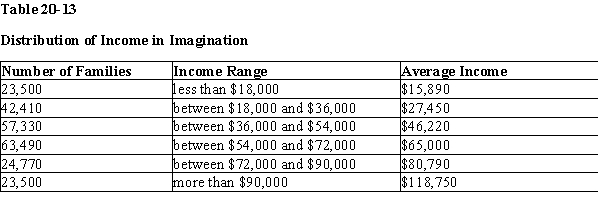 -Refer to Table 20-13. If the poverty rate in Imagination is 10%, what is the poverty line?
 (Short Answer)
4.9/5 (86)
(86) Table 20-7 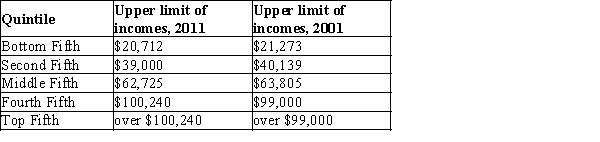 -Refer to Table 20-7. Which of the following is the best overall conclusion to draw from the data?
 (Multiple Choice)
4.8/5 (84)
(84) A U.S. family earning $80,000 would be in the top 20 percent of income distribution in 2011.
(True/False)
5.0/5 (81)
(81) In the United States from 1935 to 2011 the share of total income earned by the bottom fifth of income earners rose and then fell.
(True/False)
4.8/5 (67)
(67) Figure 20-3 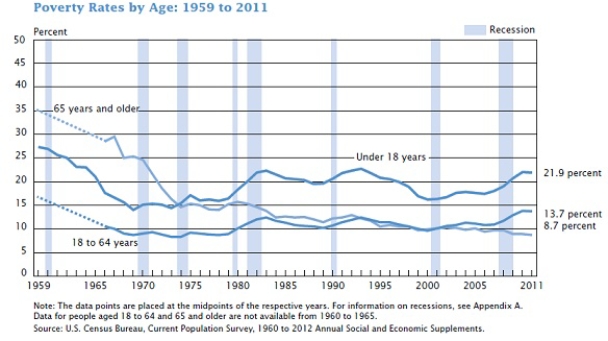 -Refer to Figure 20-3. In 2011, the percent of elderly aged 65 and over in poverty is
 (Multiple Choice)
4.7/5 (84)
(84) Compare and contrast the "life cycle" hypothesis and the "permanent income" hypothesis. What are their respective implications for inequality in the income distribution?
(Essay)
4.7/5 (75)
(75) Figure 20-3
-Refer to Figure 20-3. Which of the following is consistent with the data reported in the figure?
-Refer to Figure 20-3. Which of the following is consistent with the data reported in the figure? (Multiple Choice)
5.0/5 (89)
(89) In the US, is it more likely that someone will become a millionaire by making money on his/her own or by inheriting a fortune?
(Short Answer)
4.9/5 (83)
(83) The maximin criterion for government policies is associated with
(Multiple Choice)
4.8/5 (79)
(79) Aniella believes that the demand for unskilled labor is relatively inelastic. Carmella believes that the demand for unskilled labor is relatively elastic. Which believes that a minimum-wage law will result in significant unemployment?
(Short Answer)
4.8/5 (84)
(84) The poverty rate is the percentage of the population whose family income falls below the poverty line..
(True/False)
4.8/5 (84)
(84) The Earned Income Tax Credit (EITC) is a tax provision that allows poor working families to receive income tax refunds greater than the taxes they paid during the year. Therefore, the EITC works much like a .
(Short Answer)
5.0/5 (77)
(77) 
Filters
- Essay(0)
- Multiple Choice(0)
- Short Answer(0)
- True False(0)
- Matching(0)