



 Chat with AI
Exam 20: Income Inequality and Poverty

Exam 1: Ten Principles of Economics455 Questions
Exam 2: Thinking Like an Economist645 Questions
Exam 3: Interdependence and the Gains From Trade550 Questions
Exam 4: The Market Forces of Supply and Demand693 Questions
Exam 5: Elasticity and Its Application625 Questions
Exam 6: Supply, Demand, and Government Policies671 Questions
Exam 7: Consumers, Producers, and the Efficiency of Markets547 Questions
Exam 8: Application: The Costs of Taxation507 Questions
Exam 9: Application: International Trade521 Questions
Exam 10: Externalities543 Questions
Exam 11: Public Goods and Common Resources453 Questions
Exam 12: The Design of the Tax System563 Questions
Exam 13: The Costs of Production649 Questions
Exam 14: Firms in Competitive Markets608 Questions
Exam 15: Monopoly662 Questions
Exam 16: Monopolistic Competition649 Questions
Exam 17: Oligopoly522 Questions
Exam 18: The Markets for the Factors of Production592 Questions
Exam 19: Earnings and Discrimination511 Questions
Exam 20: Income Inequality and Poverty478 Questions
Exam 21: The Theory of Consumer Choice568 Questions
Exam 22: Frontiers in Microeconomics461 Questions
Select questions type


The top 5 percent of U.S. annual family income in 2011 was $205,200 or more.
(True/False)
4.7/5  (88)
(88) A disadvantage of the Earned Income Tax Credit (EITC) program is that it does not help alleviate poverty due to unemployment, sickness, or other inability to work.
(True/False)
4.8/5 (78)
(78) Which group would be the least upset by wide variation in the income distribution?
(Multiple Choice)
4.7/5 (91)
(91) The study by economists Cox and Alm found that the 2006 pre-tax income of the richest fifth of U.S. households is
(Multiple Choice)
4.9/5 (86)
(86) In 2011 the top 5 percent of income earners accounted for over 50% of all income received by United States' families.
(True/False)
4.7/5 (78)
(78) If in-kind transfers were included in income at their market value, what would happen to the number of families below the poverty line?
(Short Answer)
4.9/5 (80)
(80) Scenario 20-8
Suppose the government implemented a negative income tax and used the following formula to compute a family's tax liability:
Taxes owed = (1/4 of income) - $14,000
-Refer to Scenario 20-8. A family earning $56,000 before taxes will have $56,000 after tax.
(True/False)
5.0/5 (70)
(70) Would the maximin criterion achieve perfect income equality?
(Multiple Choice)
4.8/5 (90)
(90) In the United States in 2011, the bottom fifth of the income distribution had incomes below $27,218.
(True/False)
4.7/5 (93)
(93) Which political philosophy believes that the government should equalize the incomes of all members of society?
(Multiple Choice)
4.7/5 (73)
(73) Table 20-14
Income Inequality in the United States
The values in the table reflect the percentages of pre-tax-and transfer income. 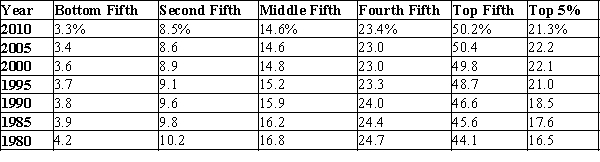 Source: US Census Bureau
-Refer to Table 20-14. The trend in income inequality from 1980 to 2010 is .
Source: US Census Bureau
-Refer to Table 20-14. The trend in income inequality from 1980 to 2010 is . (Short Answer)
4.8/5 (84)
(84) If a father earns 20% above his generation's average income, his son will most likely earn what percent above his generation's average income? What does this statistic indicate?
(Essay)
4.8/5 (68)
(68) When the government enacts policies to redistribute income,
(Multiple Choice)
4.8/5 (83)
(83) Figure 20-3 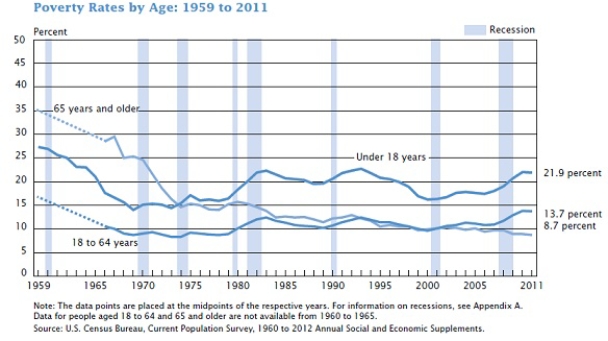 -Refer to Figure 20-3. In 2011, the percent of adults between ages 18 and 64 in poverty is
 (Multiple Choice)
4.8/5 (87)
(87) Briefly describe the three prominent schools of thought in political philosophy. Identify one of the most well-known philosophers in each school.
(Essay)
4.9/5 (67)
(67) Many Democrats support raising the U.S. minimum wage. Critics of raising the minimum wage argue that minimum-wage laws are
(Multiple Choice)
4.9/5 (85)
(85) 
Filters
- Essay(0)
- Multiple Choice(0)
- Short Answer(0)
- True False(0)
- Matching(0)