



 Chat with AI
Exam 20: Income Inequality and Poverty

Exam 1: Ten Principles of Economics455 Questions
Exam 2: Thinking Like an Economist645 Questions
Exam 3: Interdependence and the Gains From Trade550 Questions
Exam 4: The Market Forces of Supply and Demand693 Questions
Exam 5: Elasticity and Its Application625 Questions
Exam 6: Supply, Demand, and Government Policies671 Questions
Exam 7: Consumers, Producers, and the Efficiency of Markets547 Questions
Exam 8: Application: The Costs of Taxation507 Questions
Exam 9: Application: International Trade521 Questions
Exam 10: Externalities543 Questions
Exam 11: Public Goods and Common Resources453 Questions
Exam 12: The Design of the Tax System563 Questions
Exam 13: The Costs of Production649 Questions
Exam 14: Firms in Competitive Markets608 Questions
Exam 15: Monopoly662 Questions
Exam 16: Monopolistic Competition649 Questions
Exam 17: Oligopoly522 Questions
Exam 18: The Markets for the Factors of Production592 Questions
Exam 19: Earnings and Discrimination511 Questions
Exam 20: Income Inequality and Poverty478 Questions
Exam 21: The Theory of Consumer Choice568 Questions
Exam 22: Frontiers in Microeconomics461 Questions
Select questions type


The study by economists Cox and Alm found that the 2006 after-tax income of the richest fifth of U.S. households is
(Multiple Choice)
4.9/5  (91)
(91) Which political philosophy focuses on the process of determining the distribution of income rather than on the outcome?
(Multiple Choice)
4.8/5 (94)
(94) Table 20-13
The following table shows the distribution of income in Widgetapolis. 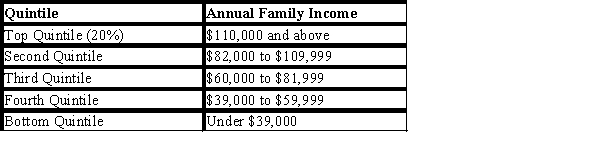
-Refer to Table 20-13. Twenty percent of all families have incomes above what level?
-Refer to Table 20-13. Twenty percent of all families have incomes above what level? (Multiple Choice)
4.8/5 (80)
(80) Scenario 20-2
The government is proposing switching from a progressive tax system, in which families pay 15% of the first $40,000 earned, 30% of the next $40,000 earned, and 45% of any income over $80,000 to a tax system in which every family pays 1/4 of its income regardless of how much they earn and all income redistribution is eliminated. That is, the tax revenue generated is used only for infrastructure, public administration, and national defense.
-Refer to Scenario 20-2. Which group would be most in favor of the proposed change in tax policy?
(Multiple Choice)
4.9/5 (96)
(96) Table 20-11
Poverty Thresholds in 2011, by Size of Family and Number of Related Children Under 18 Years
[Dollars] 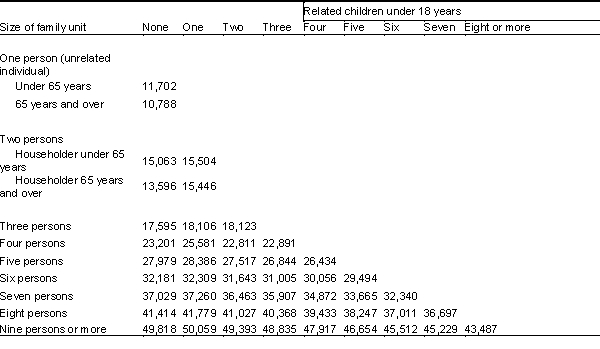 Source: U. S. Bureau of the Census, Current Population Survey.
-Refer to Table 20-11. What is the poverty line for a family of eight with two children?
Source: U. S. Bureau of the Census, Current Population Survey.
-Refer to Table 20-11. What is the poverty line for a family of eight with two children? (Multiple Choice)
4.9/5 (93)
(93) Figure 20-1
Number of Poor 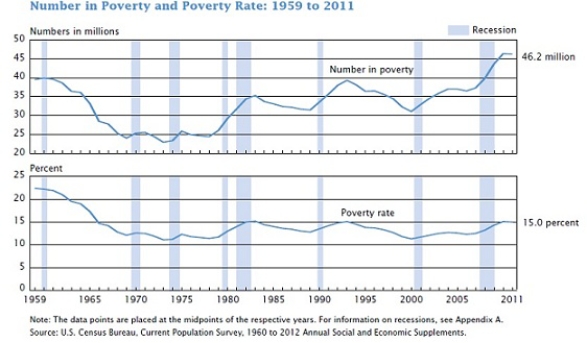 -Refer to Figure 20-1. Between 1965 and 2011, during recessions (the shaded bars) the number of individuals in poverty has
 (Multiple Choice)
4.9/5 (69)
(69) Which of the following statements accurately characterizes the effects of minimum-wage laws?
(Multiple Choice)
4.9/5 (79)
(79) Scenario 20-7
Zooey is a single mother of two young children whose husband died in a tragic car accident. She earns $20,000 per year working as a cashier at a grocery store. The government uses a negative income tax system in which
Taxes owed = (1/4 of income) - $15,000.
-Refer to Scenario 20-7. Does Zooey owe or receive money from the government? How much?
(Short Answer)
4.9/5 (80)
(80) Table 20-10  *A Gini coefficient is a commonly used measure of income inequality, with values between 0 and 1 (0 corresponds to perfect equality whereby everyone has exactly the same income, and 1 corresponds to perfect inequality where one person has all the income, while everyone else has zero income).
Source: The World Bank
-Refer to Table 20-10. Which country has the most equal income distribution?
*A Gini coefficient is a commonly used measure of income inequality, with values between 0 and 1 (0 corresponds to perfect equality whereby everyone has exactly the same income, and 1 corresponds to perfect inequality where one person has all the income, while everyone else has zero income).
Source: The World Bank
-Refer to Table 20-10. Which country has the most equal income distribution? (Multiple Choice)
5.0/5 (83)
(83) Suppose the government used the following formula to compute a family's tax liability:
Taxes owed = 28% of income - $8,000. How much would a family that earned $75,000 owe?
(Short Answer)
4.7/5 (76)
(76) Of the four countries below, which has the highest degree of income inequality?
(Multiple Choice)
4.8/5 (77)
(77) Economists who support minimum-wage legislation are likely to believe that the
(Multiple Choice)
4.9/5 (80)
(80) The economic life cycle describes how young people usually have higher savings rates than middle-aged people.
(True/False)
4.7/5 (90)
(90) Table 20-13
The following table shows the distribution of income in Widgetapolis.
-Refer to Table 20-13. Eighty percent of all families have incomes below what level?
-Refer to Table 20-13. Eighty percent of all families have incomes below what level? (Multiple Choice)
4.8/5 (90)
(90) The Callaway family owns a small bait and tackle shop in a resort town in Wisconsin. An economic recession reduces the number of tourists for one summer, which reduces the family's income for that year. For the Callaway family, their
(Multiple Choice)
4.8/5 (74)
(74) 
Filters
- Essay(0)
- Multiple Choice(0)
- Short Answer(0)
- True False(0)
- Matching(0)