



 Chat with AI
Exam 20: Income Inequality and Poverty

Exam 1: Ten Principles of Economics455 Questions
Exam 2: Thinking Like an Economist645 Questions
Exam 3: Interdependence and the Gains From Trade550 Questions
Exam 4: The Market Forces of Supply and Demand693 Questions
Exam 5: Elasticity and Its Application625 Questions
Exam 6: Supply, Demand, and Government Policies671 Questions
Exam 7: Consumers, Producers, and the Efficiency of Markets547 Questions
Exam 8: Application: The Costs of Taxation507 Questions
Exam 9: Application: International Trade521 Questions
Exam 10: Externalities543 Questions
Exam 11: Public Goods and Common Resources453 Questions
Exam 12: The Design of the Tax System563 Questions
Exam 13: The Costs of Production649 Questions
Exam 14: Firms in Competitive Markets608 Questions
Exam 15: Monopoly662 Questions
Exam 16: Monopolistic Competition649 Questions
Exam 17: Oligopoly522 Questions
Exam 18: The Markets for the Factors of Production592 Questions
Exam 19: Earnings and Discrimination511 Questions
Exam 20: Income Inequality and Poverty478 Questions
Exam 21: The Theory of Consumer Choice568 Questions
Exam 22: Frontiers in Microeconomics461 Questions
Select questions type


In the United States, labor earnings are about what percent of total income?
(Multiple Choice)
4.8/5  (74)
(74) The poverty line is an absolute standard and is based on the cost of providing an adequate diet.
(True/False)
4.8/5 (81)
(81) Explain how a "leaky bucket" can be used to illustrate the utilitarian argument that governments should not attempt to completely equalize individual incomes.
(Essay)
4.8/5 (88)
(88) The concept of diminishing marginal utility is embedded in the utilitarian rationale for
(Multiple Choice)
4.7/5 (75)
(75) Which of the following is not a finding of Cox and Alm regarding the gap between rich and poor?
(Multiple Choice)
4.9/5 (71)
(71) The Smith family owns an apple orchard in Illinois. The Jones family owns an apple orchard in Wisconsin. A late frost destroys half of the Smith family's harvest for one year. For the Jones family, their
(Multiple Choice)
4.8/5 (78)
(78) Table 20-4 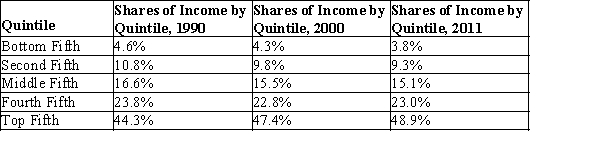 Source: U.S. Bureau of Census
-Refer to Table 20-4. In 2011, the top fifth of families have
Source: U.S. Bureau of Census
-Refer to Table 20-4. In 2011, the top fifth of families have (Multiple Choice)
4.9/5 (75)
(75) In the Temporary Assistance for Needy Families program, most families
(Multiple Choice)
4.7/5 (68)
(68) Which of the following programs would be opposed by philosopher John Rawls?
(Multiple Choice)
4.8/5 (80)
(80) Assume that the government proposes a negative income tax that calculates taxes owed by the formula, Taxes Owed = (a  Income) -
a.What is the value for "a"?
b.What is the value for "b"?
b. A family with an income of $40,000 pays $5,000 in taxes, and a family with an income of $12,000 receives an income subsidy of $2,000.
c.What is the tax liability of a family with an income of $50,000?
d.At what level of income will a family neither pay taxes, nor receive an income subsidy?
Income) -
a.What is the value for "a"?
b.What is the value for "b"?
b. A family with an income of $40,000 pays $5,000 in taxes, and a family with an income of $12,000 receives an income subsidy of $2,000.
c.What is the tax liability of a family with an income of $50,000?
d.At what level of income will a family neither pay taxes, nor receive an income subsidy? (Essay)
4.8/5 (88)
(88) Scenario 20-8
Suppose the government implemented a negative income tax and used the following formula to compute a family's tax liability:
Taxes owed = (1/4 of income) - $14,000
-Refer to Scenario 20-8. A family earning $40,000 before taxes will owe tax.
(True/False)
5.0/5 (73)
(73) Table 20-15
Income Inequality in 2010 in the United States by Race
The values in the table reflect the percentages of pre-tax-and-transfer income.  Source: US Census Bureau
-Refer to Table 20-15. Which race shows the least equal distribution of income?
Source: US Census Bureau
-Refer to Table 20-15. Which race shows the least equal distribution of income? (Short Answer)
4.8/5 (81)
(81) The concept of utility is fundamental to utilitarianism and describes the
(Multiple Choice)
4.8/5 (84)
(84) Table 20-11
Poverty Thresholds in 2011, by Size of Family and Number of Related Children Under 18 Years
[Dollars] 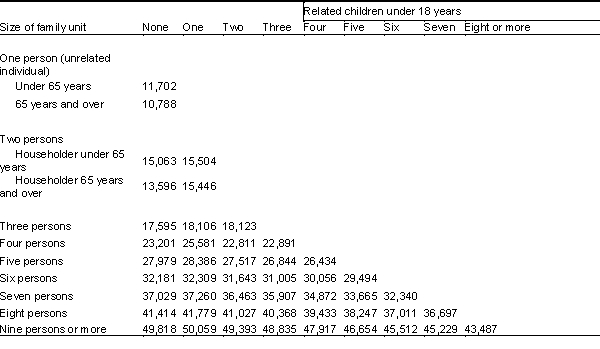 Source: U. S. Bureau of the Census, Current Population Survey.
-Refer to Table 20-11. What is the poverty line for a family of six with three children?
Source: U. S. Bureau of the Census, Current Population Survey.
-Refer to Table 20-11. What is the poverty line for a family of six with three children? (Multiple Choice)
4.7/5 (79)
(79) 
Filters
- Essay(0)
- Multiple Choice(0)
- Short Answer(0)
- True False(0)
- Matching(0)