



 Chat with AI
Exam 16: The Cardiovascular System: Blood Vessels and Circulation

Exam 1: Organization of the Human Body105 Questions
Exam 2: Introductory Chemistry99 Questions
Exam 3: Cells112 Questions
Exam 4: Tissues106 Questions
Exam 5: The Integumentary System110 Questions
Exam 6: The Skeletal System92 Questions
Exam 7: Joints88 Questions
Exam 8: The Muscular System99 Questions
Exam 9: Nervous Tissue79 Questions
Exam 10: Central Nervous System, Spinal Nerves, and Cranial Nerves96 Questions
Exam 11: Autonomic Nervous System82 Questions
Exam 12: Somatic Senses and Special Sense102 Questions
Exam 13: The Endocrine System97 Questions
Exam 14: The Cardiovascular System: Blood92 Questions
Exam 15: The Cardiovascular System: Heart69 Questions
Exam 16: The Cardiovascular System: Blood Vessels and Circulation95 Questions
Exam 17: The Lymphatic System and Immunity91 Questions
Exam 18: The Respiratory System102 Questions
Exam 19: The Digestive System97 Questions
Exam 20: Nutrition and Metabolism85 Questions
Exam 21: The Urinary System90 Questions
Exam 22: Fluid, Electrolyte, and Acid-Base Balance81 Questions
Exam 23: The Reproductive Systems95 Questions
Exam 24: Development and Inheritance90 Questions
Select questions type


The vasomotor region of the cardiovascular center is located in the hypothalamus.
(True/False)
4.7/5  (84)
(84) Exchange of nutrients and gases between the blood and tissues occurs in the
(Multiple Choice)
4.9/5 (77)
(77) Which of the following types of sensory receptors are involved in the regulation of blood pressure?
(Multiple Choice)
4.8/5 (77)
(77) Which of the following answer selections properly labels the two aortic pressures designated A and B in the diagram? 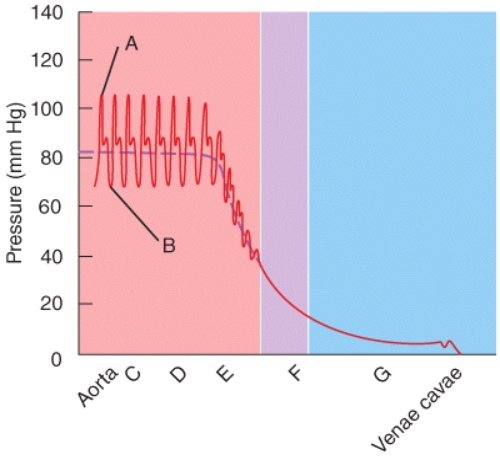
(Multiple Choice)
4.7/5 (78)
(78) Orthostatic hypotension is a large decrease in blood pressure that occurs when a person stands up.
(True/False)
4.9/5 (88)
(88) Starting at the left ventricle, list the blood vessels in the systemic circulatory route that carries blood to the kidneys and back to the heart.
(Essay)
4.9/5 (72)
(72) Under the new guidelines, the prehypertension classification now contains individuals that would previously have been considered normal. This means the systolic and diastolic readings for this category are lower than in the past.
(True/False)
4.8/5 (82)
(82) When blood pressure falls, the baroreceptors increase the rate of nerve impulses sent to the cardiovascular center to stimulate an increase in cardiac output.
(True/False)
4.9/5 (79)
(79) The main vein draining blood from the heart muscle tissue is the
(Multiple Choice)
4.8/5 (72)
(72) Increased parasympathetic stimulation of the heart via the vagus nerve causes a decrease in heart rate.
(True/False)
4.7/5 (73)
(73) The circulatory route that brings nutrient-rich oxygenated blood to the tissues throughout the body and back to the heart is the
(Multiple Choice)
4.9/5 (90)
(90) 
Filters
- Essay(0)
- Multiple Choice(0)
- Short Answer(0)
- True False(0)
- Matching(0)