



 Chat with AI
Exam 16: The Cardiovascular System: Blood Vessels and Circulation

Exam 1: Organization of the Human Body105 Questions
Exam 2: Introductory Chemistry99 Questions
Exam 3: Cells112 Questions
Exam 4: Tissues106 Questions
Exam 5: The Integumentary System110 Questions
Exam 6: The Skeletal System92 Questions
Exam 7: Joints88 Questions
Exam 8: The Muscular System99 Questions
Exam 9: Nervous Tissue79 Questions
Exam 10: Central Nervous System, Spinal Nerves, and Cranial Nerves96 Questions
Exam 11: Autonomic Nervous System82 Questions
Exam 12: Somatic Senses and Special Sense102 Questions
Exam 13: The Endocrine System97 Questions
Exam 14: The Cardiovascular System: Blood92 Questions
Exam 15: The Cardiovascular System: Heart69 Questions
Exam 16: The Cardiovascular System: Blood Vessels and Circulation95 Questions
Exam 17: The Lymphatic System and Immunity91 Questions
Exam 18: The Respiratory System102 Questions
Exam 19: The Digestive System97 Questions
Exam 20: Nutrition and Metabolism85 Questions
Exam 21: The Urinary System90 Questions
Exam 22: Fluid, Electrolyte, and Acid-Base Balance81 Questions
Exam 23: The Reproductive Systems95 Questions
Exam 24: Development and Inheritance90 Questions
Select questions type


A thin weakened section of an artery or vein that bulges out is called an

Free
(Multiple Choice)
4.9/5  (75)
(75) Correct Answer: Verified
B
Systolic blood pressure in arteries is always lower than the diastolic pressure.
Free
(True/False)
4.9/5 (92)
(92) Correct Answer:Verified
VerifiedFalse
Starting at the left ventricle, list the blood vessels in the systemic circulatory route that carries blood to the spleen and back to the heart.
Free
(Essay)
4.9/5 (71)
(71) Correct Answer:Verified
VerifiedLeft ventricle - ascending aorta - arch of the aorta - descending aorta - thoracic aorta - abdominal aorta - celiac trunk - splenic artery - spleen - splenic vein - hepatic portal vein - liver - hepatic vein - inferior vena cava - right atrium.
Which of the labeled vessels in the figure above contains blood with the highest concentration of carbon dioxide (CO2)? 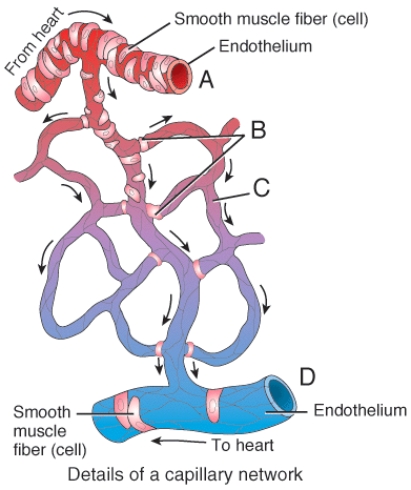
(Multiple Choice)
4.9/5 (78)
(78) Which of the labeled arteries in the diagram are considered to be part of the aorta? 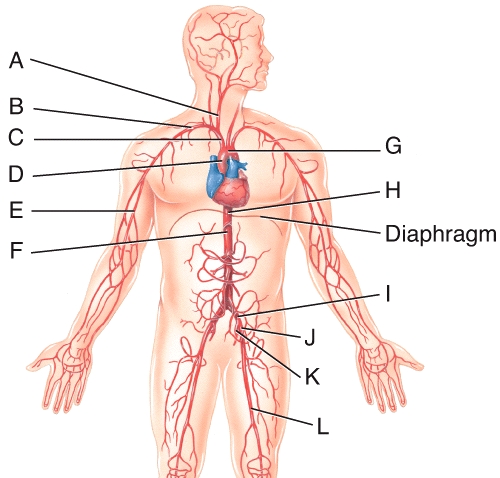
(Multiple Choice)
4.9/5 (82)
(82) Blood pressure is primarily regulated by the cardiac center in the hypothalamus using input from chemoreceptors that detect oxygen levels in the blood.
(True/False)
4.9/5 (85)
(85) Filtration of fluid out of the capillaries into the interstitial fluid is generally highest on the arterial end of a capillary network because the
(Multiple Choice)
4.8/5 (90)
(90) Which of the labeled sections of the graph represent the pressure characteristics observed in the arterioles? 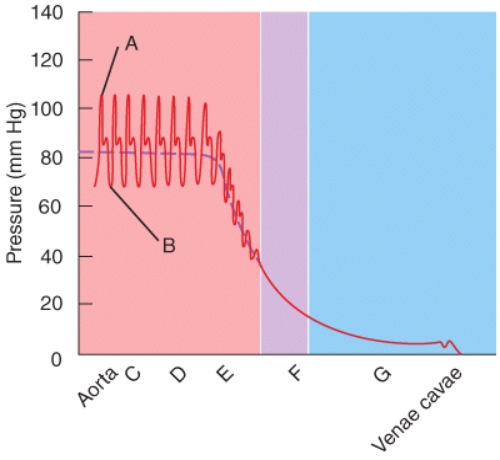
(Multiple Choice)
4.9/5 (75)
(75) Pain and lameness caused by defective circulation of the blood in the vessels of the limbs is called
(Multiple Choice)
4.8/5 (87)
(87) The fetal circulation differs from adult circulation because three of the fetal organ systems do not fully function until birth. These three organ systems are the
(Multiple Choice)
4.8/5 (85)
(85) Which of the following arteries branch directly from the brachial artery?
(Multiple Choice)
4.9/5 (84)
(84) Systolic pressure is the pressure in the arteries when the ventricles are contracting, while diastolic pressure is the pressure in blood vessels when the ventricles are relaxed.
(True/False)
4.9/5 (64)
(64) Which of the following statements comparing arteries to veins is NOT true?
(Multiple Choice)
4.8/5 (72)
(72) Autoregulation of blood flow through tissues is controlled by the ANS.
(True/False)
4.9/5 (69)
(69) Which of the following are common changes observed in the cardiovascular system as a result of the aging process?
(Multiple Choice)
4.9/5 (82)
(82) The largest diameter arteries have thick muscular walls that alternately contract and relax to help propel blood through the cardiovascular system.
(True/False)
4.8/5 (93)
(93) 
Filters
- Essay(0)
- Multiple Choice(0)
- Short Answer(0)
- True False(0)
- Matching(0)