



 Chat with AI
Exam 16: The Cardiovascular System: Blood Vessels and Circulation

Exam 1: Organization of the Human Body105 Questions
Exam 2: Introductory Chemistry99 Questions
Exam 3: Cells112 Questions
Exam 4: Tissues106 Questions
Exam 5: The Integumentary System110 Questions
Exam 6: The Skeletal System92 Questions
Exam 7: Joints88 Questions
Exam 8: The Muscular System99 Questions
Exam 9: Nervous Tissue79 Questions
Exam 10: Central Nervous System, Spinal Nerves, and Cranial Nerves96 Questions
Exam 11: Autonomic Nervous System82 Questions
Exam 12: Somatic Senses and Special Sense102 Questions
Exam 13: The Endocrine System97 Questions
Exam 14: The Cardiovascular System: Blood92 Questions
Exam 15: The Cardiovascular System: Heart69 Questions
Exam 16: The Cardiovascular System: Blood Vessels and Circulation95 Questions
Exam 17: The Lymphatic System and Immunity91 Questions
Exam 18: The Respiratory System102 Questions
Exam 19: The Digestive System97 Questions
Exam 20: Nutrition and Metabolism85 Questions
Exam 21: The Urinary System90 Questions
Exam 22: Fluid, Electrolyte, and Acid-Base Balance81 Questions
Exam 23: The Reproductive Systems95 Questions
Exam 24: Development and Inheritance90 Questions
Select questions type


In a clinical setting using a sphygmomanometer, how would the blood pressure of the individual whose results are shown in the diagram be reported? 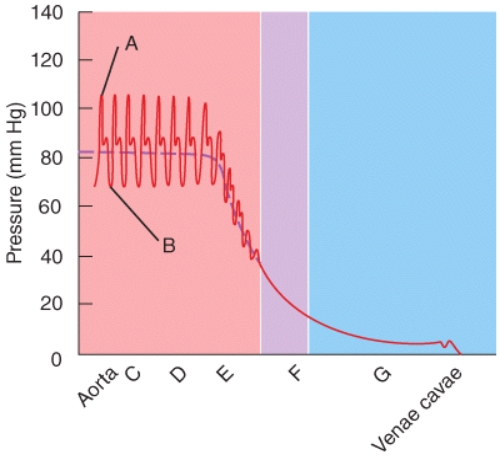
(Multiple Choice)
5.0/5  (85)
(85) The walls of both arteries and veins contain multiple layers composed of a combination of connective tissue, smooth muscle, and endothelial cells.
(True/False)
4.9/5 (79)
(79) In the sinusoids of the liver, oxygenated blood coming from the hepatic artery mixes with deoxygenated coming from the hepatic portal vein.
(True/False)
4.8/5 (91)
(91) 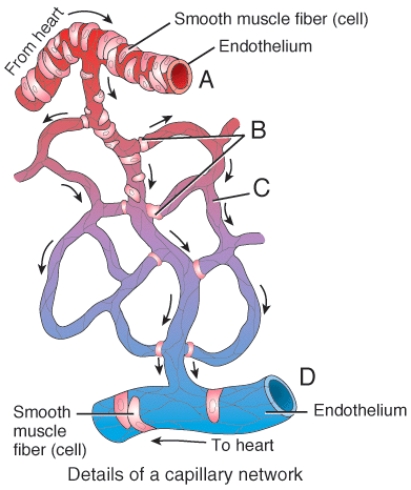
During periods of increased physical activity, large veins contract to divert blood from its venous reservoir to the skeletal muscles to help fuel the increased levels of activity.
(True/False)
4.9/5 (85)
(85) Changes in blood volume of the circulatory system have no effect on blood pressure.
(True/False)
4.8/5 (84)
(84) Type of sensory neurons located in the aortic and carotid bodies that monitor carbon dioxide and oxygen levels in the arterial blood are called
(Multiple Choice)
4.9/5 (73)
(73) Which of the following blood vessels would have the greatest resistance to blood flow?
(Multiple Choice)
4.7/5 (75)
(75) List the three main factors that help return venous blood to the heart.
(Essay)
4.9/5 (73)
(73) Venous return of blood to the heart occurs due to pressure created by
(Multiple Choice)
4.8/5 (89)
(89) The movement of blood from the abdominal veins into the thoracic veins based on the pressure differences that occur during breathing is called
(Multiple Choice)
4.8/5 (82)
(82) The baroreceptors involved in blood pressure control are located in
(Multiple Choice)
4.9/5 (71)
(71) Gases and nutrients leave the blood and enter the tissues as they pass through the
(Multiple Choice)
4.9/5 (85)
(85) Which of the labeled arteries in the diagram is the femoral artery? 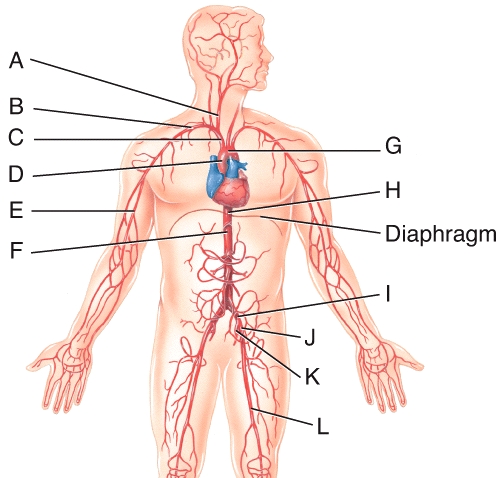
(Multiple Choice)
4.7/5 (84)
(84) Coronary artery disease is a major cause of heart disease and death in older Americans.
(True/False)
4.9/5 (72)
(72) Which of the following blood vessels carries blood with the lowest oxygen content?
(Multiple Choice)
4.8/5 (68)
(68) Which of the following arteries does NOT directly branch from the abdominal aorta?
(Multiple Choice)
4.8/5 (76)
(76) 
Filters
- Essay(0)
- Multiple Choice(0)
- Short Answer(0)
- True False(0)
- Matching(0)