



 Chat with AI
Exam 15: The Cardiovascular System: Heart

Exam 1: Organization of the Human Body105 Questions
Exam 2: Introductory Chemistry99 Questions
Exam 3: Cells112 Questions
Exam 4: Tissues106 Questions
Exam 5: The Integumentary System110 Questions
Exam 6: The Skeletal System92 Questions
Exam 7: Joints88 Questions
Exam 8: The Muscular System99 Questions
Exam 9: Nervous Tissue79 Questions
Exam 10: Central Nervous System, Spinal Nerves, and Cranial Nerves96 Questions
Exam 11: Autonomic Nervous System82 Questions
Exam 12: Somatic Senses and Special Sense102 Questions
Exam 13: The Endocrine System97 Questions
Exam 14: The Cardiovascular System: Blood92 Questions
Exam 15: The Cardiovascular System: Heart69 Questions
Exam 16: The Cardiovascular System: Blood Vessels and Circulation95 Questions
Exam 17: The Lymphatic System and Immunity91 Questions
Exam 18: The Respiratory System102 Questions
Exam 19: The Digestive System97 Questions
Exam 20: Nutrition and Metabolism85 Questions
Exam 21: The Urinary System90 Questions
Exam 22: Fluid, Electrolyte, and Acid-Base Balance81 Questions
Exam 23: The Reproductive Systems95 Questions
Exam 24: Development and Inheritance90 Questions
Select questions type


At a normal resting heart rate, the last 25% of the blood that fills the ventricles enters during

Free
(Multiple Choice)
4.8/5  (86)
(86) Correct Answer: Verified
B
The beginning of an atherosclerotic plaque occurs when a "fatty streak" in the vessel wall is formed from macrophages eating accumulated LDL particles.
Free
(True/False)
4.9/5 (80)
(80) Correct Answer:Verified
VerifiedTrue
Acetylcholine released by the parasympathetic fibers increases the heart rate.
Free
(True/False)
4.9/5 (83)
(83) Correct Answer:Verified
VerifiedFalse
The pericardium is composed of three layers. The outer layer is the parietal pericardium. The middle layer is the visceral pericardium. The innermost layer is called the fibrous pericardium or epicardium.
(True/False)
4.9/5 (75)
(75) Which of the following characteristics would NOT commonly be observed in a well-trained endurance athlete?
(Multiple Choice)
4.7/5 (77)
(77) In the diagram of the heart action potential conduction system, the structure labeled A is called the ___, which spontaneously creates action potentials at a rate of approximately ___ times per minute. 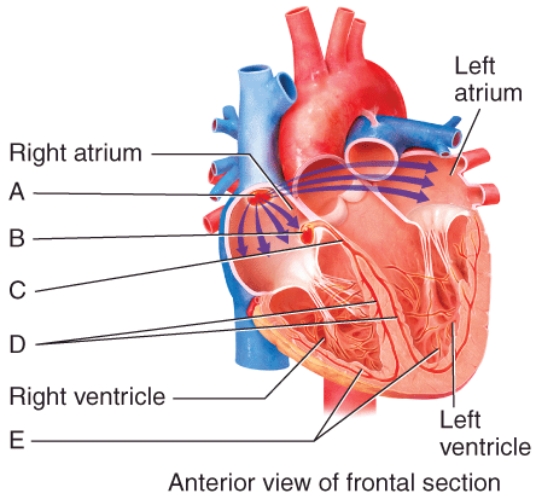
(Multiple Choice)
4.7/5 (74)
(74) The heart valve found between the left atrium and left ventricle is the
(Multiple Choice)
4.8/5 (71)
(71) Which of the following does NOT directly affect stroke volume of the left ventricle?
(Multiple Choice)
4.8/5 (85)
(85) Impulses carried from the cardiovascular center to the heart by means of the vagus nerve are
(Multiple Choice)
4.8/5 (64)
(64) The cardiovascular (CV)center that regulates cardiac output is located in the
(Multiple Choice)
4.8/5 (78)
(78) During strenuous exercise, a well-trained athlete can achieve a cardiac output that is ___ that of a sedentary person.
(Multiple Choice)
4.7/5 (70)
(70) List the correct sequence of the structures that the cardiac action potential passes through as it stimulates contraction of the heart.
(Essay)
4.9/5 (90)
(90) Between steps 7 and 8 in the diagram of blood flow through the heart, blood moves through the ___ valve. 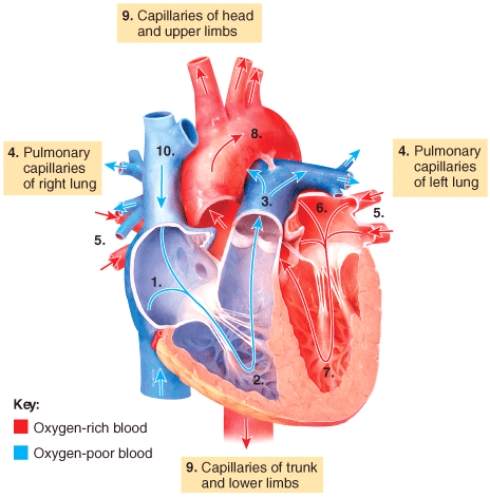
(Multiple Choice)
4.8/5 (80)
(80) Which of the following chambers of the heart has the thickest myocardium?
(Multiple Choice)
4.9/5 (82)
(82) Which of the following blood vessels delivers deoxygenated blood to the right atrium?
(Multiple Choice)
4.9/5 (91)
(91) Ischemia, hypoxia, angina pectoris and myocardial infarction all result from a lack of oxygen to the heart tissue.
(True/False)
4.8/5 (71)
(71) 
Filters
- Essay(0)
- Multiple Choice(0)
- Short Answer(0)
- True False(0)
- Matching(0)