



 Chat with AI
Exam 20: Nutrition and Metabolism

Exam 1: Organization of the Human Body105 Questions
Exam 2: Introductory Chemistry99 Questions
Exam 3: Cells112 Questions
Exam 4: Tissues106 Questions
Exam 5: The Integumentary System110 Questions
Exam 6: The Skeletal System92 Questions
Exam 7: Joints88 Questions
Exam 8: The Muscular System99 Questions
Exam 9: Nervous Tissue79 Questions
Exam 10: Central Nervous System, Spinal Nerves, and Cranial Nerves96 Questions
Exam 11: Autonomic Nervous System82 Questions
Exam 12: Somatic Senses and Special Sense102 Questions
Exam 13: The Endocrine System97 Questions
Exam 14: The Cardiovascular System: Blood92 Questions
Exam 15: The Cardiovascular System: Heart69 Questions
Exam 16: The Cardiovascular System: Blood Vessels and Circulation95 Questions
Exam 17: The Lymphatic System and Immunity91 Questions
Exam 18: The Respiratory System102 Questions
Exam 19: The Digestive System97 Questions
Exam 20: Nutrition and Metabolism85 Questions
Exam 21: The Urinary System90 Questions
Exam 22: Fluid, Electrolyte, and Acid-Base Balance81 Questions
Exam 23: The Reproductive Systems95 Questions
Exam 24: Development and Inheritance90 Questions
Select questions type


The control centers (labeled C in this diagram)for the regulation of body temperature are located in the 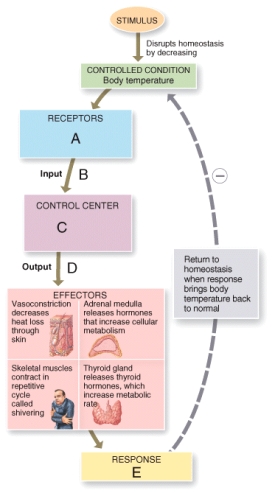

Free
(Multiple Choice)
5.0/5  (88)
(88) Correct Answer: Verified
D
Chemical reactions in which simple substances are combined into more complex substances usually with the consumption of energy are collectively called
Free
(Multiple Choice)
4.9/5 (72)
(72) Correct Answer:Verified
VerifiedB
Each gram of dietary protein provides about 4 Calories, while a gram of fat provides about ___ Calories.
Free
(Multiple Choice)
4.8/5 (74)
(74) Correct Answer:Verified
VerifiedC
What is the fate of the digested food molecules absorbed by the GI tract?
(Multiple Choice)
4.8/5 (78)
(78) In the diagram showing the interactions that occur in metabolism, which of the labeled positions on the diagram represents anabolism? 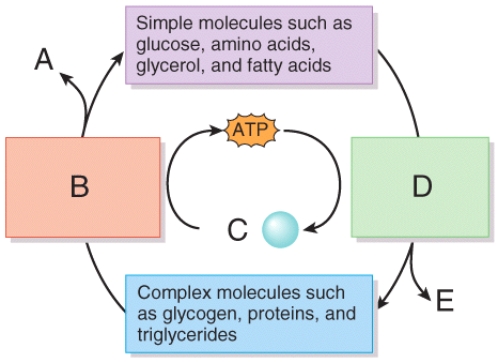
(Multiple Choice)
4.9/5 (88)
(88) Under resting conditions, about 50% of our heat loss occurs through the evaporation of water from the surface of the skin.
(True/False)
4.8/5 (72)
(72) The rate of glucose transport from the plasma into the body's cells is greatly increased in the presence of
(Multiple Choice)
4.8/5 (77)
(77) Which of the following hormones are the main regulators of the basal metabolic rate (BMR)?
(Multiple Choice)
4.7/5 (92)
(92) Before being used for energy production, proteins have to be broken down into
(Multiple Choice)
4.9/5 (87)
(87) The breakdown of complex organic molecules into smaller ones is known as
(Multiple Choice)
4.8/5 (74)
(74) The synthesis of glucose from noncarbohydrate sources, like amino acids and glycerol, is called
(Multiple Choice)
4.9/5 (91)
(91) Which of the following processes are involved in carbohydrate catabolism?
(Multiple Choice)
5.0/5 (85)
(85) Which of the following hormones is the MAIN regulator of the basal metabolic rate?
(Multiple Choice)
4.9/5 (72)
(72) Which of the following vitamins is used to make coenzyme A?
(Multiple Choice)
4.7/5 (90)
(90) The Krebs cycle and electron transport chain are collectively referred to as anaerobic cellular respiration.
(True/False)
4.9/5 (78)
(78) When phagocytes like macrophages ingest certain bacteria, they are stimulated to secrete a fever-producing substance called a/an
(Multiple Choice)
4.9/5 (80)
(80) All of the following result in an increase in body temperature EXCEPT
(Multiple Choice)
4.9/5 (82)
(82) Before entering the Krebs cycle, fatty acids are broken down into molecules of
(Multiple Choice)
4.9/5 (74)
(74) 
Filters
- Essay(0)
- Multiple Choice(0)
- Short Answer(0)
- True False(0)
- Matching(0)