



 Chat with AI
Exam 20: Nutrition and Metabolism

Exam 1: Organization of the Human Body105 Questions
Exam 2: Introductory Chemistry99 Questions
Exam 3: Cells112 Questions
Exam 4: Tissues106 Questions
Exam 5: The Integumentary System110 Questions
Exam 6: The Skeletal System92 Questions
Exam 7: Joints88 Questions
Exam 8: The Muscular System99 Questions
Exam 9: Nervous Tissue79 Questions
Exam 10: Central Nervous System, Spinal Nerves, and Cranial Nerves96 Questions
Exam 11: Autonomic Nervous System82 Questions
Exam 12: Somatic Senses and Special Sense102 Questions
Exam 13: The Endocrine System97 Questions
Exam 14: The Cardiovascular System: Blood92 Questions
Exam 15: The Cardiovascular System: Heart69 Questions
Exam 16: The Cardiovascular System: Blood Vessels and Circulation95 Questions
Exam 17: The Lymphatic System and Immunity91 Questions
Exam 18: The Respiratory System102 Questions
Exam 19: The Digestive System97 Questions
Exam 20: Nutrition and Metabolism85 Questions
Exam 21: The Urinary System90 Questions
Exam 22: Fluid, Electrolyte, and Acid-Base Balance81 Questions
Exam 23: The Reproductive Systems95 Questions
Exam 24: Development and Inheritance90 Questions
Select questions type


The energy to synthesize ATP primarily comes from the catabolic breakdown of glycogen, proteins, and triglycerides.
(True/False)
4.8/5  (81)
(81) Excess dietary carbohydrates, proteins, and fats can all be converted into triglycerides and stored in fat cells.
(True/False)
4.8/5 (83)
(83) Both vitamins D and K can be made in the human body. Vitamin D is made in the skin and vitamin K is made by bacteria in the large intestine.
(True/False)
4.9/5 (72)
(72) To a certain point, fever is beneficial in fighting microbial infections.
(True/False)
4.7/5 (72)
(72) The production of new glucose from either lipids or amino acids is called glycogenolysis.
(True/False)
4.9/5 (87)
(87) A nutritional disorder resulting from inadequate protein and calories in the diet is called
(Multiple Choice)
4.9/5 (75)
(75) Even moderate obesity is considered as a risk factor for such diseases as hypertension, non-insulin-dependent diabetes mellitus, and cardiovascular disease.
(True/False)
4.8/5 (89)
(89) The amount of energy derived from nutrients is most commonly expressed in
(Multiple Choice)
5.0/5 (86)
(86) Before entering the Krebs cycle, pyruvic acid has to be decarboxylated and combined with
(Multiple Choice)
4.9/5 (74)
(74) For each molecule of glucose converted into two pyruvic acids, the chemical reactions of glycolysis directly produce a net total of
(Multiple Choice)
4.8/5 (77)
(77) The receptors (labeled A in the diagram)used to detect changes in body temperature are 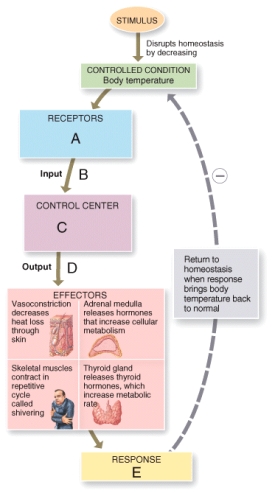
(Multiple Choice)
4.9/5 (88)
(88) Carbohydrate loading, which involves eating large amounts of complex carbohydrates in the days prior to competition, helps maximize the total amount of glycogen available for ATP production.
(True/False)
4.9/5 (86)
(86) Glucose is stored in the liver and muscles as a large polysaccharide called
(Multiple Choice)
4.9/5 (76)
(76) 
Filters
- Essay(0)
- Multiple Choice(0)
- Short Answer(0)
- True False(0)
- Matching(0)