



 Chat with AI
Exam 11: Managing Demand and Forecasting

Exam 1: Creating Customer Value128 Questions
Exam 2: Supply Chain Management170 Questions
Exam 3: Supply Chain Sustainability and Humanitarian Logistics132 Questions
Exam 4: Process Configuration132 Questions
Exam 5: Capacity143 Questions
Exam 6: Waiting Lines165 Questions
Exam 7: Inventory Management218 Questions
Exam 8: Quality and Process Improvement153 Questions
Exam 9: Lean Systems112 Questions
Exam 10: Location and Layout216 Questions
Exam 11: Managing Demand and Forecasting189 Questions
Exam 12: Operations Planning and Scheduling134 Questions
Exam 13: Resource Planning174 Questions
Select questions type


_________ variables are the variables in linear regression analysis that are used to predict the measure or quantity being forecast
(Short Answer)
4.7/5  (77)
(77) For time series methods of forecasting, explain the distinction between the simple moving average method and the weighted moving average method.
(Essay)
4.8/5 (76)
(76) Calculate three forecasts using the following data. First, for periods 4 through 11, develop the exponentially smoothed forecasts using a forecast for period 3 (F3) of 45.0 and an alpha of 0.3. Second, calculate the 3- period moving average forecast for periods 4 through 11. Third, calculate the weighted moving average for periods 4 through 11, using weights of .50, .30, and .20. Calculate the mean absolute deviation (MAD) and the cumulative sum of forecast error (CFE) for each forecasting procedure. Which forecasting procedure would you select? Why? Month Demand 1 45 2 48 3 42 4 48 5 49 6 54 7 47 8 50 9 46 10 47
(Essay)
4.8/5 (74)
(74) Table 11.4.
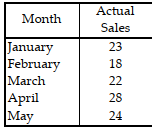 -Use the information in Table 11.4. The forecasting equation for a three- month weighted moving average is: At = W1Dt + W2Dt - 1 + W3Dt - 2
If the sales for June were 40 units and the weights are W1= 1/2, W2 = 1/3, and W3 = 1/6, what is the forecast for July?
-Use the information in Table 11.4. The forecasting equation for a three- month weighted moving average is: At = W1Dt + W2Dt - 1 + W3Dt - 2
If the sales for June were 40 units and the weights are W1= 1/2, W2 = 1/3, and W3 = 1/6, what is the forecast for July? (Multiple Choice)
4.8/5 (69)
(69) A naive forecast is a time- series method whereby the forecast for the next period equals the demand for the current period.
(True/False)
4.8/5 (80)
(80) There will be a lag behind the trend in actual demand when using single smooth forecasts.
(True/False)
4.8/5 (86)
(86) Table 11.7.
Month Units Sold (00) 1 150 2 145 3 160 4 180 5 220
-Use the information in Table 11.7. The forecast for month 4 is
(Multiple Choice)
5.0/5 (81)
(81) Table 11.2
The manager of a pizza shop must forecast weekly demand for special pizzas
so that he can order pizza shells weekly. Recent demand has been:
Week No. Special Pizzas 1 50 2 65 3 53 4 56 5 55 6 60
-Use the information from Table 11.2. If a four- week weighted moving average were used, what would be the forecast for week 7? (The weights are 0.77, 0.11, 0.11, and 0.01.)
(Multiple Choice)
4.9/5 (75)
(75) An initial forecast must be obtained by another method, before beginning a series of exponentially smoothed forecasts.
(True/False)
4.9/5 (86)
(86) A quantitative approach is applied when using the Delphi forecasting method.
(True/False)
4.8/5 (75)
(75) Table 11.7
Month Units Sold (00) 1 150 2 145 3 160 4 180 5 220
-Use the information in Table 11.7. What is the MAD for months 2 through 5?
(Multiple Choice)
4.7/5 (74)
(74) Some analysts prefer to use a holdout set as the final test of a forecasting procedure.
(True/False)
4.9/5 (87)
(87) Judgment methods of forecasting are quantitative methods that use historical data on independent variables to predict demand.
(True/False)
4.8/5 (78)
(78) In developing a regression equation of the form Y = a + bX, the intent is to use values of X to predict the likely outcome for the dependent variable Y.
(True/False)
4.8/5 (84)
(84) Why are forecasts for product families typically more accurate than forecasts for the individual items within a product family?
(Essay)
4.9/5 (79)
(79) _________ is a forecasting method in which the opinions, experience, and technical knowledge of one or more managers are summarized to arrive at a single forecast.
(Short Answer)
4.9/5 (71)
(71) Which one of the following statements about forecasting is FALSE?
(Multiple Choice)
5.0/5 (79)
(79) 
Filters
- Essay(0)
- Multiple Choice(0)
- Short Answer(0)
- True False(0)
- Matching(0)