



 Chat with AI
Exam 4: Economic Efficiency, Government Price Setting, and Taxes

Exam 1: Economics: Foundations and Models459 Questions
Exam 2: Trade-Offs, Comparative Advantage, and the Market System492 Questions
Exam 3: Where Prices Come From: the Interaction of Demand and Supply476 Questions
Exam 4: Economic Efficiency, Government Price Setting, and Taxes420 Questions
Exam 5: Externalities, Environmental Policy, and Public Goods262 Questions
Exam 6: Elasticity: the Responsiveness of Demand and Supply293 Questions
Exam 7: The Economics of Health Care337 Questions
Exam 8: Firms, the Stock Market, and Corporate Governance512 Questions
Exam 9: Comparative Advantage and the Gains From International Trade377 Questions
Exam 10: Consumer Choice and Behavioral Economics304 Questions
Exam 11: Technology, Production, and Costs326 Questions
Exam 12: Firms in Perfectly Competitive Markets296 Questions
Exam 13: Monopolistic Competition: the Competitive Model in a More Realistic Setting272 Questions
Exam 14: Oligopoly: Firms in Less Competitive Markets256 Questions
Exam 15: Monopoly and Antitrust Policy279 Questions
Exam 16: Pricing Strategy258 Questions
Exam 17: The Markets for Labor and Other Factors of Production279 Questions
Exam 18: Public Choice, Taxes, and the Distribution of Income258 Questions
Exam 19: Gdp: Measuring Total Production and Income260 Questions
Exam 20: Unemployment and Inflation290 Questions
Exam 21: Economic Growth, the Financial System, and Business Cycles251 Questions
Exam 22: Long-Run Economic Growth: Sources and Policies261 Questions
Exam 23: Aggregate Expenditure and Output in the Short Run305 Questions
Exam 24: Aggregate Demand and Aggregate Supply Analysis286 Questions
Exam 25: Money, Banks, and the Federal Reserve System278 Questions
Exam 26: Monetary Policy280 Questions
Exam 27: Fiscal Policy313 Questions
Exam 28: Inflation, Unemployment, and Federal Reserve Policy257 Questions
Exam 29: Macroeconomics in an Open Economy277 Questions
Exam 30: The International Financial System258 Questions
Select questions type


The area ________ the market supply curve and ________ the market price is equal to the total amount of producer surplus in a market.
(Multiple Choice)
4.9/5  (83)
(83) The willingness of consumers to buy a product at different prices is shown on a
(Multiple Choice)
4.8/5 (76)
(76) If the price of toothpaste is represented by equation P = 40 - .5QD, then the corresponding quantity of toothpaste demanded is represented by the equation
(Multiple Choice)
4.8/5 (85)
(85) Figure 4-15  Figure 4-15 shows the market for beer. The government plans to impose a per-unit tax in this market.
-Refer to Figure 4-15. How much of the tax is paid by sellers?
Figure 4-15 shows the market for beer. The government plans to impose a per-unit tax in this market.
-Refer to Figure 4-15. How much of the tax is paid by sellers? (Multiple Choice)
4.9/5 (93)
(93) The following equations represent the demand and supply for kumquats. QD = 60 - 3P
QS = -20 + 5P
What is the equilibrium price (P) and quantity (Q - in thousands) of kumquats?
(Multiple Choice)
4.9/5 (88)
(88) Figure 4-8  Figure 4-8 shows the market for apartments in Springfield. Recently, the government imposed a rent ceiling of $1,000 per month.
-Refer to Figure 4-8. Suppose that instead of a rent ceiling, the government imposed a price floor of $2,000 per month for apartments. What is the value of consumer surplus after the imposition of the price floor?
Figure 4-8 shows the market for apartments in Springfield. Recently, the government imposed a rent ceiling of $1,000 per month.
-Refer to Figure 4-8. Suppose that instead of a rent ceiling, the government imposed a price floor of $2,000 per month for apartments. What is the value of consumer surplus after the imposition of the price floor? (Multiple Choice)
5.0/5 (76)
(76) Table 4-8
 Table 4-8 shows the demand and supply schedules for the low-skilled labor market in the city of Westover.
-Refer to Table 4-8. If a minimum wage of $9.50 an hour is mandated, what is the quantity of labor supplied?
Table 4-8 shows the demand and supply schedules for the low-skilled labor market in the city of Westover.
-Refer to Table 4-8. If a minimum wage of $9.50 an hour is mandated, what is the quantity of labor supplied? (Multiple Choice)
4.8/5 (83)
(83) Figure 4-3  Figure 4-3 shows Kendra's demand curve for ice cream cones.
-Refer to Figure 4-3. If the market price is $2.50, what is Kendra's consumer surplus?
Figure 4-3 shows Kendra's demand curve for ice cream cones.
-Refer to Figure 4-3. If the market price is $2.50, what is Kendra's consumer surplus? (Multiple Choice)
4.9/5 (82)
(82) ________ dictates the lowest wage that firms may pay for labor.
(Multiple Choice)
4.9/5 (75)
(75) Figure 4-4  Figure 4-4 shows the market for tiger shrimp. The market is initially in equilibrium at a price of $15 and a quantity of 80. Now suppose producers decide to cut output to 40 in order to raise the price to $18.
-Refer to Figure 4-4. At a price of $18 consumers are willing to buy 40 pounds of tiger shrimp. Is this an economically efficient quantity?
Figure 4-4 shows the market for tiger shrimp. The market is initially in equilibrium at a price of $15 and a quantity of 80. Now suppose producers decide to cut output to 40 in order to raise the price to $18.
-Refer to Figure 4-4. At a price of $18 consumers are willing to buy 40 pounds of tiger shrimp. Is this an economically efficient quantity? (Multiple Choice)
4.9/5 (77)
(77) Figure 4-1 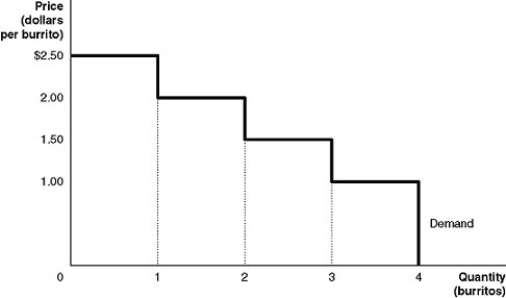 Figure 4-1 shows Arnold's demand curve for burritos.
-Refer to Figure 4-1. If the market price is $1.50, what is Arnold's consumer surplus?
Figure 4-1 shows Arnold's demand curve for burritos.
-Refer to Figure 4-1. If the market price is $1.50, what is Arnold's consumer surplus? (Multiple Choice)
4.9/5 (77)
(77) Table 4-8
Table 4-8 shows the demand and supply schedules for the low-skilled labor market in the city of Westover.
-Refer to Table 4-8. Suppose that the quantity of labor supplied decreases by 40,000 at each wage level. What are the new free market equilibrium hourly wage and the new equilibrium quantity of labor?
Table 4-8 shows the demand and supply schedules for the low-skilled labor market in the city of Westover.
-Refer to Table 4-8. Suppose that the quantity of labor supplied decreases by 40,000 at each wage level. What are the new free market equilibrium hourly wage and the new equilibrium quantity of labor? (Multiple Choice)
4.8/5 (85)
(85) Figure 4-1 Figure 4-1 shows Arnold's demand curve for burritos.
-Refer to Figure 4-1. If the market price is $2.00, what is Arnold's consumer surplus?
Figure 4-1 shows Arnold's demand curve for burritos.
-Refer to Figure 4-1. If the market price is $2.00, what is Arnold's consumer surplus? (Multiple Choice)
4.8/5 (76)
(76) Figure 4-1 Figure 4-1 shows Arnold's demand curve for burritos.
-Refer to Figure 4-1. If the market price is $1.50, what is the consumer surplus on the first burrito?
Figure 4-1 shows Arnold's demand curve for burritos.
-Refer to Figure 4-1. If the market price is $1.50, what is the consumer surplus on the first burrito? (Multiple Choice)
4.7/5 (84)
(84) Producer surplus is the difference between the lowest price a firm is willing to accept for a product and the price it actually receives for the product.
(True/False)
4.9/5 (76)
(76) When Congress passed a law that imposed a tax designed to fund its Social Security and Medicare programs it wanted employers and workers to share the burden of the tax equally. Most economists who have studied the incidence of the tax have concluded
(Multiple Choice)
4.7/5 (87)
(87) 
Filters
- Essay(0)
- Multiple Choice(0)
- Short Answer(0)
- True False(0)
- Matching(0)