



 Chat with AI
Exam 4: Economic Efficiency, Government Price Setting, and Taxes

Exam 1: Economics: Foundations and Models459 Questions
Exam 2: Trade-Offs, Comparative Advantage, and the Market System492 Questions
Exam 3: Where Prices Come From: the Interaction of Demand and Supply476 Questions
Exam 4: Economic Efficiency, Government Price Setting, and Taxes420 Questions
Exam 5: Externalities, Environmental Policy, and Public Goods262 Questions
Exam 6: Elasticity: the Responsiveness of Demand and Supply293 Questions
Exam 7: The Economics of Health Care337 Questions
Exam 8: Firms, the Stock Market, and Corporate Governance512 Questions
Exam 9: Comparative Advantage and the Gains From International Trade377 Questions
Exam 10: Consumer Choice and Behavioral Economics304 Questions
Exam 11: Technology, Production, and Costs326 Questions
Exam 12: Firms in Perfectly Competitive Markets296 Questions
Exam 13: Monopolistic Competition: the Competitive Model in a More Realistic Setting272 Questions
Exam 14: Oligopoly: Firms in Less Competitive Markets256 Questions
Exam 15: Monopoly and Antitrust Policy279 Questions
Exam 16: Pricing Strategy258 Questions
Exam 17: The Markets for Labor and Other Factors of Production279 Questions
Exam 18: Public Choice, Taxes, and the Distribution of Income258 Questions
Exam 19: Gdp: Measuring Total Production and Income260 Questions
Exam 20: Unemployment and Inflation290 Questions
Exam 21: Economic Growth, the Financial System, and Business Cycles251 Questions
Exam 22: Long-Run Economic Growth: Sources and Policies261 Questions
Exam 23: Aggregate Expenditure and Output in the Short Run305 Questions
Exam 24: Aggregate Demand and Aggregate Supply Analysis286 Questions
Exam 25: Money, Banks, and the Federal Reserve System278 Questions
Exam 26: Monetary Policy280 Questions
Exam 27: Fiscal Policy313 Questions
Exam 28: Inflation, Unemployment, and Federal Reserve Policy257 Questions
Exam 29: Macroeconomics in an Open Economy277 Questions
Exam 30: The International Financial System258 Questions
Select questions type


Table 4-10
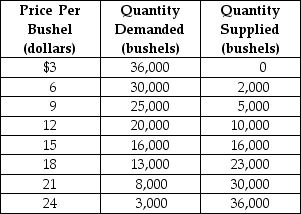 Table 4-10 above contains information about the wheat market. Answer the following questions based on this table.
-Refer to Table 4-10. An agricultural price floor is a price that the government guarantees farmers will receive for a particular crop. Suppose the federal government sets a price floor for wheat at $21 per bushel.
a. What is the amount of shortage or surplus in the wheat market as result of the price floor?
b. If the government agrees to purchase any surplus output at $21, how much will it cost the government?
c. If the government buys all of the farmers' output at the floor price, how many bushels of wheat will it have to purchase and how much will it cost the government?
d. Suppose the government buys up all of the farmers' output at the floor price and then sells the output to consumers at whatever price it can get. Under this scheme, what is the price at which the government will be able to sell off all of the output it had purchased from farmers? What is the revenue received from the government's sale?
e. In this problem we have considered two government schemes: (1) a price floor is established and the government purchases any excess output and (2) the government buys all the farmers' output at the floor price and resells at whatever price it can get. Which scheme will taxpayers prefer?
f. Consider again the two schemes. Which scheme will the farmers prefer?
g. Consider again the two schemes. Which scheme will wheat buyers prefer?
Table 4-10 above contains information about the wheat market. Answer the following questions based on this table.
-Refer to Table 4-10. An agricultural price floor is a price that the government guarantees farmers will receive for a particular crop. Suppose the federal government sets a price floor for wheat at $21 per bushel.
a. What is the amount of shortage or surplus in the wheat market as result of the price floor?
b. If the government agrees to purchase any surplus output at $21, how much will it cost the government?
c. If the government buys all of the farmers' output at the floor price, how many bushels of wheat will it have to purchase and how much will it cost the government?
d. Suppose the government buys up all of the farmers' output at the floor price and then sells the output to consumers at whatever price it can get. Under this scheme, what is the price at which the government will be able to sell off all of the output it had purchased from farmers? What is the revenue received from the government's sale?
e. In this problem we have considered two government schemes: (1) a price floor is established and the government purchases any excess output and (2) the government buys all the farmers' output at the floor price and resells at whatever price it can get. Which scheme will taxpayers prefer?
f. Consider again the two schemes. Which scheme will the farmers prefer?
g. Consider again the two schemes. Which scheme will wheat buyers prefer? (Essay)
4.8/5  (77)
(77) Figure 4-18  Figure 4-18 shows the market for cigarettes. The government plans to impose a per-unit tax in this market.
-Refer to Figure 4-18. For each unit sold, the price sellers receive after the tax (net of tax) is
Figure 4-18 shows the market for cigarettes. The government plans to impose a per-unit tax in this market.
-Refer to Figure 4-18. For each unit sold, the price sellers receive after the tax (net of tax) is (Multiple Choice)
4.9/5 (83)
(83) Economic surplus is maximized in a competitive market when
(Multiple Choice)
4.9/5 (77)
(77) Table 4-2
 -Refer to Table 4-2. The table above lists the highest prices five consumers are willing to pay for a theater ticket. If the price of one ticket falls from $25 to $10,
 (Multiple Choice)
4.8/5 (85)
(85) Table 4-12
 -Refer to Table 4-12. The equations above describe the demand and supply for Bubba's Fried Jellybeans. The equilibrium price and quantity for Bubba's Fried Jellybeans are $40 and 5 thousand units. What is the value of producer surplus?
 (Multiple Choice)
4.9/5 (79)
(79) Congress passed the Freedom to Farm Act in 1996. What was the purpose of this act?
(Multiple Choice)
4.9/5 (71)
(71) Figure 4-8  Figure 4-8 shows the market for apartments in Springfield. Recently, the government imposed a rent ceiling of $1,000 per month.
-Refer to Figure 4-8. Suppose that instead of a rent ceiling, the government imposed a price floor of $2,000 per month for apartments. What is the value of the portion of consumer surplus transferred to producers as a result of the price floor?
Figure 4-8 shows the market for apartments in Springfield. Recently, the government imposed a rent ceiling of $1,000 per month.
-Refer to Figure 4-8. Suppose that instead of a rent ceiling, the government imposed a price floor of $2,000 per month for apartments. What is the value of the portion of consumer surplus transferred to producers as a result of the price floor? (Multiple Choice)
4.9/5 (86)
(86) Figure 4-15  Figure 4-15 shows the market for beer. The government plans to impose a per-unit tax in this market.
-Refer to Figure 4-15. How much of the tax is paid by buyers?
Figure 4-15 shows the market for beer. The government plans to impose a per-unit tax in this market.
-Refer to Figure 4-15. How much of the tax is paid by buyers? (Multiple Choice)
4.8/5 (71)
(71) Paul goes to Dick's Sporting Goods to buy a new tennis racquet. He is willing to pay $200 for a new racquet, but buys one on sale for $125. Paul's consumer surplus from the purchase is
(Multiple Choice)
4.8/5 (72)
(72) Consumer surplus in a market for a product would be equal to the area under the demand curve if
(Multiple Choice)
4.9/5 (78)
(78) Table 4-7
 Table 4-7 shows the demand and supply schedules for the labor market in the city of Pixley.
-Refer to Table 4-7. If a minimum wage of $11.50 is mandated, there will be a
Table 4-7 shows the demand and supply schedules for the labor market in the city of Pixley.
-Refer to Table 4-7. If a minimum wage of $11.50 is mandated, there will be a (Multiple Choice)
4.8/5 (79)
(79) Figure 4-3  Figure 4-3 shows Kendra's demand curve for ice cream cones.
-Refer to Figure 4-3. If the market price is $2.50, what is the consumer surplus on the second ice cream cone?
Figure 4-3 shows Kendra's demand curve for ice cream cones.
-Refer to Figure 4-3. If the market price is $2.50, what is the consumer surplus on the second ice cream cone? (Multiple Choice)
4.8/5 (92)
(92) If a tax is imposed on a product, the buyer will always bear the entire burden of the tax.
(True/False)
5.0/5 (87)
(87) Figure 4-6  Figure 4-6 shows the market for granola. The market is initially in equilibrium at a price of P1 and a quantity of Q1. Now suppose producers decide to cut output to Q2 in order to raise the price to P2.
-Refer to Figure 4-6. At the equilibrium price of P1, consumers are willing to buy Q1 pounds of granola. Is this an economically efficient quantity?
Figure 4-6 shows the market for granola. The market is initially in equilibrium at a price of P1 and a quantity of Q1. Now suppose producers decide to cut output to Q2 in order to raise the price to P2.
-Refer to Figure 4-6. At the equilibrium price of P1, consumers are willing to buy Q1 pounds of granola. Is this an economically efficient quantity? (Multiple Choice)
5.0/5 (81)
(81) The division of the burden of a tax between buyers and sellers in a market is called tax incidence.
(True/False)
4.9/5 (71)
(71) Figure 4-17  -Refer to Figure 4-17. Suppose the market is initially in equilibrium at price P1 and then the government imposes a tax on every unit sold. Which of the following statements best describes the impact of the tax?
 (Multiple Choice)
4.7/5 (78)
(78) Table 4-13
 -Refer to Table 4-13. The equations above describe the demand and supply for Aunt Maud's Premium Hand Lotion. The equilibrium price and quantity for Aunt Maud's lotion are $20 and 30 thousand units. What is the value of economic surplus in this market?
 (Multiple Choice)
4.8/5 (80)
(80) The additional cost to a firm of producing one more unit of a good or service is the
(Multiple Choice)
4.8/5 (70)
(70) Table 4-6
 -Refer to Table 4-6. The table above lists the marginal cost of polo shirts by Marko's, a firm that specializes in producing men's clothing. If the market price of Marko's polo shirts is $30, producer surplus is
 (Multiple Choice)
4.7/5 (93)
(93) 
Filters
- Essay(0)
- Multiple Choice(0)
- Short Answer(0)
- True False(0)
- Matching(0)