



 Chat with AI
Exam 4: Economic Efficiency, Government Price Setting, and Taxes

Exam 1: Economics: Foundations and Models459 Questions
Exam 2: Trade-Offs, Comparative Advantage, and the Market System492 Questions
Exam 3: Where Prices Come From: the Interaction of Demand and Supply476 Questions
Exam 4: Economic Efficiency, Government Price Setting, and Taxes420 Questions
Exam 5: Externalities, Environmental Policy, and Public Goods262 Questions
Exam 6: Elasticity: the Responsiveness of Demand and Supply293 Questions
Exam 7: The Economics of Health Care337 Questions
Exam 8: Firms, the Stock Market, and Corporate Governance512 Questions
Exam 9: Comparative Advantage and the Gains From International Trade377 Questions
Exam 10: Consumer Choice and Behavioral Economics304 Questions
Exam 11: Technology, Production, and Costs326 Questions
Exam 12: Firms in Perfectly Competitive Markets296 Questions
Exam 13: Monopolistic Competition: the Competitive Model in a More Realistic Setting272 Questions
Exam 14: Oligopoly: Firms in Less Competitive Markets256 Questions
Exam 15: Monopoly and Antitrust Policy279 Questions
Exam 16: Pricing Strategy258 Questions
Exam 17: The Markets for Labor and Other Factors of Production279 Questions
Exam 18: Public Choice, Taxes, and the Distribution of Income258 Questions
Exam 19: Gdp: Measuring Total Production and Income260 Questions
Exam 20: Unemployment and Inflation290 Questions
Exam 21: Economic Growth, the Financial System, and Business Cycles251 Questions
Exam 22: Long-Run Economic Growth: Sources and Policies261 Questions
Exam 23: Aggregate Expenditure and Output in the Short Run305 Questions
Exam 24: Aggregate Demand and Aggregate Supply Analysis286 Questions
Exam 25: Money, Banks, and the Federal Reserve System278 Questions
Exam 26: Monetary Policy280 Questions
Exam 27: Fiscal Policy313 Questions
Exam 28: Inflation, Unemployment, and Federal Reserve Policy257 Questions
Exam 29: Macroeconomics in an Open Economy277 Questions
Exam 30: The International Financial System258 Questions
Select questions type


Figure 4-3  Figure 4-3 shows Kendra's demand curve for ice cream cones.
-Refer to Figure 4-3. If the market price is $3.50, what is the maximum number of ice cream cones that Kendra will buy?
Figure 4-3 shows Kendra's demand curve for ice cream cones.
-Refer to Figure 4-3. If the market price is $3.50, what is the maximum number of ice cream cones that Kendra will buy? (Multiple Choice)
4.9/5  (79)
(79) Congress passed the ________ in 1996, the purpose of which was to phase out price floors and return to a free market in agriculture
(Multiple Choice)
4.7/5 (82)
(82) Table 4-7
 Table 4-7 shows the demand and supply schedules for the labor market in the city of Pixley.
-Refer to Table 4-7. If a minimum wage of $12.50 an hour is mandated, what is the quantity of labor demanded?
Table 4-7 shows the demand and supply schedules for the labor market in the city of Pixley.
-Refer to Table 4-7. If a minimum wage of $12.50 an hour is mandated, what is the quantity of labor demanded? (Multiple Choice)
4.9/5 (84)
(84) Figure 4-18  Figure 4-18 shows the market for cigarettes. The government plans to impose a per-unit tax in this market.
-Refer to Figure 4-18. How much of the tax is paid by buyers?
Figure 4-18 shows the market for cigarettes. The government plans to impose a per-unit tax in this market.
-Refer to Figure 4-18. How much of the tax is paid by buyers? (Multiple Choice)
4.8/5 (78)
(78) Figure 4-8  Figure 4-8 shows the market for apartments in Springfield. Recently, the government imposed a rent ceiling of $1,000 per month.
-Refer to Figure 4-8. With rent control, the quantity supplied is 200 apartments. Suppose apartment owners ignore the law and rent this quantity for the highest rent they can get. What is the highest rent they can get per month?
Figure 4-8 shows the market for apartments in Springfield. Recently, the government imposed a rent ceiling of $1,000 per month.
-Refer to Figure 4-8. With rent control, the quantity supplied is 200 apartments. Suppose apartment owners ignore the law and rent this quantity for the highest rent they can get. What is the highest rent they can get per month? (Multiple Choice)
4.9/5 (85)
(85) Table 4-9
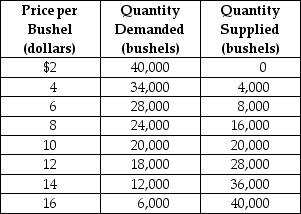 Table 4-9 above contains information about the corn market. Answer the following questions based on this table.
-Refer to Table 4-9. An agricultural price floor is a price that the government guarantees farmers will receive for a particular crop. Suppose the federal government sets a price floor for corn at $12 per bushel.
a. What is the amount of shortage or surplus in the corn market as result of the price floor?
b. If the government agrees to purchase any surplus output at $12, how much will it cost the government?
c. If the government buys all of the farmers' output at the floor price, how many bushels of corn will it have to purchase and how much will it cost the government?
d. Suppose the government buys up all of the farmers' output at the floor price and then sells the output to consumers at whatever price it can get. Under this scheme, what is the price at which the government will be able to sell off all of the output it had purchased from farmers? What is the revenue received from the government's sale?
e. In this problem we have considered two government schemes: (1) a price floor is established and the government purchases any excess output and (2) the government buys all the farmers' output at the floor price and resells at whatever price it can get. Which scheme will taxpayers prefer?
f. Consider again the two schemes. Which scheme will the farmers prefer?
g. Consider again the two schemes. Which scheme will corn buyers prefer?
Table 4-9 above contains information about the corn market. Answer the following questions based on this table.
-Refer to Table 4-9. An agricultural price floor is a price that the government guarantees farmers will receive for a particular crop. Suppose the federal government sets a price floor for corn at $12 per bushel.
a. What is the amount of shortage or surplus in the corn market as result of the price floor?
b. If the government agrees to purchase any surplus output at $12, how much will it cost the government?
c. If the government buys all of the farmers' output at the floor price, how many bushels of corn will it have to purchase and how much will it cost the government?
d. Suppose the government buys up all of the farmers' output at the floor price and then sells the output to consumers at whatever price it can get. Under this scheme, what is the price at which the government will be able to sell off all of the output it had purchased from farmers? What is the revenue received from the government's sale?
e. In this problem we have considered two government schemes: (1) a price floor is established and the government purchases any excess output and (2) the government buys all the farmers' output at the floor price and resells at whatever price it can get. Which scheme will taxpayers prefer?
f. Consider again the two schemes. Which scheme will the farmers prefer?
g. Consider again the two schemes. Which scheme will corn buyers prefer? (Essay)
4.9/5 (81)
(81) Figure 4-1  Figure 4-1 shows Arnold's demand curve for burritos.
-Refer to Figure 4-1. What is the total amount that Arnold is willing to pay for 3 burritos?
Figure 4-1 shows Arnold's demand curve for burritos.
-Refer to Figure 4-1. What is the total amount that Arnold is willing to pay for 3 burritos? (Multiple Choice)
4.9/5 (85)
(85) In Venezuela, the government attempted to control rising food prices by implementing price ceilings in the market. These price ceilings were set ________ the market prices, which resulted in ________ of food.
(Multiple Choice)
4.9/5 (79)
(79) Figure 4-3 Figure 4-3 shows Kendra's demand curve for ice cream cones.
-Refer to Figure 4-3. If the market price is $3.00, what is the consumer surplus on the second ice cream cone?
Figure 4-3 shows Kendra's demand curve for ice cream cones.
-Refer to Figure 4-3. If the market price is $3.00, what is the consumer surplus on the second ice cream cone? (Multiple Choice)
4.9/5 (90)
(90) The difference between the ________ and the ________ from the sale of a product is called producer surplus.
(Multiple Choice)
4.8/5 (77)
(77) Figure 4-15  Figure 4-15 shows the market for beer. The government plans to impose a per-unit tax in this market.
-Refer to Figure 4-15. What is the size of the per-unit tax?
Figure 4-15 shows the market for beer. The government plans to impose a per-unit tax in this market.
-Refer to Figure 4-15. What is the size of the per-unit tax? (Multiple Choice)
4.8/5 (83)
(83) Table 4-11
 -Refer to Table 4-11. The equations above describe the demand and supply for Chef Ernie's Sushi-on-a-Stick. The equilibrium price and quantity for Chef Ernie's sushi are $60 and 20 thousand units. What is the value of producer surplus?
 (Multiple Choice)
4.8/5 (81)
(81) The additional benefit to a consumer from consuming one more unit of a good or service
(Multiple Choice)
4.8/5 (87)
(87) A tax is efficient if it imposes a large excess burden relative to the tax revenue it raises.
(True/False)
4.8/5 (69)
(69) You are given the following market data for apples.
Demand is represented by: P = 12 - 0.01Q
Supply is represented by: P = 0.02Q
where P= price per bushel, and Q=quantity.
a. Calculate the equilibrium price and quantity.
b. Suppose the government guaranteed producers a price of $10 per bushel. What would be the effect on quantity supplied? Provide a numerical value.
c. By how much would the $10 price change the quantity of apples demanded? Provide a numerical value.
d. Would there be a shortage or surplus of apples?
e. What is the size of this shortage or surplus? Provide a numerical value.
(Essay)
4.9/5 (79)
(79) If the demand curve for a product is vertical, any tax increase on the product is paid for entirely by the consumer.
(True/False)
4.7/5 (78)
(78) ________ is defined as a market outcome in which the marginal benefit to consumers of the last unit produced is equal to the marginal cost of production, and in which the sum of consumer surplus and producer surplus is at a maximum.
(Multiple Choice)
4.8/5 (91)
(91) When ________ in a market, the total net benefit to society is maximized.
(Multiple Choice)
4.8/5 (83)
(83) 
Filters
- Essay(0)
- Multiple Choice(0)
- Short Answer(0)
- True False(0)
- Matching(0)