



 Chat with AI
Exam 4: Economic Efficiency, Government Price Setting, and Taxes

Exam 1: Economics: Foundations and Models459 Questions
Exam 2: Trade-Offs, Comparative Advantage, and the Market System492 Questions
Exam 3: Where Prices Come From: the Interaction of Demand and Supply476 Questions
Exam 4: Economic Efficiency, Government Price Setting, and Taxes420 Questions
Exam 5: Externalities, Environmental Policy, and Public Goods262 Questions
Exam 6: Elasticity: the Responsiveness of Demand and Supply293 Questions
Exam 7: The Economics of Health Care337 Questions
Exam 8: Firms, the Stock Market, and Corporate Governance512 Questions
Exam 9: Comparative Advantage and the Gains From International Trade377 Questions
Exam 10: Consumer Choice and Behavioral Economics304 Questions
Exam 11: Technology, Production, and Costs326 Questions
Exam 12: Firms in Perfectly Competitive Markets296 Questions
Exam 13: Monopolistic Competition: the Competitive Model in a More Realistic Setting272 Questions
Exam 14: Oligopoly: Firms in Less Competitive Markets256 Questions
Exam 15: Monopoly and Antitrust Policy279 Questions
Exam 16: Pricing Strategy258 Questions
Exam 17: The Markets for Labor and Other Factors of Production279 Questions
Exam 18: Public Choice, Taxes, and the Distribution of Income258 Questions
Exam 19: Gdp: Measuring Total Production and Income260 Questions
Exam 20: Unemployment and Inflation290 Questions
Exam 21: Economic Growth, the Financial System, and Business Cycles251 Questions
Exam 22: Long-Run Economic Growth: Sources and Policies261 Questions
Exam 23: Aggregate Expenditure and Output in the Short Run305 Questions
Exam 24: Aggregate Demand and Aggregate Supply Analysis286 Questions
Exam 25: Money, Banks, and the Federal Reserve System278 Questions
Exam 26: Monetary Policy280 Questions
Exam 27: Fiscal Policy313 Questions
Exam 28: Inflation, Unemployment, and Federal Reserve Policy257 Questions
Exam 29: Macroeconomics in an Open Economy277 Questions
Exam 30: The International Financial System258 Questions
Select questions type


The additional benefit to a consumer from consuming one more unit of a good or service is the marginal benefit.
(True/False)
4.7/5  (77)
(77) Suppose an excise tax of $1 is imposed on every case of beer sold and sellers are responsible for paying this tax. How would the imposition of the tax be illustrated in a graph?
(Multiple Choice)
4.8/5 (78)
(78) Table 4-13
 -Refer to Table 4-13. The equations above describe the demand and supply for Aunt Maud's Premium Hand Lotion. What are the equilibrium price and quantity (in thousands) for Aunt Maud's Lotion?
 (Multiple Choice)
4.7/5 (60)
(60) Table 4-6
 -Refer to Table 4-6. The table above lists the marginal cost of polo shirts by Marko's, a firm that specializes in producing men's clothing. If the price of polo shirts increases from $15 to $20,
 (Multiple Choice)
4.9/5 (68)
(68) Government intervention in agriculture began in the United States in the 1890s.
(True/False)
4.9/5 (73)
(73) Figure 4-19 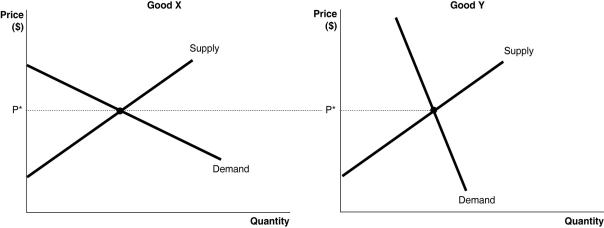 -Refer to Figure 4-19. The figure above illustrates the markets for two goods, Good X and Good Y. Suppose an identical dollar tax is imposed on sellers in each market.
a. Compare the consumer burden and producer burden in each market. Illustrate your answer graphically.
b. If the goal of the government is to raise revenue with minimum impact to quantity consumed, in which market should the tax be imposed?
c. If the goal of the government is to discourage consumption, in which market should the tax be imposed?
-Refer to Figure 4-19. The figure above illustrates the markets for two goods, Good X and Good Y. Suppose an identical dollar tax is imposed on sellers in each market.
a. Compare the consumer burden and producer burden in each market. Illustrate your answer graphically.
b. If the goal of the government is to raise revenue with minimum impact to quantity consumed, in which market should the tax be imposed?
c. If the goal of the government is to discourage consumption, in which market should the tax be imposed? (Essay)
4.8/5 (90)
(90) Government intervention in agricultural markets in the U.S. began in the
(Multiple Choice)
4.7/5 (85)
(85) Figure 4-14 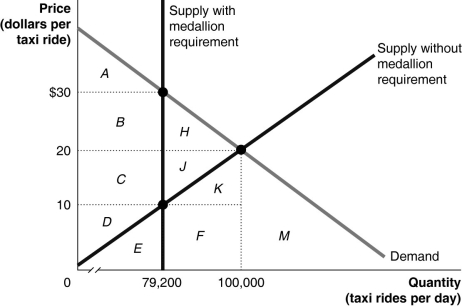 Figure 4-14 shows the market for taxi rides. The following question(s) are based on this figure.
-Refer to Figure 4-14. To legally drive a taxicab in New York City, you must have a medallion issued by the city government. Assume that only 13,200 medallions have been issued. Let's also assume this puts an absolute limit on the number of taxi rides that can be supplied in New York City on any day, because no one breaks the law by driving a taxi without a medallion. Assume as well that each taxi provides 6 trips per day. In that case, the quantity of taxi rides supplied is 79,200 (or 6 rides per taxi × 13,200 taxis). This is shown in the diagram with a vertical line at this quantity. Assume that there are no government controls on the prices that drivers can charge for rides.
a. What would the equilibrium price and quantity be in this market if there was no medallion requirement?
b. If there was no medallion requirement, indicate the area that represents consumer surplus.
c. If there was no medallion requirement, indicate the area that represents producer surplus.
d. If there was no medallion requirement, indicate the area that represents economic surplus.
e. What are the price and quantity with the medallion requirement?
f. With a medallion requirement in place, what area represents consumer surplus?
g. With a medallion requirement in place, what area represents producer surplus?
h. With a medallion requirement in place, what area represents the deadweight loss?
i. Based on your answers to parts (c) and (g), are taxicab drivers better off with the medallion requirement for taxicabs than without?
j. Are consumers better off with or without the medallion requirement for taxicabs?
Figure 4-14 shows the market for taxi rides. The following question(s) are based on this figure.
-Refer to Figure 4-14. To legally drive a taxicab in New York City, you must have a medallion issued by the city government. Assume that only 13,200 medallions have been issued. Let's also assume this puts an absolute limit on the number of taxi rides that can be supplied in New York City on any day, because no one breaks the law by driving a taxi without a medallion. Assume as well that each taxi provides 6 trips per day. In that case, the quantity of taxi rides supplied is 79,200 (or 6 rides per taxi × 13,200 taxis). This is shown in the diagram with a vertical line at this quantity. Assume that there are no government controls on the prices that drivers can charge for rides.
a. What would the equilibrium price and quantity be in this market if there was no medallion requirement?
b. If there was no medallion requirement, indicate the area that represents consumer surplus.
c. If there was no medallion requirement, indicate the area that represents producer surplus.
d. If there was no medallion requirement, indicate the area that represents economic surplus.
e. What are the price and quantity with the medallion requirement?
f. With a medallion requirement in place, what area represents consumer surplus?
g. With a medallion requirement in place, what area represents producer surplus?
h. With a medallion requirement in place, what area represents the deadweight loss?
i. Based on your answers to parts (c) and (g), are taxicab drivers better off with the medallion requirement for taxicabs than without?
j. Are consumers better off with or without the medallion requirement for taxicabs? (Essay)
4.9/5 (94)
(94) The total amount of producer surplus in a market is equal to the area above the market supply curve and below the market price.
(True/False)
4.9/5 (88)
(88) Figure 4-5  -Refer to Figure 4-5. The figure above represents the market for pecans. Assume that this is a competitive market. If the price of pecans is $3, what changes in the market would result in an economically efficient output?
 (Multiple Choice)
4.9/5 (85)
(85) Table 4-8
 Table 4-8 shows the demand and supply schedules for the low-skilled labor market in the city of Westover.
-Refer to Table 4-8. If a minimum wage of $10.00 is mandated there will be a
Table 4-8 shows the demand and supply schedules for the low-skilled labor market in the city of Westover.
-Refer to Table 4-8. If a minimum wage of $10.00 is mandated there will be a (Multiple Choice)
4.9/5 (74)
(74) Which of the following describes the difference between "scarcity" and "shortage"?
(Multiple Choice)
4.8/5 (83)
(83) Table 4-7
 Table 4-7 shows the demand and supply schedules for the labor market in the city of Pixley.
-Refer to Table 4-7. Suppose that the quantity of labor supplied increases by 40,000 at each wage level. What are the new free market equilibrium hourly wage and the new equilibrium quantity of labor?
Table 4-7 shows the demand and supply schedules for the labor market in the city of Pixley.
-Refer to Table 4-7. Suppose that the quantity of labor supplied increases by 40,000 at each wage level. What are the new free market equilibrium hourly wage and the new equilibrium quantity of labor? (Multiple Choice)
4.9/5 (90)
(90) Which of the following is a result of imposing a rent ceiling?
(Multiple Choice)
4.8/5 (83)
(83) If the price of hairspray is represented by P in the equation P = 10 - 0.2 QD, then the corresponding quantity of hairspray demanded is represented by the demand equation
(Multiple Choice)
4.9/5 (80)
(80) Figure 4-8  Figure 4-8 shows the market for apartments in Springfield. Recently, the government imposed a rent ceiling of $1,000 per month.
-Refer to Figure 4-8. What is the value of the portion of producer surplus transferred to consumers as a result of the rent ceiling?
Figure 4-8 shows the market for apartments in Springfield. Recently, the government imposed a rent ceiling of $1,000 per month.
-Refer to Figure 4-8. What is the value of the portion of producer surplus transferred to consumers as a result of the rent ceiling? (Multiple Choice)
4.9/5 (78)
(78) In the economic sense, almost everything is scarce. ________ of a good or service occurs when the quantity demanded is greater than the quantity supplied at the current market price.
(Multiple Choice)
4.9/5 (88)
(88) Figure 4-18  Figure 4-18 shows the market for cigarettes. The government plans to impose a per-unit tax in this market.
-Refer to Figure 4-18. How much of the tax is paid by producers?
Figure 4-18 shows the market for cigarettes. The government plans to impose a per-unit tax in this market.
-Refer to Figure 4-18. How much of the tax is paid by producers? (Multiple Choice)
4.9/5 (78)
(78) Figure 4-8 Figure 4-8 shows the market for apartments in Springfield. Recently, the government imposed a rent ceiling of $1,000 per month.
-Refer to Figure 4-8. Suppose that instead of a rent ceiling, the government imposed a price floor of $2,000 per month for apartments. What is the value of the deadweight loss after the imposition of the price floor?
Figure 4-8 shows the market for apartments in Springfield. Recently, the government imposed a rent ceiling of $1,000 per month.
-Refer to Figure 4-8. Suppose that instead of a rent ceiling, the government imposed a price floor of $2,000 per month for apartments. What is the value of the deadweight loss after the imposition of the price floor? (Multiple Choice)
4.9/5 (80)
(80) 
Filters
- Essay(0)
- Multiple Choice(0)
- Short Answer(0)
- True False(0)
- Matching(0)