



 Chat with AI
Exam 4: Economic Efficiency, Government Price Setting, and Taxes

Exam 1: Economics: Foundations and Models459 Questions
Exam 2: Trade-Offs, Comparative Advantage, and the Market System492 Questions
Exam 3: Where Prices Come From: the Interaction of Demand and Supply476 Questions
Exam 4: Economic Efficiency, Government Price Setting, and Taxes420 Questions
Exam 5: Externalities, Environmental Policy, and Public Goods262 Questions
Exam 6: Elasticity: the Responsiveness of Demand and Supply293 Questions
Exam 7: The Economics of Health Care337 Questions
Exam 8: Firms, the Stock Market, and Corporate Governance512 Questions
Exam 9: Comparative Advantage and the Gains From International Trade377 Questions
Exam 10: Consumer Choice and Behavioral Economics304 Questions
Exam 11: Technology, Production, and Costs326 Questions
Exam 12: Firms in Perfectly Competitive Markets296 Questions
Exam 13: Monopolistic Competition: the Competitive Model in a More Realistic Setting272 Questions
Exam 14: Oligopoly: Firms in Less Competitive Markets256 Questions
Exam 15: Monopoly and Antitrust Policy279 Questions
Exam 16: Pricing Strategy258 Questions
Exam 17: The Markets for Labor and Other Factors of Production279 Questions
Exam 18: Public Choice, Taxes, and the Distribution of Income258 Questions
Exam 19: Gdp: Measuring Total Production and Income260 Questions
Exam 20: Unemployment and Inflation290 Questions
Exam 21: Economic Growth, the Financial System, and Business Cycles251 Questions
Exam 22: Long-Run Economic Growth: Sources and Policies261 Questions
Exam 23: Aggregate Expenditure and Output in the Short Run305 Questions
Exam 24: Aggregate Demand and Aggregate Supply Analysis286 Questions
Exam 25: Money, Banks, and the Federal Reserve System278 Questions
Exam 26: Monetary Policy280 Questions
Exam 27: Fiscal Policy313 Questions
Exam 28: Inflation, Unemployment, and Federal Reserve Policy257 Questions
Exam 29: Macroeconomics in an Open Economy277 Questions
Exam 30: The International Financial System258 Questions
Select questions type


In Venezuela, the government has implemented price controls on cornmeal, and the resulting shortage created a black market for the product. When compared to the competitive equilibrium, this situation has resulted in a transfer of ________ to black market sellers.
(Multiple Choice)
4.9/5  (80)
(80) Figure 4-5  -Refer to Figure 4-5. The figure above represents the market for pecans. Assume that this is a competitive market. If the price of pecans is $9
 (Multiple Choice)
5.0/5 (68)
(68) If the quantity of jelly beans supplied is represented by the equation QS = -20 + 4P then the corresponding price of jelly beans is represented by the equation
(Multiple Choice)
4.7/5 (76)
(76) Table 4-12
 -Refer to Table 4-12. The equations above describe the demand and supply for Bubba's Fried Jellybeans. The equilibrium price and quantity for Bubba's Fried Jellybeans are $40 and 5 thousand units. What is the value of economic surplus in this market?
 (Multiple Choice)
4.9/5 (91)
(91) Table 4-5
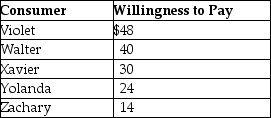 -Refer to Table 4-5. The table above lists the highest prices five consumers are willing to pay for a concert ticket. If the price of one of the tickets is $20,
 (Multiple Choice)
4.8/5 (78)
(78) Table 4-3
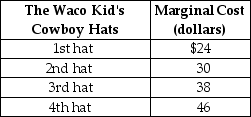 -Refer to Table 4-3. The table above lists the marginal cost of cowboy hats by The Waco Kid, a firm that specializes in producing western wear. If the market price of cowboy hats is $50, how many hats will be produced?
 (Multiple Choice)
4.7/5 (72)
(72) The government proposes a tax on imported champagne. Buyers will bear the entire burden of the tax if the
(Multiple Choice)
4.9/5 (66)
(66) Figure 4-18  Figure 4-18 shows the market for cigarettes. The government plans to impose a per-unit tax in this market.
-Refer to Figure 4-18. The price buyers pay after the tax is
Figure 4-18 shows the market for cigarettes. The government plans to impose a per-unit tax in this market.
-Refer to Figure 4-18. The price buyers pay after the tax is (Multiple Choice)
4.9/5 (85)
(85) Figure 4-2 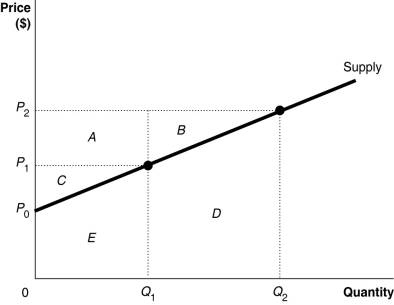 -Refer to Figure 4-2. What area represents producer surplus at a price of P1?
 (Multiple Choice)
4.9/5 (66)
(66) Figure 4-11  Figure 4-11 shows the demand and supply curves for the coffee market. The government believes that the equilibrium price is too low and tries to help almond growers by setting a price floor at $7.00.
-Refer to Figure 4-11. What is the value of producer surplus after the imposition of the price floor?
Figure 4-11 shows the demand and supply curves for the coffee market. The government believes that the equilibrium price is too low and tries to help almond growers by setting a price floor at $7.00.
-Refer to Figure 4-11. What is the value of producer surplus after the imposition of the price floor? (Multiple Choice)
4.9/5 (71)
(71) Figure 4-10  Figure 4-10 shows the market for apartments in Bay City. Recently, the government imposed a rent ceiling at R0.
-Refer to Figure 4-10. Suppose that instead of a price ceiling, the government imposed a price floor of R1. What is the area representing producer surplus after the imposition of the price floor?
Figure 4-10 shows the market for apartments in Bay City. Recently, the government imposed a rent ceiling at R0.
-Refer to Figure 4-10. Suppose that instead of a price ceiling, the government imposed a price floor of R1. What is the area representing producer surplus after the imposition of the price floor? (Multiple Choice)
4.9/5 (70)
(70) If the quantity of tacos demanded is represented by the equation QD = 20 - 0.5P then the corresponding price of tacos is represented by the equation
(Multiple Choice)
4.9/5 (80)
(80) Table 4-7
 Table 4-7 shows the demand and supply schedules for the labor market in the city of Pixley.
-Refer to Table 4-7. What is the equilibrium hourly wage (W*) and the equilibrium quantity of labor (Q*)?
Table 4-7 shows the demand and supply schedules for the labor market in the city of Pixley.
-Refer to Table 4-7. What is the equilibrium hourly wage (W*) and the equilibrium quantity of labor (Q*)? (Multiple Choice)
4.8/5 (74)
(74) Figure 4-15  Figure 4-15 shows the market for beer. The government plans to impose a per-unit tax in this market.
-Refer to Figure 4-15. For each unit sold, the price sellers receive after the tax (net of tax) is
Figure 4-15 shows the market for beer. The government plans to impose a per-unit tax in this market.
-Refer to Figure 4-15. For each unit sold, the price sellers receive after the tax (net of tax) is (Multiple Choice)
4.7/5 (84)
(84) The graph below represents the market for lychee nuts. The equilibrium price is $7.00 per bushel, but the market price is $5.00 per bushel. Identify the areas representing consumer surplus, producer surplus, and deadweight loss at the equilibrium price of $7.00 and at the market price of $5.00. 
(Essay)
4.8/5 (69)
(69) Figure 4-18 Figure 4-18 shows the market for cigarettes. The government plans to impose a per-unit tax in this market.
-Refer to Figure 4-18. What is the size of the per-unit tax?
Figure 4-18 shows the market for cigarettes. The government plans to impose a per-unit tax in this market.
-Refer to Figure 4-18. What is the size of the per-unit tax? (Multiple Choice)
4.9/5 (83)
(83) Figure 4-11 Figure 4-11 shows the demand and supply curves for the coffee market. The government believes that the equilibrium price is too low and tries to help almond growers by setting a price floor at $7.00.
-Refer to Figure 4-11. What is the value of consumer surplus after the imposition of the price floor?
Figure 4-11 shows the demand and supply curves for the coffee market. The government believes that the equilibrium price is too low and tries to help almond growers by setting a price floor at $7.00.
-Refer to Figure 4-11. What is the value of consumer surplus after the imposition of the price floor? (Multiple Choice)
4.9/5 (88)
(88) Consumer surplus is the difference between the highest price someone is willing to pay for a product and the price he actually pays for the product.
(True/False)
4.9/5 (77)
(77) The additional cost to a firm of producing one more unit of a good or service is equal to producer surplus.
(True/False)
4.8/5 (73)
(73) 
Filters
- Essay(0)
- Multiple Choice(0)
- Short Answer(0)
- True False(0)
- Matching(0)