



 Chat with AI
Exam 10: Consumer Choice and Behavioral Economics

Exam 1: Economics: Foundations and Models459 Questions
Exam 2: Trade-Offs, Comparative Advantage, and the Market System492 Questions
Exam 3: Where Prices Come From: the Interaction of Demand and Supply476 Questions
Exam 4: Economic Efficiency, Government Price Setting, and Taxes420 Questions
Exam 5: Externalities, Environmental Policy, and Public Goods262 Questions
Exam 6: Elasticity: the Responsiveness of Demand and Supply293 Questions
Exam 7: The Economics of Health Care337 Questions
Exam 8: Firms, the Stock Market, and Corporate Governance512 Questions
Exam 9: Comparative Advantage and the Gains From International Trade377 Questions
Exam 10: Consumer Choice and Behavioral Economics304 Questions
Exam 11: Technology, Production, and Costs326 Questions
Exam 12: Firms in Perfectly Competitive Markets296 Questions
Exam 13: Monopolistic Competition: the Competitive Model in a More Realistic Setting272 Questions
Exam 14: Oligopoly: Firms in Less Competitive Markets256 Questions
Exam 15: Monopoly and Antitrust Policy279 Questions
Exam 16: Pricing Strategy258 Questions
Exam 17: The Markets for Labor and Other Factors of Production279 Questions
Exam 18: Public Choice, Taxes, and the Distribution of Income258 Questions
Exam 19: Gdp: Measuring Total Production and Income260 Questions
Exam 20: Unemployment and Inflation290 Questions
Exam 21: Economic Growth, the Financial System, and Business Cycles251 Questions
Exam 22: Long-Run Economic Growth: Sources and Policies261 Questions
Exam 23: Aggregate Expenditure and Output in the Short Run305 Questions
Exam 24: Aggregate Demand and Aggregate Supply Analysis286 Questions
Exam 25: Money, Banks, and the Federal Reserve System278 Questions
Exam 26: Monetary Policy280 Questions
Exam 27: Fiscal Policy313 Questions
Exam 28: Inflation, Unemployment, and Federal Reserve Policy257 Questions
Exam 29: Macroeconomics in an Open Economy277 Questions
Exam 30: The International Financial System258 Questions
Select questions type


Why might network externalities result in products that contain inferior technologies?
(Essay)
4.8/5  (97)
(97) Table 10-2
 Table 10-2 above shows Keira's utility from soup and sandwiches. The price of soup is $2 per cup and the price of a sandwich is $3. Keira has $18 to spend on these two goods.
-Refer to Table 10-2. If Keira maximizes her utility, how many units of each good should she buy?
Table 10-2 above shows Keira's utility from soup and sandwiches. The price of soup is $2 per cup and the price of a sandwich is $3. Keira has $18 to spend on these two goods.
-Refer to Table 10-2. If Keira maximizes her utility, how many units of each good should she buy? (Multiple Choice)
4.9/5 (73)
(73) Economists usually assume that people act in a rational, self-interested way. In explaining how consumers make choices this means that economists believe
(Multiple Choice)
4.8/5 (87)
(87) Maurice Allais, Reinhard Selten, and Vernon Smith all were awarded the Nobel Prize in Economics in part because
(Multiple Choice)
4.9/5 (84)
(84) In order to derive an individual's demand curve for salmon, we would observe what happens to the utility-maximizing bundle when we change
(Multiple Choice)
4.8/5 (94)
(94) If a consumer receives 20 units of utility from consuming two candy bars, and 25 units of utility from consuming three candy bars, the marginal utility of the second candy bar is
(Multiple Choice)
4.8/5 (91)
(91) Which of the following describes the substitution effect of a price change?
(Multiple Choice)
4.8/5 (87)
(87) Figure 10-7  The above panels show various combinations of indifference curves and budget constraints for two products: Popcorn and Candy.
-Refer to Figure 10-7. A change in the price of candy only is shown in
The above panels show various combinations of indifference curves and budget constraints for two products: Popcorn and Candy.
-Refer to Figure 10-7. A change in the price of candy only is shown in (Multiple Choice)
4.9/5 (77)
(77) Eliza consumes 12 cappuccinos and 8 apple turnovers per week. The price of a cappuccino is $4 each and apple turnovers are $1 each.
a. What is the amount of income allocated to cappuccino and apple turnover consumption?
b. What is the price ratio (the price of cappuccinos relative to the price of apple turnovers)?
c. Explain the meaning of the price ratio you computed.
d. If Eliza maximize utility, what is the ratio of the marginal utility of cappuccinos to the marginal utility of apple turnovers?
e. If the price of apple turnovers falls, will Eliza consume more apple turnovers, fewer apple turnovers, or the same amount of apple turnovers? Explain your answer using the rule of equal marginal utility per dollar.
(Essay)
4.8/5 (71)
(71) Figure 10-1 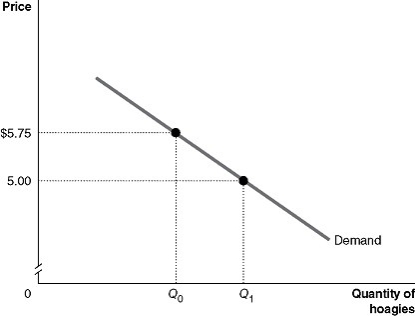 -Refer to Figure 10-1. When the price of hoagies increases from $5.00 to $5.75, quantity demanded decreases from Q1 to Q0. This change in quantity demanded is due to
 (Multiple Choice)
4.9/5 (72)
(72) In the utility maximizing model, consumer preferences are assumed to be transitive. What does this mean?
(Multiple Choice)
4.9/5 (68)
(68) Alan Krueger conducted a survey of fans at the 2001 Super Bowl who purchased tickets to the game for $325 or $400. Krueger found that (a) 94 percent of those surveyed would not have paid $3,000 for their tickets, and (b) 92 percent of those surveyed would not have sold their tickets for $3,000. These results are an example of
(Multiple Choice)
5.0/5 (81)
(81) Suppose the consumer's income increases while the prices of the goods remain constant. Then the
(Multiple Choice)
4.8/5 (86)
(86) Consumers maximize total utility within their budget constraint by
(Multiple Choice)
4.9/5 (76)
(76) You participate in a taste test for a new protein supplement called "Kapow." You are given five consecutive one ounce vials of the supplement and after consuming each vial you are asked to note your reaction. You consume the first vial and your response is: "Hmmm, quite good!" After the second, you say, "Not bad at all." After the third, you note, "It's alright." and after the fourth you wince, "No more, the after-taste is getting to me. I need water." What economic principle does this scenario illustrate? Define the principle.
(Essay)
5.0/5 (85)
(85) The order of the letters along the rows of computer keyboards could be changed to allow users to type faster, but this would inconvenience the vast majority of people who learned to type with the current keyboard layout. The costs of switching to a new layout make this change unlikely. This is an example of
(Multiple Choice)
4.8/5 (86)
(86) What is the common feature displayed by the following items?
a. eating at a newly opened "fusion" cuisine restaurant
b. attending a Red Sox game in Fenway Park
c. wearing Lucky Brand designer jeans
(Multiple Choice)
4.8/5 (82)
(82) 
Filters
- Essay(0)
- Multiple Choice(0)
- Short Answer(0)
- True False(0)
- Matching(0)