



 Chat with AI
Exam 10: Consumer Choice and Behavioral Economics

Exam 1: Economics: Foundations and Models459 Questions
Exam 2: Trade-Offs, Comparative Advantage, and the Market System492 Questions
Exam 3: Where Prices Come From: the Interaction of Demand and Supply476 Questions
Exam 4: Economic Efficiency, Government Price Setting, and Taxes420 Questions
Exam 5: Externalities, Environmental Policy, and Public Goods262 Questions
Exam 6: Elasticity: the Responsiveness of Demand and Supply293 Questions
Exam 7: The Economics of Health Care337 Questions
Exam 8: Firms, the Stock Market, and Corporate Governance512 Questions
Exam 9: Comparative Advantage and the Gains From International Trade377 Questions
Exam 10: Consumer Choice and Behavioral Economics304 Questions
Exam 11: Technology, Production, and Costs326 Questions
Exam 12: Firms in Perfectly Competitive Markets296 Questions
Exam 13: Monopolistic Competition: the Competitive Model in a More Realistic Setting272 Questions
Exam 14: Oligopoly: Firms in Less Competitive Markets256 Questions
Exam 15: Monopoly and Antitrust Policy279 Questions
Exam 16: Pricing Strategy258 Questions
Exam 17: The Markets for Labor and Other Factors of Production279 Questions
Exam 18: Public Choice, Taxes, and the Distribution of Income258 Questions
Exam 19: Gdp: Measuring Total Production and Income260 Questions
Exam 20: Unemployment and Inflation290 Questions
Exam 21: Economic Growth, the Financial System, and Business Cycles251 Questions
Exam 22: Long-Run Economic Growth: Sources and Policies261 Questions
Exam 23: Aggregate Expenditure and Output in the Short Run305 Questions
Exam 24: Aggregate Demand and Aggregate Supply Analysis286 Questions
Exam 25: Money, Banks, and the Federal Reserve System278 Questions
Exam 26: Monetary Policy280 Questions
Exam 27: Fiscal Policy313 Questions
Exam 28: Inflation, Unemployment, and Federal Reserve Policy257 Questions
Exam 29: Macroeconomics in an Open Economy277 Questions
Exam 30: The International Financial System258 Questions
Select questions type


Figure 10-1 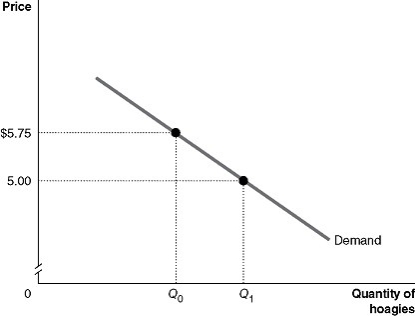 -Refer to Figure 10-1. Which of the following statements is true?
 (Multiple Choice)
4.8/5  (68)
(68) List three reasons why the demand for a product will often increase if the product is endorsed by a celebrity.
(Essay)
4.8/5 (87)
(87) A study discussed in the Making the Connection feature in the text found that there is ________ that some consumers are not well aware of prices, even for goods they buy regularly.
(Multiple Choice)
4.9/5 (84)
(84) Figure 10-8  Manuri has $300 to spend on Pilates classes and Yoga classes. The price of a group Pilates class is $20 and the price of a group Yoga class is $10. Manuri's optimal bundle is given by "A" in Figure 10-8.
-Refer to Figure 10-8. Suppose the price of Pilates sessions rise to $30 while income and the price of Yoga sessions remain unchanged. The substitution effect of this price change is represented by the movement from
Manuri has $300 to spend on Pilates classes and Yoga classes. The price of a group Pilates class is $20 and the price of a group Yoga class is $10. Manuri's optimal bundle is given by "A" in Figure 10-8.
-Refer to Figure 10-8. Suppose the price of Pilates sessions rise to $30 while income and the price of Yoga sessions remain unchanged. The substitution effect of this price change is represented by the movement from (Multiple Choice)
4.8/5 (69)
(69) All but one of the following have been suggested by some economists as possible consequences of path dependency and switching costs. Which of the following is not a possible consequence of path dependency and switching costs?
(Multiple Choice)
4.8/5 (70)
(70) In 2016, the most profit from the musical Hamilton went to
(Multiple Choice)
4.9/5 (76)
(76) Figure 10-7  The above panels show various combinations of indifference curves and budget constraints for two products: Popcorn and Candy.
-Refer to Figure 10-7. A change in income is shown in
The above panels show various combinations of indifference curves and budget constraints for two products: Popcorn and Candy.
-Refer to Figure 10-7. A change in income is shown in (Multiple Choice)
4.9/5 (83)
(83) Lilly Davis has $5 per week to spend on any combination of ice cream and candy. The price of an ice cream cone is $2 and the price of a candy bar is $1. The table below shows Lilly's utility values. Use the table to answer the questions that follow the table.
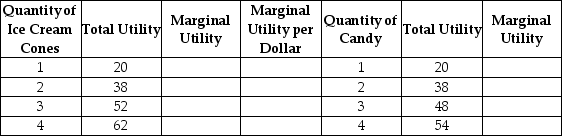 a. Complete the table by filling in the blank spaces.
b. Suppose Lilly purchases 2 ice cream cones and 1 candy bar. Is she consuming the optimal consumption bundle? If so, explain why. If not, what combination should she buy and why?
a. Complete the table by filling in the blank spaces.
b. Suppose Lilly purchases 2 ice cream cones and 1 candy bar. Is she consuming the optimal consumption bundle? If so, explain why. If not, what combination should she buy and why? (Essay)
4.9/5 (77)
(77) Harvey Miller owns a baseball that was hit for a home run by Ted Williams. Harvey, a long-time Boston Red Sox fan, recently refused to sell his baseball for $75,000 even though he would not have paid someone more than $10,000 for the baseball if he did not already own it. Harvey explained his decision not to sell the baseball by noting that: "Ted Williams was my hero. This baseball has a great deal of sentimental value for me." Which of the following can explain Harvey's behavior?
(Multiple Choice)
4.9/5 (81)
(81) Table 10-6
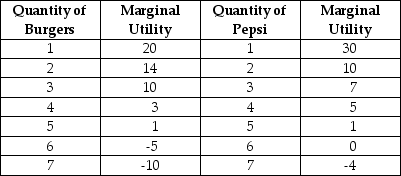 Table 10-6 lists Jay's marginal utilities for burgers and Pepsi. Jay has $7 to spend on these two goods. The price of a burger is $2 and the price of a can of Pepsi is $1.
-Refer to Table 10-6. What is Jay's optimal consumption bundle?
Table 10-6 lists Jay's marginal utilities for burgers and Pepsi. Jay has $7 to spend on these two goods. The price of a burger is $2 and the price of a can of Pepsi is $1.
-Refer to Table 10-6. What is Jay's optimal consumption bundle? (Multiple Choice)
4.8/5 (87)
(87) Farah has $100 to spend each month on bread and chicken. Suppose the price of bread is $4 a loaf and the price of chicken is $5 per pound.
a. Draw her budget constraint and label it BC0. Put bread on the horizontal axis and chicken on the vertical axis. Be sure to identify the intercept values.
b. Suppose Farah is a utility maximizer and she consumes 10 loaves of bread and 12 pounds of chicken. On the same graph you drew in part (a), draw an indifference curve to identify her optimal bundle. Label this bundle "E."
c. Is her budget exhausted? Verify your answer.
d. Now suppose Farah's income falls to so that she can now devote $80 to the two goods. Prices however remain unchanged. In the same diagram, graph her new budget constraint and label it BC1. Be sure to identify any new intercept values.
e. Following the change in income, can Farah consume the same bundle "E"? Explain your answer.
f. What must happen to her total utility following the decrease in her income?
(Essay)
4.9/5 (80)
(80) If total utility increases at a decreasing rate as a consumer consumes more coffee, then marginal utility must
(Multiple Choice)
4.9/5 (84)
(84) Table 10-6
Table 10-6 lists Jay's marginal utilities for burgers and Pepsi. Jay has $7 to spend on these two goods. The price of a burger is $2 and the price of a can of Pepsi is $1.
-Refer to Table 10-6. If Jay can eat all the burgers he wants for free, how many burgers will he consume?
Table 10-6 lists Jay's marginal utilities for burgers and Pepsi. Jay has $7 to spend on these two goods. The price of a burger is $2 and the price of a can of Pepsi is $1.
-Refer to Table 10-6. If Jay can eat all the burgers he wants for free, how many burgers will he consume? (Multiple Choice)
4.8/5 (78)
(78) An economist observes two consumers in a supermarket. One of the consumers buys a case of Coca-Cola and the other buys a case of Pepsi-Cola. Both colas sell for the same price and the ages and incomes of the consumers are also the same. Based on this information, how would the economist explain the consumers' choices?
(Multiple Choice)
4.9/5 (81)
(81) A consumer maximizes her total utility from a bundle of goods when her marginal utility from each good is equal.
(True/False)
4.9/5 (77)
(77) Table 10-5
 -Refer to Table 10-5, which lists the values of Harry Taber's marginal utility and marginal utility per dollar for Italian submarine (sub) sandwiches and tacos. Assume that the price of a sub sandwich is $4 and the price of a taco is $2. When Harry's income is $14, he buys two Italian sub sandwiches and three tacos. The last column lists the values of the marginal utility per dollar for tacos when the price of a taco decreases to $1. Complete this statement: As a result of the change in price
 (Multiple Choice)
4.9/5 (67)
(67) Figure 10-6  -Refer to Figure 10-6. Which of the following statements is true?
 (Multiple Choice)
4.9/5 (75)
(75) An increase in income results in an outward shift of an indifference curve.
(True/False)
4.9/5 (75)
(75) 
Filters
- Essay(0)
- Multiple Choice(0)
- Short Answer(0)
- True False(0)
- Matching(0)