



 Chat with AI
Exam 10: Consumer Choice and Behavioral Economics

Exam 1: Economics: Foundations and Models459 Questions
Exam 2: Trade-Offs, Comparative Advantage, and the Market System492 Questions
Exam 3: Where Prices Come From: the Interaction of Demand and Supply476 Questions
Exam 4: Economic Efficiency, Government Price Setting, and Taxes420 Questions
Exam 5: Externalities, Environmental Policy, and Public Goods262 Questions
Exam 6: Elasticity: the Responsiveness of Demand and Supply293 Questions
Exam 7: The Economics of Health Care337 Questions
Exam 8: Firms, the Stock Market, and Corporate Governance512 Questions
Exam 9: Comparative Advantage and the Gains From International Trade377 Questions
Exam 10: Consumer Choice and Behavioral Economics304 Questions
Exam 11: Technology, Production, and Costs326 Questions
Exam 12: Firms in Perfectly Competitive Markets296 Questions
Exam 13: Monopolistic Competition: the Competitive Model in a More Realistic Setting272 Questions
Exam 14: Oligopoly: Firms in Less Competitive Markets256 Questions
Exam 15: Monopoly and Antitrust Policy279 Questions
Exam 16: Pricing Strategy258 Questions
Exam 17: The Markets for Labor and Other Factors of Production279 Questions
Exam 18: Public Choice, Taxes, and the Distribution of Income258 Questions
Exam 19: Gdp: Measuring Total Production and Income260 Questions
Exam 20: Unemployment and Inflation290 Questions
Exam 21: Economic Growth, the Financial System, and Business Cycles251 Questions
Exam 22: Long-Run Economic Growth: Sources and Policies261 Questions
Exam 23: Aggregate Expenditure and Output in the Short Run305 Questions
Exam 24: Aggregate Demand and Aggregate Supply Analysis286 Questions
Exam 25: Money, Banks, and the Federal Reserve System278 Questions
Exam 26: Monetary Policy280 Questions
Exam 27: Fiscal Policy313 Questions
Exam 28: Inflation, Unemployment, and Federal Reserve Policy257 Questions
Exam 29: Macroeconomics in an Open Economy277 Questions
Exam 30: The International Financial System258 Questions
Select questions type


The ultimatum game and the dictator game are used in economic experiments to test whether fairness is an important influence on consumer decision-making.
(True/False)
4.7/5  (84)
(84) The quantity of tickets demanded to the Super Bowl is always greater than the quantity supplied. Which of the following in the best explanation why the National Football League does not raise the price of tickets to the level where the quantity demanded equals the quantity supplied?
(Multiple Choice)
4.9/5 (72)
(72) Suppose Renee can increase her total utility from consuming video rentals and books by buying one more book and renting one fewer video. Which of the following is true?
(Multiple Choice)
5.0/5 (87)
(87) The income effect of a price increase causes a decrease in the quantity of a normal good demanded.
(True/False)
4.8/5 (76)
(76) Consider a downward-sloping demand curve. When the price of a normal good decreases, the income and substitution effects
(Multiple Choice)
4.7/5 (84)
(84) Alan Krueger conducted a survey of fans at the 2001 Super Bowl who purchased tickets to the game for $325 or $400. Krueger found that (a) 94 percent of those surveyed would not have paid $3,000 for their tickets, and (b) 92 percent of those surveyed would not have sold their tickets for $3,000. These results are an example of
(Multiple Choice)
4.9/5 (80)
(80) Economists have shown that when the ultimatum game experiment is carried out, both allocators and recipients act as if fairness is important.
(True/False)
4.9/5 (84)
(84) Figure 10-10  -Refer to Figure 10-10. If the consumer has $240 to spend on DVDs and CDs, what is the price of a DVD if the budget constraint is BC1?
 (Multiple Choice)
4.8/5 (74)
(74) Wilbur Rickhiser, a financial advisor, recently told one of his clients: "The biggest mistake you can make is to hold onto a stock for too long in order to avoid a loss. Let's say you bought a stock for $50 per share but that six months later the price fell to $40 after a poor earnings report. Many of my clients in this situation will hold the stock, hoping the price will later rise above $50. In most cases like this the price does not rise and may even fall. You must know when to cut your losses." Which of the following is the best explanation for Rickhiser's advice?
(Multiple Choice)
4.9/5 (78)
(78) Firms that automatically enroll their employees in retirement plans, giving them the option to opt-out instead of to opt-in, is an example of a form of behavioral economics known as
(Multiple Choice)
4.9/5 (74)
(74) Figure 10-10
-Refer to Figure 10-10. If the consumer has $240 to spend on DVDs and CDs, what is the price of a CD if the budget constraint is BC2?
-Refer to Figure 10-10. If the consumer has $240 to spend on DVDs and CDs, what is the price of a CD if the budget constraint is BC2? (Multiple Choice)
4.8/5 (93)
(93) If Dawson prefers pizza to hamburgers and hamburgers to hot dogs, then if preferences are transitive
(Multiple Choice)
4.9/5 (87)
(87) Arnie Ziffel has $20 per week to spend on any combination of pineapples and green tea. The price of a pineapple is $4 and the price of a bottle of green tea is $2. The table below shows Arnie's utility values. Use the table to answer the questions that follow the table.
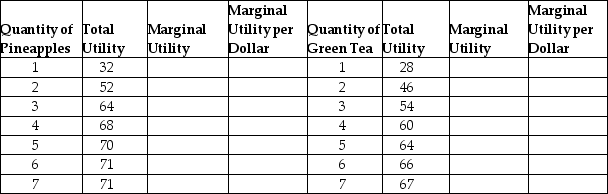 a. Complete the table by filling in the blank spaces.
b. Suppose Arnold purchases 4 pineapples and 2 bottles of green tea. Is he consuming the optimal consumption bundle? If so, explain why. If not, what combination should he buy and why?
a. Complete the table by filling in the blank spaces.
b. Suppose Arnold purchases 4 pineapples and 2 bottles of green tea. Is he consuming the optimal consumption bundle? If so, explain why. If not, what combination should he buy and why? (Essay)
4.8/5 (71)
(71) Suppose Adam Einberg pays $100 for a ticket to a new Broadway play and $100 was the maximum price he was willing to pay. On the day of the performance of the play Adam refuses to sell the ticket for $150. How would behavioral economists explain Adam's refusal to sell his ticket?
(Multiple Choice)
4.8/5 (69)
(69) The substitution effect of a change in the price of cauliflower is the portion of the change in the quantity of cauliflower demanded that can be attributed to the change in the price of a substitute vegetable such as asparagus.
(True/False)
4.9/5 (67)
(67) A new area of economics studies situations in which people appear to be making choices that do not appear to be economically rational. This area is called
(Multiple Choice)
4.9/5 (101)
(101) Figure 10-5 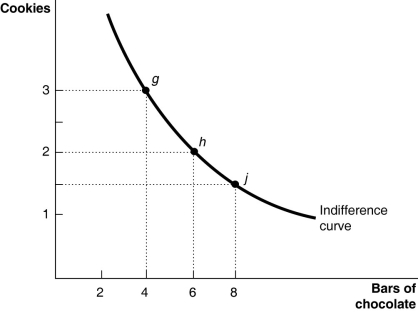 -Refer to Figure 10-5. What is the marginal rate of substitution for one bar of chocolate between g and h?
 (Multiple Choice)
4.7/5 (77)
(77) 
Filters
- Essay(0)
- Multiple Choice(0)
- Short Answer(0)
- True False(0)
- Matching(0)