



 Chat with AI
Exam 10: Consumer Choice and Behavioral Economics

Exam 1: Economics: Foundations and Models459 Questions
Exam 2: Trade-Offs, Comparative Advantage, and the Market System492 Questions
Exam 3: Where Prices Come From: the Interaction of Demand and Supply476 Questions
Exam 4: Economic Efficiency, Government Price Setting, and Taxes420 Questions
Exam 5: Externalities, Environmental Policy, and Public Goods262 Questions
Exam 6: Elasticity: the Responsiveness of Demand and Supply293 Questions
Exam 7: The Economics of Health Care337 Questions
Exam 8: Firms, the Stock Market, and Corporate Governance512 Questions
Exam 9: Comparative Advantage and the Gains From International Trade377 Questions
Exam 10: Consumer Choice and Behavioral Economics304 Questions
Exam 11: Technology, Production, and Costs326 Questions
Exam 12: Firms in Perfectly Competitive Markets296 Questions
Exam 13: Monopolistic Competition: the Competitive Model in a More Realistic Setting272 Questions
Exam 14: Oligopoly: Firms in Less Competitive Markets256 Questions
Exam 15: Monopoly and Antitrust Policy279 Questions
Exam 16: Pricing Strategy258 Questions
Exam 17: The Markets for Labor and Other Factors of Production279 Questions
Exam 18: Public Choice, Taxes, and the Distribution of Income258 Questions
Exam 19: Gdp: Measuring Total Production and Income260 Questions
Exam 20: Unemployment and Inflation290 Questions
Exam 21: Economic Growth, the Financial System, and Business Cycles251 Questions
Exam 22: Long-Run Economic Growth: Sources and Policies261 Questions
Exam 23: Aggregate Expenditure and Output in the Short Run305 Questions
Exam 24: Aggregate Demand and Aggregate Supply Analysis286 Questions
Exam 25: Money, Banks, and the Federal Reserve System278 Questions
Exam 26: Monetary Policy280 Questions
Exam 27: Fiscal Policy313 Questions
Exam 28: Inflation, Unemployment, and Federal Reserve Policy257 Questions
Exam 29: Macroeconomics in an Open Economy277 Questions
Exam 30: The International Financial System258 Questions
Select questions type


Economists have used ________ and ________ in experiments designed to determine whether consumers care about fairness when they make decisions.
(Multiple Choice)
4.9/5  (70)
(70) Which of the following is a common mistake consumers commit when they make decisions?
(Multiple Choice)
4.7/5 (73)
(73) A sunk cost is a cost that has already been paid and cannot be recovered.
(True/False)
4.9/5 (85)
(85) The income effect due to a price decrease will result in an increase in the quantity demanded for
(Multiple Choice)
4.9/5 (99)
(99) Suppose you pre-ordered a non-refundable movie ticket to Avengers: Infinity War. On the day of the movie you decide that you would rather not go to the movie. According to economists, what is the rational thing to do?
(Multiple Choice)
4.7/5 (75)
(75) The substitution effect of an increase in the price of peaches is
(Multiple Choice)
4.9/5 (75)
(75) During a study session for an economics exam with three other students, Peter Daltry commented on an example of a consumer who had to decide on number of slices of pizza and cups of Coca-Cola he would consume. Peter explained that "To maximize his utility this consumer must equate the marginal utility per dollar for pizza and Coca-Cola." Was Peter's analysis correct?
(Multiple Choice)
4.9/5 (93)
(93) Table 10-2
 Table 10-2 above shows Keira's utility from soup and sandwiches. The price of soup is $2 per cup and the price of a sandwich is $3. Keira has $18 to spend on these two goods.
-Refer to Table 10-2. Holding prices constant, when Keira's income changed from $18 to $23, what happens to her total utility and to the marginal utilities of the last cup of soup and the last sandwich purchased?
Table 10-2 above shows Keira's utility from soup and sandwiches. The price of soup is $2 per cup and the price of a sandwich is $3. Keira has $18 to spend on these two goods.
-Refer to Table 10-2. Holding prices constant, when Keira's income changed from $18 to $23, what happens to her total utility and to the marginal utilities of the last cup of soup and the last sandwich purchased? (Multiple Choice)
5.0/5 (76)
(76) There are two conditions necessary for a consumer to maximize her utility. One is that the marginal utilities per dollar spent on each good and service consumed are equal. What is the other condition?
(Multiple Choice)
4.9/5 (69)
(69) Table 10-2
Table 10-2 above shows Keira's utility from soup and sandwiches. The price of soup is $2 per cup and the price of a sandwich is $3. Keira has $18 to spend on these two goods.
-Refer to Table 10-2. What is Keira's marginal utility per dollar spent on the third cup of soup?
Table 10-2 above shows Keira's utility from soup and sandwiches. The price of soup is $2 per cup and the price of a sandwich is $3. Keira has $18 to spend on these two goods.
-Refer to Table 10-2. What is Keira's marginal utility per dollar spent on the third cup of soup? (Multiple Choice)
5.0/5 (78)
(78) The economic model of consumer behavior explains how consumers' tastes and preferences are formed.
(True/False)
4.8/5 (83)
(83) Goods with upward sloping demand curves are referred to as
(Multiple Choice)
4.9/5 (74)
(74) Most people would prefer to drive a luxury car that has all the options, but more people buy less expensive cars even though they could afford the luxury car because
(Multiple Choice)
4.8/5 (91)
(91) Figure 10-4 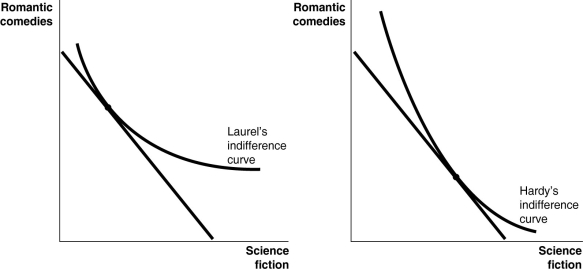 -Refer to Figure 10-4. Best friends Laurel and Hardy both enjoy watching romantic comedies and science fiction movies. Based on the diagrams above what can you conclude about their movie preferences?
 (Multiple Choice)
4.9/5 (90)
(90) Which of the following is used to explain why a consumer's willingness to buy a cell phone increases as the number of other people who own and use cell phones increases?
(Multiple Choice)
4.9/5 (70)
(70) One possible reason as to why consumers respond to sales is that by displaying a "high" regular price and a "low" sale price, sales provide consumers with a reference point to interpret the prices being offered.
(True/False)
4.8/5 (87)
(87) 
Filters
- Essay(0)
- Multiple Choice(0)
- Short Answer(0)
- True False(0)
- Matching(0)