



 Chat with AI
Exam 10: Consumer Choice and Behavioral Economics

Exam 1: Economics: Foundations and Models459 Questions
Exam 2: Trade-Offs, Comparative Advantage, and the Market System492 Questions
Exam 3: Where Prices Come From: the Interaction of Demand and Supply476 Questions
Exam 4: Economic Efficiency, Government Price Setting, and Taxes420 Questions
Exam 5: Externalities, Environmental Policy, and Public Goods262 Questions
Exam 6: Elasticity: the Responsiveness of Demand and Supply293 Questions
Exam 7: The Economics of Health Care337 Questions
Exam 8: Firms, the Stock Market, and Corporate Governance512 Questions
Exam 9: Comparative Advantage and the Gains From International Trade377 Questions
Exam 10: Consumer Choice and Behavioral Economics304 Questions
Exam 11: Technology, Production, and Costs326 Questions
Exam 12: Firms in Perfectly Competitive Markets296 Questions
Exam 13: Monopolistic Competition: the Competitive Model in a More Realistic Setting272 Questions
Exam 14: Oligopoly: Firms in Less Competitive Markets256 Questions
Exam 15: Monopoly and Antitrust Policy279 Questions
Exam 16: Pricing Strategy258 Questions
Exam 17: The Markets for Labor and Other Factors of Production279 Questions
Exam 18: Public Choice, Taxes, and the Distribution of Income258 Questions
Exam 19: Gdp: Measuring Total Production and Income260 Questions
Exam 20: Unemployment and Inflation290 Questions
Exam 21: Economic Growth, the Financial System, and Business Cycles251 Questions
Exam 22: Long-Run Economic Growth: Sources and Policies261 Questions
Exam 23: Aggregate Expenditure and Output in the Short Run305 Questions
Exam 24: Aggregate Demand and Aggregate Supply Analysis286 Questions
Exam 25: Money, Banks, and the Federal Reserve System278 Questions
Exam 26: Monetary Policy280 Questions
Exam 27: Fiscal Policy313 Questions
Exam 28: Inflation, Unemployment, and Federal Reserve Policy257 Questions
Exam 29: Macroeconomics in an Open Economy277 Questions
Exam 30: The International Financial System258 Questions
Select questions type


The absolute value of the slope of the budget constraint is equal to
(Multiple Choice)
4.8/5  (76)
(76) What happens to the absolute value of the marginal rate of substitution as you move down a convex (bowed toward the origin) indifference curve?
(Multiple Choice)
4.9/5 (78)
(78) Figure 10-10  -Refer to Figure 10-10. Consider the budget constraint BC1. If the price of DVDs is $20 and the price of CDs is $10, what is the consumer's income?
 (Multiple Choice)
4.8/5 (68)
(68) Under J.C. Penney's everyday low pricing policy, the everyday low prices
(Multiple Choice)
4.9/5 (65)
(65) Figure 10-5 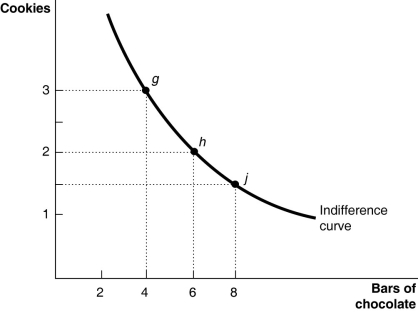 -Refer to Figure 10-5. What is the marginal rate of substitution for one bar of chocolate between h and j?
 (Multiple Choice)
4.8/5 (85)
(85) The income effect of a decrease in the price of legal services, a normal good, results in
(Multiple Choice)
4.8/5 (90)
(90) After getting an A on your economics exam, you decide to go to your favorite Mexican restaurant to celebrate. You are having trouble deciding whether to order the chipotle chicken chimichanga or the cilantro seafood enchiladas. Use the rule of equal marginal utility per dollar to determine which one to purchase: (a) the chimichanga for $8 which gives you 120 units of utility, or (b) the enchiladas for $15 which gives you 195 units of utility? Assume your budget is large enough to purchase either item.
(Essay)
4.8/5 (79)
(79) Consider the following hypothetical scenarios: Scenario A: You are about to purchase a pair of 7 for All Mankind jeans for $175 and a t-shirt for $45. The sales attendant at the store tells you that the pair of jeans you wish to buy is on sale for $160 at another store, located about a 20-minute drive away.
Scenario B: You are about to purchase a pair of 7 for All Mankind jeans for $175 and a t-shirt for $45. The sales attendant at the store tells you that the t-shirt you wish to buy is on sale for $30 at another store, located about a 20-minute drive away.
Based on standard economic theory, under which scenario would you make the 20-minute trip to the other store?
(Multiple Choice)
4.9/5 (74)
(74) Which of the following is explained by the law of diminishing marginal utility?
(Multiple Choice)
4.8/5 (94)
(94) Standard economic theory asserts that sunk costs are irrelevant in making economic decisions, yet studies conducted by behavioral economists reveal that sunk costs often affect economic decisions. Which of the following could explain this observation?
(Multiple Choice)
4.9/5 (82)
(82) The limitation that a consumer's total expenditure on goods and services purchased cannot exceed the income available is referred to as
(Multiple Choice)
4.8/5 (78)
(78) Music writer Anthony Kuzminski praised the late rock star Tom Petty in a 2007 article in the online Unrated Magazine. Kuzminski wrote: "Something Petty never can get enough credit for is his fan-friendly attitude. He kept ticket prices for [his concerts] at $50 when other acts this summer are charging upwards of $100 for stadium gigs. Petty could charge more, but he doesn't see the point. He has stated time and time again he still makes millions when he's on the road, regardless of his ticket prices. He is the last of the fan friendly rock stars out there." Use economic reasoning to write a rationale for Tom Petty's decision to charge prices for his band's ("Tom Petty and the Heartbreakers") concerts that were less than market clearing prices.
Source: Anthony Kuzminski, "Tom Petty & The Heartbreakers at the Vic Theater" http://www.unratedmagazine.com/
(Essay)
4.8/5 (82)
(82) For a demand curve to be upward sloping, the good would have to be an inferior good, and
(Multiple Choice)
4.9/5 (62)
(62) A construction project in Congressman Foghorn's district is unfinished. Foghorn has asked that a new appropriations bill include funds to complete the project, despite a report by an independent agency that the project is a waste of taxpayer money. Foghorn's project is a bridge that crosses a river between two cities in his district. The press has criticized Foghorn and dubbed the project "a bridge too far" since another bridge, located closer to the same two cities Foghorn's bridge will connect, already exists and can accommodate all traffic between the two cities. Foghorn argues that if the bridge project is not completed, the $50 million already spent will have been wasted. Is Foghorn's argument economically rational? Explain your answer.
(Essay)
4.9/5 (76)
(76) The substitution effect of a price increase causes a decrease in the quantity of an inferior good demanded.
(True/False)
4.8/5 (79)
(79) ________ is an experiment that tests the significance of fairness in consumer decision making.
(Multiple Choice)
4.9/5 (80)
(80) If the price of muffins, a normal good you enjoy, rises, then
(Multiple Choice)
4.8/5 (66)
(66) Figure 10-7  The above panels show various combinations of indifference curves and budget constraints for two products: Popcorn and Candy.
-Refer to Figure 10-7. A change in the price of popcorn only is shown in
The above panels show various combinations of indifference curves and budget constraints for two products: Popcorn and Candy.
-Refer to Figure 10-7. A change in the price of popcorn only is shown in (Multiple Choice)
4.7/5 (94)
(94) 
Filters
- Essay(0)
- Multiple Choice(0)
- Short Answer(0)
- True False(0)
- Matching(0)