



 Chat with AI
Exam 20: Game Theory, Strategic Decision Making, and Behavioral Economics

Exam 1: Economics and Economic Reasoning158 Questions
Exam 2: The Production Possibility Model, Trade, and Globalization133 Questions
Exam 3: Economic Institutions163 Questions
Exam 4: Supply and Demand182 Questions
Exam 5: Using Supply and Demand163 Questions
Exam 6: Describing Supply and Demand: Elasticities216 Questions
Exam 7: Taxation and Government Intervention201 Questions
Exam 8: Market Failure Versus Government Failure197 Questions
Exam 9: Comparative Advantage, Exchange Rates, and Globalization118 Questions
Exam 10: International Trade Policy99 Questions
Exam 11: Production and Cost Analysis I194 Questions
Exam 12: Production and Cost Analysis II152 Questions
Exam 13: Perfect Competition170 Questions
Exam 14: Monopoly and Monopolistic Competition274 Questions
Exam 15: Oligopoly and Antitrust Policy142 Questions
Exam 16: Real-World Competition and Technology108 Questions
Exam 17: Work and the Labor Market150 Questions
Exam 18: Who Gets What the Distribution of Income131 Questions
Exam 19: The Logic of Individual Choice: the Foundation of Supply and Demand170 Questions
Exam 20: Game Theory, Strategic Decision Making, and Behavioral Economics103 Questions
Exam 21: Thinking Like a Modern Economist97 Questions
Exam 22: Behavioral Economics and Modern Economic Policy126 Questions
Exam 23: Microeconomic Policy, Economic Reasoning, and Beyond134 Questions
Exam 24: Economic Growth, Business Cycles, and Unemployment124 Questions
Exam 25: Measuring and Describing the Aggregate Economy229 Questions
Exam 26: The Keynesian Short-Run Policy Model: Demand-Side Policies220 Questions
Exam 27: The Classical Long-Run Policy Model: Growth and Supply-Side Policies133 Questions
Exam 28: The Financial Sector and the Economy214 Questions
Exam 29: Monetary Policy243 Questions
Exam 30: Financial Crises, Panics, and Unconventional Monetary Policy109 Questions
Exam 31: Deficits and Debt: the Austerity Debate150 Questions
Exam 32: The Fiscal Policy Dilemma119 Questions
Exam 33: Jobs and Unemployment78 Questions
Exam 34: Inflation, Deflation, and Macro Policy175 Questions
Exam 35: International Financial Policy211 Questions
Exam 36: Macro Policy in a Global Setting134 Questions
Exam 37: Structural Stagnation and Globalization125 Questions
Exam 38: Macro Policy in Developing Countries142 Questions
Select questions type


Consider the following payoff matrix that shows the outcomes for two individuals,Aaron and Bob,as they try to decide whether or not to ask out the prettiest and smartest girl in school,Caroline.Caroline likes Aaron better than Bob,but will accept Bob's invitation if Aaron does not ask her out.Assuming that having your offer for a date accepted is the best possible outcome,being rejected is the worst,and having "nothing" happen is in the middle.
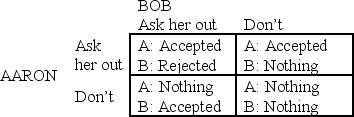 What will each of the boys decide to do?
 (Essay)
4.7/5  (73)
(73) If people are given one of two items of the same value and are given the choice to exchange it:
(Multiple Choice)
4.9/5 (98)
(98) What is a "Vickrey auction"? What is the value of this form of auction?
(Essay)
4.8/5 (95)
(95) If 90 percent of people operate as behavioral economic suggests,does that mean that the standard model is no longer applicable?
(Essay)
4.9/5 (82)
(82) What is true about the following payoff matrix? A: not cooperate A: cooperate B: do not cooperate A: 2, B: 2 A: 1, B: 3 B: cooperate A: 3, B: 1 A: 0,B:0
(Multiple Choice)
4.7/5 (71)
(71) What is the difference between a dominant strategy and a mixed strategy? Give an example of each type of strategy.
(Essay)
4.8/5 (84)
(84) In a standard highest sealed-bid auction, a bidder's best strategy:
(Multiple Choice)
4.8/5 (79)
(79) Consider the following payoff matrix facing Harry and Sally when each chooses to go to the coffee shop listed. Both Harry and Sally would like to meet each other but are shy about asking the other out on a date. Harry Starbucks Dunkin Donuts Sally Starbucks H: 1,:1 H: 0,:0 Dunkin Donuts :0,:0 :1,:1 What is Harry's best strategy?
(Multiple Choice)
4.8/5 (85)
(85) Consider the following payoff matrix facing Harry and Sally when each chooses to go to the coffee shop listed. Both Harry and Sally would like to meet each other but are shy about asking the other out on a date. Harry Starbucks Dunkin Donuts Sally Starbucks H: 1,:1 H: 0,:0 Dunkin Donuts :0,:0 :1,:1 If Harry and Sally go to the coffee shop every day, what is Harry's best strategy?
(Multiple Choice)
4.9/5 (89)
(89) If individuals can credibly cooperate and split the gains, which payoff is the most likely? A: Not Cheat A: Cheat B: Not Cheat A: 1, B: 50 A: 1, B: 1 B: Cheat A: 2, B: 1 A: 5, B: 5
(Multiple Choice)
4.9/5 (74)
(74) Consider the following payoff matrix facing Harry and Sally when each chooses to go to the coffee shop listed. Harry wants to avoid Sally at the coffee shop and is not happy when Sally ends up in the same shop he chooses. Sally would like to see Harry, and so she is not happy when Harry ends up in a different coffee shop. Harry Starbucks Dunkin Donuts Sally Starbucks H: -1,:1 :1,:-1 Dunkin Donuts :1,:-1 :-1,:1 Assuming that Sally and Harry go to the coffee shop each day, what is Harry's best strategy?
(Multiple Choice)
4.9/5 (74)
(74) Consider the following payoff matrix facing two firms selling the same product in the same market. They must choose whether to price the good at a high or low price. COMPANY B Low Price High Price COMPANY A Low Price A: 2, B: 2 A: 4, B: 1 High Price A: 1, B: 3 A: 6, B: 2 Given this information:
(Multiple Choice)
4.7/5 (77)
(77) 
Filters
- Essay(0)
- Multiple Choice(0)
- Short Answer(0)
- True False(0)
- Matching(0)