



 Chat with AI
Exam 24: Economic Growth, Business Cycles, and Unemployment

Exam 1: Economics and Economic Reasoning158 Questions
Exam 2: The Production Possibility Model, Trade, and Globalization133 Questions
Exam 3: Economic Institutions163 Questions
Exam 4: Supply and Demand182 Questions
Exam 5: Using Supply and Demand163 Questions
Exam 6: Describing Supply and Demand: Elasticities216 Questions
Exam 7: Taxation and Government Intervention201 Questions
Exam 8: Market Failure Versus Government Failure197 Questions
Exam 9: Comparative Advantage, Exchange Rates, and Globalization118 Questions
Exam 10: International Trade Policy99 Questions
Exam 11: Production and Cost Analysis I194 Questions
Exam 12: Production and Cost Analysis II152 Questions
Exam 13: Perfect Competition170 Questions
Exam 14: Monopoly and Monopolistic Competition274 Questions
Exam 15: Oligopoly and Antitrust Policy142 Questions
Exam 16: Real-World Competition and Technology108 Questions
Exam 17: Work and the Labor Market150 Questions
Exam 18: Who Gets What the Distribution of Income131 Questions
Exam 19: The Logic of Individual Choice: the Foundation of Supply and Demand170 Questions
Exam 20: Game Theory, Strategic Decision Making, and Behavioral Economics103 Questions
Exam 21: Thinking Like a Modern Economist97 Questions
Exam 22: Behavioral Economics and Modern Economic Policy126 Questions
Exam 23: Microeconomic Policy, Economic Reasoning, and Beyond134 Questions
Exam 24: Economic Growth, Business Cycles, and Unemployment124 Questions
Exam 25: Measuring and Describing the Aggregate Economy229 Questions
Exam 26: The Keynesian Short-Run Policy Model: Demand-Side Policies220 Questions
Exam 27: The Classical Long-Run Policy Model: Growth and Supply-Side Policies133 Questions
Exam 28: The Financial Sector and the Economy214 Questions
Exam 29: Monetary Policy243 Questions
Exam 30: Financial Crises, Panics, and Unconventional Monetary Policy109 Questions
Exam 31: Deficits and Debt: the Austerity Debate150 Questions
Exam 32: The Fiscal Policy Dilemma119 Questions
Exam 33: Jobs and Unemployment78 Questions
Exam 34: Inflation, Deflation, and Macro Policy175 Questions
Exam 35: International Financial Policy211 Questions
Exam 36: Macro Policy in a Global Setting134 Questions
Exam 37: Structural Stagnation and Globalization125 Questions
Exam 38: Macro Policy in Developing Countries142 Questions
Select questions type


Suppose there are 81.0 million people not in the labor force, 154.0 million in the civilian labor force, and 140.9 million employed. Based on these numbers, what is the unemployment rate?
(Multiple Choice)
4.8/5  (76)
(76) 
The two frameworks conventional economists generally use to analyze macroeconomic issues are the:
(Multiple Choice)
4.8/5 (69)
(69) What two numbers do you need to compute the unemployment rate?
(Multiple Choice)
4.8/5 (79)
(79) Unemployment caused by people entering the job market and people quitting a job just long enough to look for and find another one is called:
(Multiple Choice)
4.9/5 (75)
(75) Some economists talk about a nonaccelerating inflation rate of unemployment (NAIRU). The term the text uses for this concept is:
(Multiple Choice)
4.8/5 (90)
(90) The total labor force is 100,000 out of a possible working age population of 160,000. The total number of unemployed is 8,000. What is the unemployment rate?
(Multiple Choice)
4.8/5 (87)
(87) The lowest sustainable rate of unemployment that policy makers believe is achievable under existing conditions is:
(Multiple Choice)
4.8/5 (72)
(72) Refer to the graph shown. 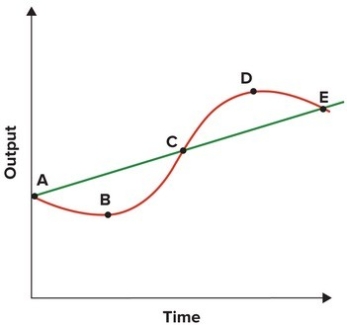 A peak occurs when the economy is at point:
 (Multiple Choice)
4.8/5 (85)
(85) Suppose a country's output is $440 billion and its population is 110 million. Now suppose that both its output and its population increase by 24 percent. As a result of these changes, its new level of per capita output will be:
(Multiple Choice)
4.9/5 (82)
(82) Workers at a car-manufacturing plant are replaced by automated machinery. What type of unemployment best describes the workers' situation?
(Multiple Choice)
4.9/5 (83)
(83) The long-run growth framework focuses on factors affecting:
(Multiple Choice)
4.8/5 (66)
(66) According to Classical economists in the 1930s, a recession will end when:
(Multiple Choice)
4.8/5 (75)
(75) If U.S. real GDP increases by 3.3 percent, we can infer that the United States experiences:
(Multiple Choice)
4.9/5 (79)
(79) 
Filters
- Essay(0)
- Multiple Choice(0)
- Short Answer(0)
- True False(0)
- Matching(0)