



 Chat with AI
Exam 29: Monetary Policy

Exam 1: Economics and Economic Reasoning158 Questions
Exam 2: The Production Possibility Model, Trade, and Globalization133 Questions
Exam 3: Economic Institutions163 Questions
Exam 4: Supply and Demand182 Questions
Exam 5: Using Supply and Demand163 Questions
Exam 6: Describing Supply and Demand: Elasticities216 Questions
Exam 7: Taxation and Government Intervention201 Questions
Exam 8: Market Failure Versus Government Failure197 Questions
Exam 9: Comparative Advantage, Exchange Rates, and Globalization118 Questions
Exam 10: International Trade Policy99 Questions
Exam 11: Production and Cost Analysis I194 Questions
Exam 12: Production and Cost Analysis II152 Questions
Exam 13: Perfect Competition170 Questions
Exam 14: Monopoly and Monopolistic Competition274 Questions
Exam 15: Oligopoly and Antitrust Policy142 Questions
Exam 16: Real-World Competition and Technology108 Questions
Exam 17: Work and the Labor Market150 Questions
Exam 18: Who Gets What the Distribution of Income131 Questions
Exam 19: The Logic of Individual Choice: the Foundation of Supply and Demand170 Questions
Exam 20: Game Theory, Strategic Decision Making, and Behavioral Economics103 Questions
Exam 21: Thinking Like a Modern Economist97 Questions
Exam 22: Behavioral Economics and Modern Economic Policy126 Questions
Exam 23: Microeconomic Policy, Economic Reasoning, and Beyond134 Questions
Exam 24: Economic Growth, Business Cycles, and Unemployment124 Questions
Exam 25: Measuring and Describing the Aggregate Economy229 Questions
Exam 26: The Keynesian Short-Run Policy Model: Demand-Side Policies220 Questions
Exam 27: The Classical Long-Run Policy Model: Growth and Supply-Side Policies133 Questions
Exam 28: The Financial Sector and the Economy214 Questions
Exam 29: Monetary Policy243 Questions
Exam 30: Financial Crises, Panics, and Unconventional Monetary Policy109 Questions
Exam 31: Deficits and Debt: the Austerity Debate150 Questions
Exam 32: The Fiscal Policy Dilemma119 Questions
Exam 33: Jobs and Unemployment78 Questions
Exam 34: Inflation, Deflation, and Macro Policy175 Questions
Exam 35: International Financial Policy211 Questions
Exam 36: Macro Policy in a Global Setting134 Questions
Exam 37: Structural Stagnation and Globalization125 Questions
Exam 38: Macro Policy in Developing Countries142 Questions
Select questions type


The AS/AD model implies that monetary policy should be used to:
(Multiple Choice)
4.8/5  (70)
(70) If the Fed decreases the reserve requirement, it will likely:
(Multiple Choice)
4.9/5 (69)
(69) Explain how distinction between the real and nominal interest rate poses problems for the conduct of monetary policy.
(Essay)
4.9/5 (76)
(76) Refer to the graph shown. Suppose the economy is initially at A but then the Fed adopts a contractionary monetary policy. The long-term effect of this policy will be to move the economy to: 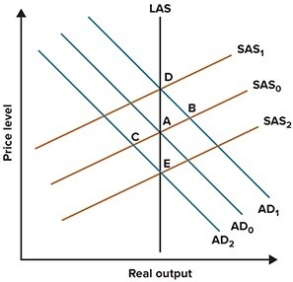
(Multiple Choice)
4.8/5 (73)
(73) The art of monetary policy requires acting in accordance with the Taylor Rule.
(True/False)
4.9/5 (81)
(81) By law, a commercial bank is allowed to lend out of all its:
(Multiple Choice)
4.9/5 (74)
(74) The Fed took action in late 2008 to significantly decrease the federal funds rate. This action is best considered:
(Multiple Choice)
4.8/5 (71)
(71) If the Fed simultaneously reduces the discount rate and the required reserve ratio, the money supply will:
(Multiple Choice)
4.8/5 (76)
(76) During an inflationary period, policy makers who use the AS/AD model would probably recommend an open market:
(Multiple Choice)
4.9/5 (83)
(83) Demonstrate graphically and explain verbally that the impact of expansionary monetary policy on the economy depends upon the position of equilibrium output in relation to potential output.
(Essay)
4.9/5 (71)
(71) What is the yield curve? What happens when one moves out along the yield curve? How does its shape reflect the fact that the Federal Reserve's ability to control the economy through controlling short-term interest rates is limited?
(Essay)
4.9/5 (82)
(82) Expansionary monetary policy results in a shift of the aggregate demand curve to the right. The effect of the monetary policy on the aggregate demand is:
(Multiple Choice)
4.8/5 (84)
(84) All of the following are components of the Federal Reserve system except the:
(Multiple Choice)
4.9/5 (85)
(85) In the fall of 2008, the Federal Reserve lowered its target for the federal funds rate to nearly 0 percent. What is the name of the group within the Federal Reserve that made this decision?
(Multiple Choice)
4.9/5 (84)
(84) 
Filters
- Essay(0)
- Multiple Choice(0)
- Short Answer(0)
- True False(0)
- Matching(0)