



 Chat with AI
Exam 30: Financial Crises, Panics, and Unconventional Monetary Policy

Exam 1: Economics and Economic Reasoning158 Questions
Exam 2: The Production Possibility Model, Trade, and Globalization133 Questions
Exam 3: Economic Institutions163 Questions
Exam 4: Supply and Demand182 Questions
Exam 5: Using Supply and Demand163 Questions
Exam 6: Describing Supply and Demand: Elasticities216 Questions
Exam 7: Taxation and Government Intervention201 Questions
Exam 8: Market Failure Versus Government Failure197 Questions
Exam 9: Comparative Advantage, Exchange Rates, and Globalization118 Questions
Exam 10: International Trade Policy99 Questions
Exam 11: Production and Cost Analysis I194 Questions
Exam 12: Production and Cost Analysis II152 Questions
Exam 13: Perfect Competition170 Questions
Exam 14: Monopoly and Monopolistic Competition274 Questions
Exam 15: Oligopoly and Antitrust Policy142 Questions
Exam 16: Real-World Competition and Technology108 Questions
Exam 17: Work and the Labor Market150 Questions
Exam 18: Who Gets What the Distribution of Income131 Questions
Exam 19: The Logic of Individual Choice: the Foundation of Supply and Demand170 Questions
Exam 20: Game Theory, Strategic Decision Making, and Behavioral Economics103 Questions
Exam 21: Thinking Like a Modern Economist97 Questions
Exam 22: Behavioral Economics and Modern Economic Policy126 Questions
Exam 23: Microeconomic Policy, Economic Reasoning, and Beyond134 Questions
Exam 24: Economic Growth, Business Cycles, and Unemployment124 Questions
Exam 25: Measuring and Describing the Aggregate Economy229 Questions
Exam 26: The Keynesian Short-Run Policy Model: Demand-Side Policies220 Questions
Exam 27: The Classical Long-Run Policy Model: Growth and Supply-Side Policies133 Questions
Exam 28: The Financial Sector and the Economy214 Questions
Exam 29: Monetary Policy243 Questions
Exam 30: Financial Crises, Panics, and Unconventional Monetary Policy109 Questions
Exam 31: Deficits and Debt: the Austerity Debate150 Questions
Exam 32: The Fiscal Policy Dilemma119 Questions
Exam 33: Jobs and Unemployment78 Questions
Exam 34: Inflation, Deflation, and Macro Policy175 Questions
Exam 35: International Financial Policy211 Questions
Exam 36: Macro Policy in a Global Setting134 Questions
Exam 37: Structural Stagnation and Globalization125 Questions
Exam 38: Macro Policy in Developing Countries142 Questions
Select questions type


The graph below shows what happens when the Fed implements: 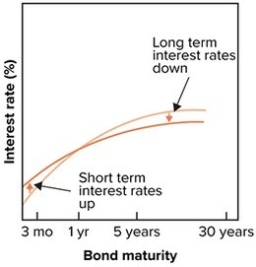
(Multiple Choice)
4.9/5  (68)
(68) I invest $100 in a stock and borrow 90 percent of the $100 at 10 percent. The stock price rises by 20 percent. The rate of return on my investment is:
(Multiple Choice)
4.9/5 (83)
(83) Which of the following would have the impact shown in the accompanying graph? 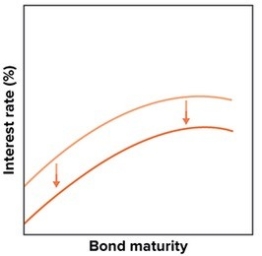
(Multiple Choice)
4.7/5 (78)
(78) To offset the moral hazard problem created by the FDIC, the government:
(Multiple Choice)
4.7/5 (78)
(78) A policy buying a wide range of financial assets from banks and other financial institutions in order to stimulate the economy is called:
(Multiple Choice)
4.9/5 (77)
(77) Initially, policy makers were not concerned about the financial crisis because:
(Multiple Choice)
4.8/5 (73)
(73) What are the three general principles that most economists share about dealing with a financial crisis?
(Essay)
4.9/5 (89)
(89) Government regulations that deal with financial crises tend to become less effective over time.
(True/False)
4.8/5 (77)
(77) What role do economists' view on special interests play in economists' views on regulation?
(Essay)
4.8/5 (72)
(72) The recent regulation that was designed to limit risk-taking by banks by requiring them to report their holdings is called the:
(Multiple Choice)
4.9/5 (79)
(79) When the Fed loaned to banks using banks' long-run assets such as mortgages as collateral, it was:
(Multiple Choice)
4.8/5 (82)
(82) The central bank unwound unconventional policy slowly because:
(Multiple Choice)
4.9/5 (70)
(70) Define each of the following: the moral hazard problem,the law of diminishing control,and the bad precedent problem.
(Essay)
4.8/5 (76)
(76) 
Filters
- Essay(0)
- Multiple Choice(0)
- Short Answer(0)
- True False(0)
- Matching(0)