



 Chat with AI
Exam 14: Monopoly and Monopolistic Competition

Exam 1: Economics and Economic Reasoning121 Questions
Exam 2: The Production Possibility Model, Trade, and Globalization111 Questions
Exam 3: Economic Institutions144 Questions
Exam 4: Supply and Demand151 Questions
Exam 5: Using Supply and Demand136 Questions
Exam 6: Describing Supply and Demand: Elasticities176 Questions
Exam 7: Taxation and Government Intervention169 Questions
Exam 8: Market Failure Versus Government Failure160 Questions
Exam 9: Comparative Advantage, Exchange Rates, and Globalization107 Questions
Exam 10: International Trade Policy82 Questions
Exam 11: Production and Cost Analysis I160 Questions
Exam 12: Production and Cost Analysis II129 Questions
Exam 13: Perfect Competition137 Questions
Exam 14: Monopoly and Monopolistic Competition231 Questions
Exam 15: Oligopoly and Antitrust Policy111 Questions
Exam 16: Real-World Competition and Technology86 Questions
Exam 17: Work and the Labor Market130 Questions
Exam 18: Who Gets What the Distribution of Income100 Questions
Exam 19: The Logic of Individual Choice: the Foundation of Supply and Demand134 Questions
Exam 20: Game Theory, Strategic Decision Making, and Behavioral Economics76 Questions
Exam 21: Thinking Like a Modern Economist67 Questions
Exam 22: Behavioral Economics and Modern Economic Policy87 Questions
Exam 23: Microeconomic Policy, Economic Reasoning, and Beyond111 Questions
Select questions type


Refer to the graph shown. If this firm is maximizing profit, it will: 
(Multiple Choice)
4.9/5  (84)
(84) If P = 3Qs + 3 represents market supply for a competitive industry and market demand is given by Qd = 31 - 1/3 P, the equilibrium quantity is:
(Multiple Choice)
4.7/5 (68)
(68) Refer to the graph shown of a monopolistically competitive firm. You can conclude that: 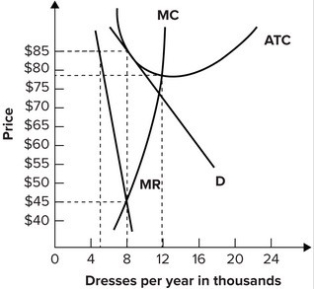
(Multiple Choice)
4.7/5 (72)
(72) In the absence of economies of scale, advertising and product differentiation:
(Multiple Choice)
4.9/5 (58)
(58) A market structure in which one firm makes up the entire market is:
(Multiple Choice)
4.8/5 (89)
(89) Refer to the graph shown. If hamburgers are produced by a pure monopoly that maximizes profit, the price of hamburger dinners will be: 
(Multiple Choice)
4.8/5 (73)
(73) Refer to the graph shown. If this monopolist were allowed to choose the profit-maximizing level of output, it would produce: 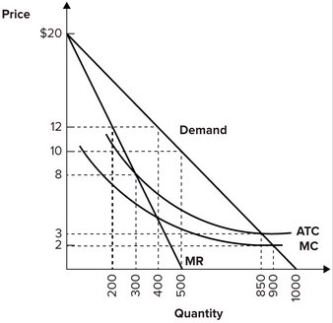
(Multiple Choice)
4.8/5 (81)
(81) Since marginal revenue is less than price for a monopolist, a monopolist maximizes profits by equating marginal revenue and marginal cost, not price and marginal cost.
(True/False)
4.8/5 (83)
(83) Refer to the graph shown. If the price of the product is $1 and the firm is a natural monopoly: 
(Multiple Choice)
4.9/5 (71)
(71) Often, gas stations only a few miles apart differ in price by as much as $0.10 per gallon. The most likely explanation for this kind of price discrimination is that:
(Multiple Choice)
4.9/5 (87)
(87) Under normal monopoly, P > MC, and so the marginal benefit to society of increasing output exceeds the marginal cost. This means that an increase in output will increase welfare.
(True/False)
4.9/5 (86)
(86) A movie theater is a price-discriminating monopolist and charges a higher ticket price for late-evening showings. From this we know that:
(Multiple Choice)
4.8/5 (85)
(85) Refer to the graph shown. If this monopolist were allowed to choose the profit-maximizing level of output, it would produce: 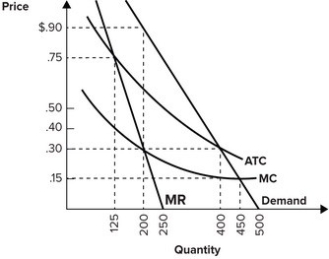
(Multiple Choice)
4.8/5 (76)
(76) Refer to the graph shown. If this graph represents a monopoly market, the equilibrium price and quantity will be: 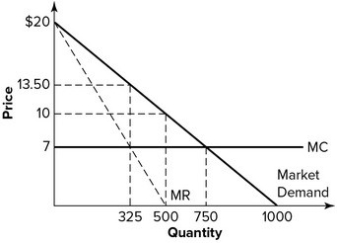
(Multiple Choice)
4.8/5 (71)
(71) You are shown a graph of a monopolist in long-run equilibrium and a graph of a monopolistically competitive firm in short-run equilibrium. How could you tell which is which?
(Multiple Choice)
4.8/5 (74)
(74) The DeBeers Company is a profit-maximizing monopolist that exercises monopoly power in the distribution of diamonds. If the company earns positive economic profits this year, the price of diamonds will:
(Multiple Choice)
4.9/5 (87)
(87) If a college student's demand for newspaper subscriptions is more price-elastic than a business executive's demand for newspaper subscriptions, which of the following pricing strategies would a price-discriminating newspaper publisher follow?
(Multiple Choice)
4.7/5 (83)
(83) If P = Q/15 represents market supply for a competitive industry and market demand is given by Qd = 500 - 10P, the equilibrium quantity is:
(Multiple Choice)
4.7/5 (80)
(80) 
Filters
- Essay(0)
- Multiple Choice(0)
- Short Answer(0)
- True False(0)
- Matching(0)