



 Chat with AI
Exam 14: Monopoly and Monopolistic Competition

Exam 1: Economics and Economic Reasoning121 Questions
Exam 2: The Production Possibility Model, Trade, and Globalization111 Questions
Exam 3: Economic Institutions144 Questions
Exam 4: Supply and Demand151 Questions
Exam 5: Using Supply and Demand136 Questions
Exam 6: Describing Supply and Demand: Elasticities176 Questions
Exam 7: Taxation and Government Intervention169 Questions
Exam 8: Market Failure Versus Government Failure160 Questions
Exam 9: Comparative Advantage, Exchange Rates, and Globalization107 Questions
Exam 10: International Trade Policy82 Questions
Exam 11: Production and Cost Analysis I160 Questions
Exam 12: Production and Cost Analysis II129 Questions
Exam 13: Perfect Competition137 Questions
Exam 14: Monopoly and Monopolistic Competition231 Questions
Exam 15: Oligopoly and Antitrust Policy111 Questions
Exam 16: Real-World Competition and Technology86 Questions
Exam 17: Work and the Labor Market130 Questions
Exam 18: Who Gets What the Distribution of Income100 Questions
Exam 19: The Logic of Individual Choice: the Foundation of Supply and Demand134 Questions
Exam 20: Game Theory, Strategic Decision Making, and Behavioral Economics76 Questions
Exam 21: Thinking Like a Modern Economist67 Questions
Exam 22: Behavioral Economics and Modern Economic Policy87 Questions
Exam 23: Microeconomic Policy, Economic Reasoning, and Beyond111 Questions
Select questions type


The drug maker Wyeth produces the hormone-therapy drug Premarin, which is derived from the urine of pregnant mares. Not even Wyeth knows exactly what chemicals are in it, and the method of making the drug is a trade secret. Barr Laboratories has been trying to make a pill that is close enough to Premarin to be approved by the U.S. Food and Drug Administration as an "equivalent" drug. This story illustrates the importance of:
(Multiple Choice)
4.9/5  (69)
(69) Regulations created some years ago allow cell phone customers to keep the same phone number even when they switch to a different provider. This change:
(Multiple Choice)
4.8/5 (79)
(79) Suppose quantity demanded is 2,000 when price is $10 and 3,000 when price is $5. If a monopolist who was initially charging a price of $10 discovers a way to price-discriminate, it will be able to increase revenue from $20,000 to:
(Multiple Choice)
4.9/5 (74)
(74) Monopolies that exist because economies of scale create a barrier to entry are called natural monopolies.
(True/False)
4.8/5 (92)
(92) With a natural monopoly, the minimum price a single firm must charge to make a profit:
(Multiple Choice)
4.9/5 (81)
(81) Refer to the graph shown. If the firm seeks to maximize profit, it should set a price equal to: 
(Multiple Choice)
4.8/5 (86)
(86) The profit-maximizing output level for a monopolist occurs where marginal revenue equals marginal cost.
(True/False)
4.9/5 (75)
(75) Charging different prices to different individuals or groups for the same product is called:
(Multiple Choice)
4.8/5 (88)
(88) 
Refer to the graph shown. If the monopoly firm maximizes profit, there will be a welfare loss equal to: 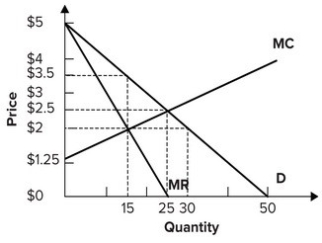
(Multiple Choice)
4.9/5 (83)
(83) Refer to the graph shown. If the monopoly firm maximizes profit, consumers will pay: 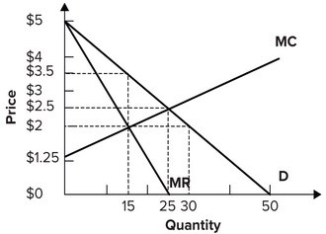
(Multiple Choice)
4.9/5 (86)
(86) A monopolistically competitive industry has many firms that sell differentiated products.
(True/False)
4.7/5 (73)
(73) If a monopolist had no production costs, it would produce the output where marginal revenue intersects the quantity axis. At this point, the price elasticity of demand would be:
(Multiple Choice)
4.7/5 (85)
(85) Refer to the graph shown. If a price control is used to eliminate deadweight loss, the new price and quantity in this market will be: 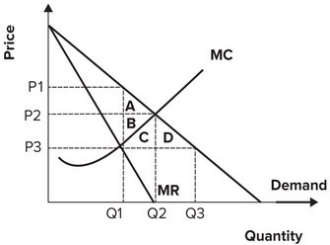
(Multiple Choice)
4.9/5 (76)
(76) Refer to the graph shown. The equilibrium price for the monopolistically competitive firm represented is: 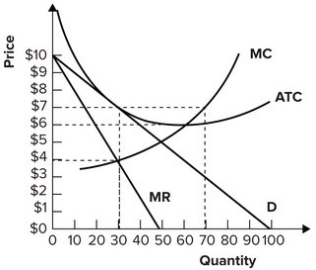
(Multiple Choice)
4.7/5 (83)
(83) Refer to the graph shown. In a perfectly competitive industry, price would: 
(Multiple Choice)
4.8/5 (71)
(71) 
Filters
- Essay(0)
- Multiple Choice(0)
- Short Answer(0)
- True False(0)
- Matching(0)