



 Chat with AI
Exam 14: Monopoly and Monopolistic Competition

Exam 1: Economics and Economic Reasoning121 Questions
Exam 2: The Production Possibility Model, Trade, and Globalization111 Questions
Exam 3: Economic Institutions144 Questions
Exam 4: Supply and Demand151 Questions
Exam 5: Using Supply and Demand136 Questions
Exam 6: Describing Supply and Demand: Elasticities176 Questions
Exam 7: Taxation and Government Intervention169 Questions
Exam 8: Market Failure Versus Government Failure160 Questions
Exam 9: Comparative Advantage, Exchange Rates, and Globalization107 Questions
Exam 10: International Trade Policy82 Questions
Exam 11: Production and Cost Analysis I160 Questions
Exam 12: Production and Cost Analysis II129 Questions
Exam 13: Perfect Competition137 Questions
Exam 14: Monopoly and Monopolistic Competition231 Questions
Exam 15: Oligopoly and Antitrust Policy111 Questions
Exam 16: Real-World Competition and Technology86 Questions
Exam 17: Work and the Labor Market130 Questions
Exam 18: Who Gets What the Distribution of Income100 Questions
Exam 19: The Logic of Individual Choice: the Foundation of Supply and Demand134 Questions
Exam 20: Game Theory, Strategic Decision Making, and Behavioral Economics76 Questions
Exam 21: Thinking Like a Modern Economist67 Questions
Exam 22: Behavioral Economics and Modern Economic Policy87 Questions
Exam 23: Microeconomic Policy, Economic Reasoning, and Beyond111 Questions
Select questions type


Refer to the graph shown. If this monopolist produces 700 units of output per day, it: 

Free
(Multiple Choice)
4.8/5  (72)
(72) Correct Answer: Verified
B
There are many restaurants in a city, each one offering food and services that differ from those of its competitors. There is also free entry of sellers into the market, and each seller serves a very small fraction of the total number of meals served each day. The restaurant industry in Raleigh is best categorized as:
Free
(Multiple Choice)
4.9/5 (79)
(79) Correct Answer:Verified
VerifiedB
A significant difference between monopoly and perfect competition is that:
Free
(Multiple Choice)
4.9/5 (70)
(70) Correct Answer:Verified
VerifiedC
Microsoft sells a special version of its Windows operating system at a low price in countries where cheap pirated software is widespread. Since the cost of producing another copy of this software is the same as the cost of producing another copy of the regular Windows product, why is Microsoft charging this lower price?
(Multiple Choice)
4.9/5 (68)
(68) A price-discriminating monopolist will make less in profit than will one that does not price-discriminate.
(True/False)
4.9/5 (78)
(78) Under monopolistic competition, a firm's ability to influence the price of the product it sells arises because:
(Multiple Choice)
4.8/5 (82)
(82) All of the following are good examples of network externalities except:
(Multiple Choice)
5.0/5 (73)
(73) Monopolies that exist because economies of scale create a barrier to entry are called:
(Multiple Choice)
4.8/5 (74)
(74) If a monopolistically competitive firm is earning economic profits in the short run:
(Multiple Choice)
4.8/5 (83)
(83) Refer to the following graph.  If the demand curve is curve D for a monopoly, the marginal revenue curve is:
 (Multiple Choice)
4.9/5 (70)
(70) A British waste management company acquired two other companies that specialized in disposal of hazardous wastes even though the two companies were losing money. Planning and regulatory requirements in the United Kingdom make it difficult for firms to establish new hazardous waste landfills, and the combined companies would control most hazardous waste landfills in some parts of the country. How do the planning and regulatory requirements affect the market for hazardous waste?
(Multiple Choice)
4.8/5 (80)
(80) Refer to the graph shown. The areas that represent the net gain to society of eliminating the monopoly are: 
(Multiple Choice)
4.8/5 (76)
(76) Refer to the graph shown depicting a monopolistically competitive firm. The average total cost curve is represented by curve: 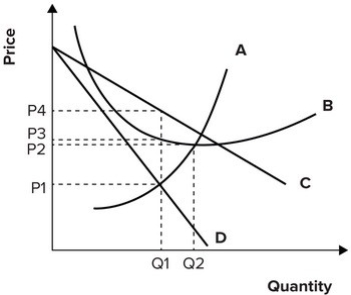
(Multiple Choice)
5.0/5 (78)
(78) When a monopolistically competitive firm is in long-run equilibrium, average total cost is at its minimum.
(True/False)
4.9/5 (85)
(85) Refer to the graph shown. If this graph represents a competitive market, the equilibrium price and quantity will be: 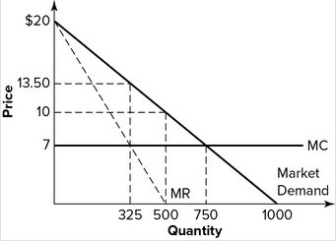
(Multiple Choice)
4.7/5 (84)
(84) When a monopolistically competitive industry is in long-run equilibrium:
(Multiple Choice)
4.9/5 (78)
(78) Refer to the graph shown. If the government set the selling price equal to the marginal cost, the firm in the graph would be: 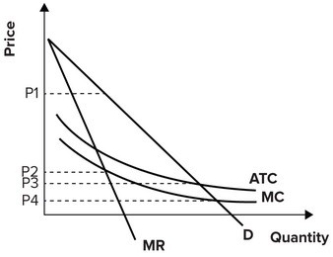
(Multiple Choice)
4.9/5 (77)
(77) 
Filters
- Essay(0)
- Multiple Choice(0)
- Short Answer(0)
- True False(0)
- Matching(0)