



 Chat with AI
Exam 2: The Production Possibility Model, Trade, and Globalization

Exam 1: Economics and Economic Reasoning121 Questions
Exam 2: The Production Possibility Model, Trade, and Globalization111 Questions
Exam 3: Economic Institutions144 Questions
Exam 4: Supply and Demand151 Questions
Exam 5: Using Supply and Demand136 Questions
Exam 6: Describing Supply and Demand: Elasticities176 Questions
Exam 7: Taxation and Government Intervention169 Questions
Exam 8: Market Failure Versus Government Failure160 Questions
Exam 9: Comparative Advantage, Exchange Rates, and Globalization107 Questions
Exam 10: International Trade Policy82 Questions
Exam 11: Production and Cost Analysis I160 Questions
Exam 12: Production and Cost Analysis II129 Questions
Exam 13: Perfect Competition137 Questions
Exam 14: Monopoly and Monopolistic Competition231 Questions
Exam 15: Oligopoly and Antitrust Policy111 Questions
Exam 16: Real-World Competition and Technology86 Questions
Exam 17: Work and the Labor Market130 Questions
Exam 18: Who Gets What the Distribution of Income100 Questions
Exam 19: The Logic of Individual Choice: the Foundation of Supply and Demand134 Questions
Exam 20: Game Theory, Strategic Decision Making, and Behavioral Economics76 Questions
Exam 21: Thinking Like a Modern Economist67 Questions
Exam 22: Behavioral Economics and Modern Economic Policy87 Questions
Exam 23: Microeconomic Policy, Economic Reasoning, and Beyond111 Questions
Select questions type


The text attributes the growth of economies over the last 200 years largely to:

Free
(Multiple Choice)
4.8/5  (73)
(73) Correct Answer: Verified
A
This production possibility table illustrates: Eggs Rye 10 0 8 10 6 20 4 30 2 40 0 50
Free
(Multiple Choice)
4.9/5 (78)
(78) Correct Answer:Verified
VerifiedC
Refer to the graph below. 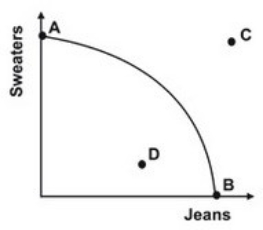 Productive inefficiency occurs at what point?
Free
(Multiple Choice)
4.9/5 (74)
(74) Correct Answer:Verified
VerifiedD
Suppose New Zealand uses one unit of labor to produce a kiwi and two units of labor to produce an apple. Suppose Australia uses two units of labor to produce a kiwi and one unit of labor to produce an apple. In this case, New Zealand:
(Multiple Choice)
4.7/5 (83)
(83) Refer to the graph below. 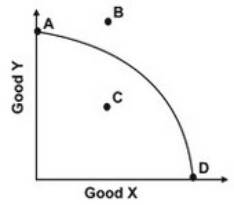 If the production possibility curve shifts along the Good Y axis, which point will remain as a point of efficiency?
 (Multiple Choice)
4.8/5 (73)
(73) Refer to the graph below. 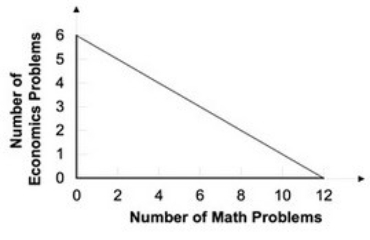 Laura's production possibility curve for math and economics problems in one night is shown in the graph. Her opportunity cost of finishing six math problems instead of four math problems is:
 (Multiple Choice)
4.8/5 (77)
(77) The principle of increasing marginal opportunity cost holds in which of the following cases?
(Multiple Choice)
4.9/5 (77)
(77) Refer to the graph shown. Given the production possibility curve, the opportunity cost of reading 2 more articles when you are already reading 11 articles is on average: 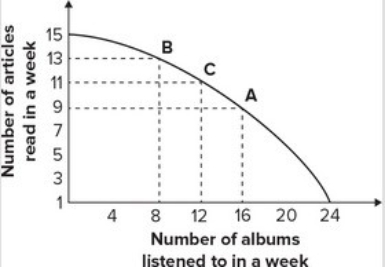
(Multiple Choice)
4.9/5 (63)
(63) John and Jane Smith are both economists who are deciding how to split household chores of cooking and cleaning. They discover that John has a comparative advantage in cooking. Does this discovery tell them anything about comparative advantage in cleaning?
(Multiple Choice)
4.8/5 (76)
(76) Refer to the graph below. 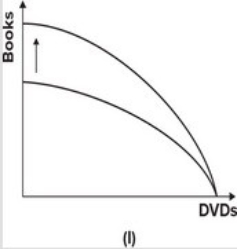
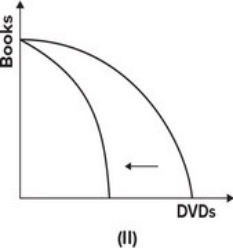
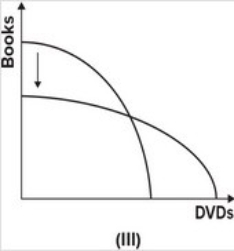
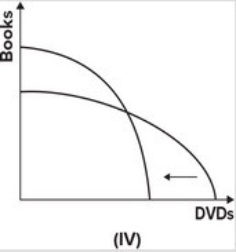 Which of the shifts explains what will happen to the production possibility curve if the cost of producing books goes down while the cost of producing DVDs goes up?
 (Multiple Choice)
4.9/5 (83)
(83) Two nations with differing comparative advantages will be able to consume more if each produces the good for which the opportunity cost is highest and trades for the good for which opportunity cost is lowest.
(True/False)
4.8/5 (67)
(67) If there is an inverse relationship between two variables, the graph relating the two variables will be:
(Multiple Choice)
4.9/5 (68)
(68) Investment in capital goods is one way to increase the standard of living in the future. Investment in capital goods, however, means that we must forgo consumption today. One of the trade-offs facing an economy is the balance of consumption today with that of the future. The following table shows such a trade-off. With this information we know that the opportunity cost of which of the following is the greatest? Current consumption Future consumption 800 100 750 260 650 340 600 380 550 400
(Multiple Choice)
4.8/5 (85)
(85) According to Adam Smith, individuals are directed to do those things for which they have a comparative advantage by:
(Multiple Choice)
4.8/5 (84)
(84) Which of the following cannot be determined by using a production possibility table?
(Multiple Choice)
4.9/5 (81)
(81) Suppose that in Colombia one unit of labor can produce 8 tons of papayas or 2 tons of bananas and in Brazil, one unit of labor can produce either 2 tons of papayas or 4 tons of bananas. If each country has two units of labor, which of the following consumption combinations can be attained only with trade?
(Multiple Choice)
4.9/5 (73)
(73) If the hourly wage of German workers is $6, the hourly wage of Canadian workers is $10, and German workers produce half as much output per hour as Canadian workers, all else equal, it would be efficient to locate production facilities in:
(Multiple Choice)
4.9/5 (71)
(71) Refer to the graph below. 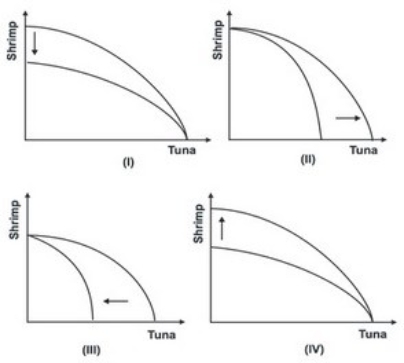 Which of the shifts explains what would happen to the production possibility curve if restrictions were imposed on tuna fishing?
 (Multiple Choice)
4.8/5 (83)
(83) If no resources had a comparative advantage in the production of any good, the production possibility curve would be:
(Multiple Choice)
4.9/5 (89)
(89) 
Filters
- Essay(0)
- Multiple Choice(0)
- Short Answer(0)
- True False(0)
- Matching(0)