



 Chat with AI
Exam 6: Describing Supply and Demand: Elasticities

Exam 1: Economics and Economic Reasoning121 Questions
Exam 2: The Production Possibility Model, Trade, and Globalization111 Questions
Exam 3: Economic Institutions144 Questions
Exam 4: Supply and Demand151 Questions
Exam 5: Using Supply and Demand136 Questions
Exam 6: Describing Supply and Demand: Elasticities176 Questions
Exam 7: Taxation and Government Intervention169 Questions
Exam 8: Market Failure Versus Government Failure160 Questions
Exam 9: Comparative Advantage, Exchange Rates, and Globalization107 Questions
Exam 10: International Trade Policy82 Questions
Exam 11: Production and Cost Analysis I160 Questions
Exam 12: Production and Cost Analysis II129 Questions
Exam 13: Perfect Competition137 Questions
Exam 14: Monopoly and Monopolistic Competition231 Questions
Exam 15: Oligopoly and Antitrust Policy111 Questions
Exam 16: Real-World Competition and Technology86 Questions
Exam 17: Work and the Labor Market130 Questions
Exam 18: Who Gets What the Distribution of Income100 Questions
Exam 19: The Logic of Individual Choice: the Foundation of Supply and Demand134 Questions
Exam 20: Game Theory, Strategic Decision Making, and Behavioral Economics76 Questions
Exam 21: Thinking Like a Modern Economist67 Questions
Exam 22: Behavioral Economics and Modern Economic Policy87 Questions
Exam 23: Microeconomic Policy, Economic Reasoning, and Beyond111 Questions
Select questions type


As the manager of a ski resort, you want to increase the number of lift tickets sold by 8 percent. Your staff economist has determined that the price elasticity of demand for lift tickets is 2. To increase sales by the desired amount, you should decrease the price of a lift ticket by:

Free
(Multiple Choice)
4.8/5  (70)
(70) Correct Answer: Verified
B
If the supply of a product is inelastic, this implies that a specific percentage change in price leads to:
Free
(Multiple Choice)
4.9/5 (73)
(73) Correct Answer:Verified
VerifiedC
As the price of tomatoes fell from $2.50 to $2.00, the quantity imported from Mexico fell from 1,800 tons to 900 tons. The elasticity of supply of tomatoes imported from Mexico is:
Free
(Multiple Choice)
4.8/5 (89)
(89) Correct Answer:Verified
VerifiedC
College students tend to eat more ramen noodles than do recent college graduates. A primary reason for this is that:
(Multiple Choice)
4.7/5 (88)
(88) Suppose the demand for butter increases from 800 to 1,000 pounds when income falls from $40,000 to 30,000. Income elasticity is:
(Multiple Choice)
4.8/5 (85)
(85) It is estimated that a 5 percent decline in income will reduce health care purchases by 2.5 percent and reduce dental service purchases by 8 percent. From this information, one can conclude that:
(Multiple Choice)
4.8/5 (61)
(61) Measuring the price of gasoline in dollars per quart, an economist calculates the price elasticity of demand to be 1. What would the price elasticity of demand be if the economist had chosen to measure the price in dollars per gallon?
(Multiple Choice)
4.9/5 (84)
(84) If the price elasticity of supply is 0.5, a 10 percent increase in price will cause a:
(Multiple Choice)
4.7/5 (86)
(86) George Davis and Michael Wohlgenant estimate that for every 1 percent increase in the price of Christmas trees, quantity demanded falls by 0.6 percent. The demand for Christmas trees is:
(Multiple Choice)
5.0/5 (74)
(74) Price elasticity of demand is the percentage change in price divided by the percentage change in quantity demanded.
(True/False)
4.7/5 (84)
(84) If the supply curve intersects the vertical (price) axis, the supply curve has an elasticity:
(Multiple Choice)
4.8/5 (90)
(90) If the percentage increase in the quantity supplied equals the percentage increase in the price, the supply:
(Multiple Choice)
4.8/5 (87)
(87) Refer to the following graph. 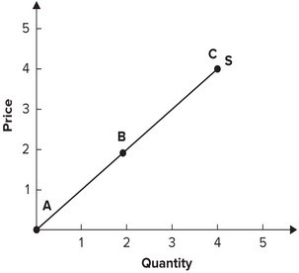 Elasticity is greatest at point:
 (Multiple Choice)
4.8/5 (84)
(84) Refer to the following table to answer the question. Demand is most elastic between: Price Quantity Demanded \ 2.00 26 \ 4.00 22 \ 6.00 18 \ 8.00 14 \ 10.00 10
(Multiple Choice)
4.8/5 (79)
(79) If frost in Florida reduces the quantity of vegetables sold by 20 percent and increases their retail price by 30 percent, one can conclude that:
(Multiple Choice)
4.8/5 (81)
(81) Refer to the graph shown. Which of the following curves demonstrates a perfectly inelastic demand curve? 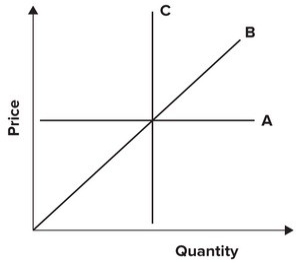
(Multiple Choice)
4.9/5 (83)
(83) The supply of Russian caviar from the Caspian Sea diminished after the collapse of Soviet communism. The price of caviar rose from $395 a pound to $595 a pound. Still, revenue from the sale of caviar rose 30 percent. You can conclude that:
(Multiple Choice)
4.8/5 (81)
(81) 
Filters
- Essay(0)
- Multiple Choice(0)
- Short Answer(0)
- True False(0)
- Matching(0)