



 Chat with AI
Exam 6: Describing Supply and Demand: Elasticities

Exam 1: Economics and Economic Reasoning121 Questions
Exam 2: The Production Possibility Model, Trade, and Globalization111 Questions
Exam 3: Economic Institutions144 Questions
Exam 4: Supply and Demand151 Questions
Exam 5: Using Supply and Demand136 Questions
Exam 6: Describing Supply and Demand: Elasticities176 Questions
Exam 7: Taxation and Government Intervention169 Questions
Exam 8: Market Failure Versus Government Failure160 Questions
Exam 9: Comparative Advantage, Exchange Rates, and Globalization107 Questions
Exam 10: International Trade Policy82 Questions
Exam 11: Production and Cost Analysis I160 Questions
Exam 12: Production and Cost Analysis II129 Questions
Exam 13: Perfect Competition137 Questions
Exam 14: Monopoly and Monopolistic Competition231 Questions
Exam 15: Oligopoly and Antitrust Policy111 Questions
Exam 16: Real-World Competition and Technology86 Questions
Exam 17: Work and the Labor Market130 Questions
Exam 18: Who Gets What the Distribution of Income100 Questions
Exam 19: The Logic of Individual Choice: the Foundation of Supply and Demand134 Questions
Exam 20: Game Theory, Strategic Decision Making, and Behavioral Economics76 Questions
Exam 21: Thinking Like a Modern Economist67 Questions
Exam 22: Behavioral Economics and Modern Economic Policy87 Questions
Exam 23: Microeconomic Policy, Economic Reasoning, and Beyond111 Questions
Select questions type


If the price of a good goes up by 20 percent and the quantity demanded falls by 40 percent, the price elasticity of demand is 2.
(True/False)
5.0/5  (78)
(78) As the price of samosas (a triangular pastry in India) was raised from 2 to 3 rupees (Indian currency), their quantity demanded fell from 15,000 to 12,000. Rounding to the nearest tenth, the elasticity of demand of samosas is:
(Multiple Choice)
5.0/5 (66)
(66) A marketing student observes that when the price of ice cream rises by 10 percent, the quantity of ice cream a supplier is willing to sell rises by 5 percent. The student correctly concludes that the elasticity of supply for ice cream is:
(Multiple Choice)
4.8/5 (77)
(77) Measuring the price of gasoline in dollars, an economist calculates the price elasticity of demand to be .5. What would the price elasticity of demand be if the economist had chosen to measure the price of gasoline in pennies rather than dollars?
(Multiple Choice)
4.8/5 (81)
(81) 
Refer to the graph shown. Total revenue is at a maximum when price is: 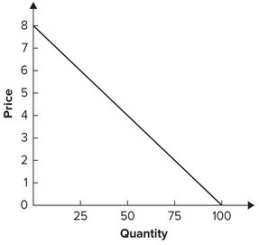
(Multiple Choice)
4.7/5 (82)
(82) Refer to the following graph. 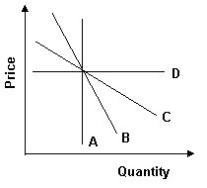 The demand curve with the greatest elasticity is:
 (Multiple Choice)
4.9/5 (82)
(82) Refer to the following table to answer the question. Which of the following statements is true? Price of A Quantity Demanded of A Quantity Demanded of B Quantity Demanded of C \ 1.00 80 100 5 \ 1.50 60 98 10 \ 2.00 40 96 15 \ 2.50 20 94 20 \ 3.00 0 92 25
(Multiple Choice)
4.9/5 (88)
(88) Refer to the table shown to answer the question. Between $2 and $2.20, demand is: Price Quantity Demanded \ 1.60 130 \ 1.80 120 \ 2.00 110 \ 2.20 100 \ 2.40 90 \ 2.60 80
(Multiple Choice)
4.8/5 (75)
(75) A price elasticity of demand for a good or service of 1.8 tells us that:
(Multiple Choice)
4.8/5 (80)
(80) If the quantity of Arizona green teas demanded falls from 4.0 million to 3.0 million as the price of Lipton green teas falls from $2.70 to $2.50, Arizona's teas and Lipton's teas are:
(Multiple Choice)
4.8/5 (72)
(72) If macaroni and cheese is an inferior good, falling incomes will tend to:
(Multiple Choice)
4.9/5 (84)
(84) As the price of beachfront cottages in Florida was raised from $400,000 to $500,000, their quantity supplied rose from 2,000 to 2,100. Rounding to the nearest tenth, the elasticity of supply of beachfront cottages is:
(Multiple Choice)
4.8/5 (80)
(80) Refer to the following graph.  If price is currently at B and rises, total revenue will rise.
 (True/False)
4.8/5 (86)
(86) During World War II, the price of rubber went up considerably. The rise in price stimulated research for alternatives. Today's automobile tires are made almost entirely from synthetic materials. As a result, the increase in the price of rubber eventually led to a very large drop in quantity demanded. This is an example of how the price elasticity of demand:
(Multiple Choice)
4.7/5 (83)
(83) If an economist observed that higher hot dog prices lead to an increase in the demand for chili, she most likely would conclude that:
(Multiple Choice)
4.9/5 (89)
(89) If quantity demanded does not change when the price changes, the demand:
(Multiple Choice)
4.7/5 (79)
(79) 
Filters
- Essay(0)
- Multiple Choice(0)
- Short Answer(0)
- True False(0)
- Matching(0)