



 Chat with AI
Exam 9: Comparative Advantage, Exchange Rates, and Globalization

Exam 1: Economics and Economic Reasoning121 Questions
Exam 2: The Production Possibility Model, Trade, and Globalization111 Questions
Exam 3: Economic Institutions144 Questions
Exam 4: Supply and Demand151 Questions
Exam 5: Using Supply and Demand136 Questions
Exam 6: Describing Supply and Demand: Elasticities176 Questions
Exam 7: Taxation and Government Intervention169 Questions
Exam 8: Market Failure Versus Government Failure160 Questions
Exam 9: Comparative Advantage, Exchange Rates, and Globalization107 Questions
Exam 10: International Trade Policy82 Questions
Exam 11: Production and Cost Analysis I160 Questions
Exam 12: Production and Cost Analysis II129 Questions
Exam 13: Perfect Competition137 Questions
Exam 14: Monopoly and Monopolistic Competition231 Questions
Exam 15: Oligopoly and Antitrust Policy111 Questions
Exam 16: Real-World Competition and Technology86 Questions
Exam 17: Work and the Labor Market130 Questions
Exam 18: Who Gets What the Distribution of Income100 Questions
Exam 19: The Logic of Individual Choice: the Foundation of Supply and Demand134 Questions
Exam 20: Game Theory, Strategic Decision Making, and Behavioral Economics76 Questions
Exam 21: Thinking Like a Modern Economist67 Questions
Exam 22: Behavioral Economics and Modern Economic Policy87 Questions
Exam 23: Microeconomic Policy, Economic Reasoning, and Beyond111 Questions
Select questions type


In the United States globalization has played:

Free
(Multiple Choice)
4.8/5  (82)
(82) Correct Answer: Verified
A
The decline in the price of American goods is due in part to:
Free
(Multiple Choice)
4.7/5 (84)
(84) Correct Answer:Verified
VerifiedD
If a country's exchange rate depreciates,
Free
(Multiple Choice)
4.8/5 (75)
(75) Correct Answer:Verified
VerifiedA
In the United States, globalization has caused workers in the education, health care, and government sectors to face:
(Multiple Choice)
4.8/5 (73)
(73) Refer to the table shown. 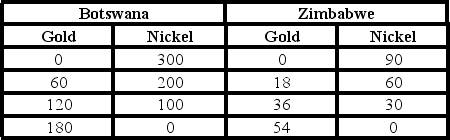 Botswana's opportunity cost of producing nickel (in terms of gold) is:
 (Multiple Choice)
4.8/5 (77)
(77) The recent discovery of a significant amount of shale oil in the U.S. that can be exported will shift the:
(Multiple Choice)
4.9/5 (80)
(80) If the United States were to stop trading with other nations, economists would predict that in the long run the United States would end up with:
(Multiple Choice)
4.9/5 (76)
(76) Refer to the graph shown. 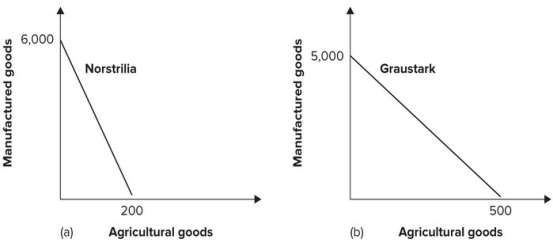 We would expect that if the two countries trade with each other (and neither trades with the rest of the world):
 (Multiple Choice)
4.9/5 (64)
(64) 
Smaller countries tend to get a larger share of the gains from trade than do larger countries.
(True/False)
4.7/5 (89)
(89) If the world supply curve is SW0, and the country discovers a significant natural resource that can be exported, the world supply curve will shift: 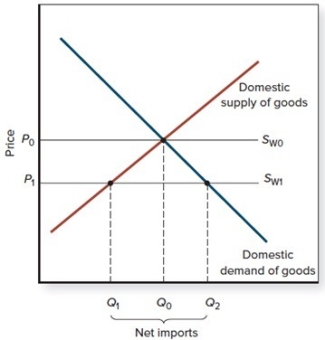
(Multiple Choice)
4.8/5 (90)
(90) Refer to the table shown. 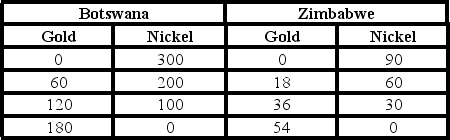 A comparative advantage in the production of gold is held by:
 (Multiple Choice)
4.8/5 (76)
(76) 
Filters
- Essay(0)
- Multiple Choice(0)
- Short Answer(0)
- True False(0)
- Matching(0)