



 Chat with AI
Exam 2: The Production Possibility Model, Trade, and Globalization

Exam 1: Economics and Economic Reasoning121 Questions
Exam 2: The Production Possibility Model, Trade, and Globalization111 Questions
Exam 3: Economic Institutions144 Questions
Exam 4: Supply and Demand151 Questions
Exam 5: Using Supply and Demand136 Questions
Exam 6: Describing Supply and Demand: Elasticities176 Questions
Exam 7: Taxation and Government Intervention169 Questions
Exam 8: Market Failure Versus Government Failure160 Questions
Exam 9: Comparative Advantage, Exchange Rates, and Globalization107 Questions
Exam 10: International Trade Policy82 Questions
Exam 11: Production and Cost Analysis I160 Questions
Exam 12: Production and Cost Analysis II129 Questions
Exam 13: Perfect Competition137 Questions
Exam 14: Monopoly and Monopolistic Competition231 Questions
Exam 15: Oligopoly and Antitrust Policy111 Questions
Exam 16: Real-World Competition and Technology86 Questions
Exam 17: Work and the Labor Market130 Questions
Exam 18: Who Gets What the Distribution of Income100 Questions
Exam 19: The Logic of Individual Choice: the Foundation of Supply and Demand134 Questions
Exam 20: Game Theory, Strategic Decision Making, and Behavioral Economics76 Questions
Exam 21: Thinking Like a Modern Economist67 Questions
Exam 22: Behavioral Economics and Modern Economic Policy87 Questions
Exam 23: Microeconomic Policy, Economic Reasoning, and Beyond111 Questions
Select questions type


If there were decreasing marginal opportunity costs, the production possibility curve would be:
(Multiple Choice)
4.8/5  (75)
(75) Because you can get more of one good only by giving up some of another good, the shape of a production possibility curve is:
(Multiple Choice)
4.8/5 (77)
(77) The principle of increasing marginal opportunity cost does not hold in which of the following cases?
(Multiple Choice)
4.9/5 (79)
(79) The graph below indicates that the economy can produce both: 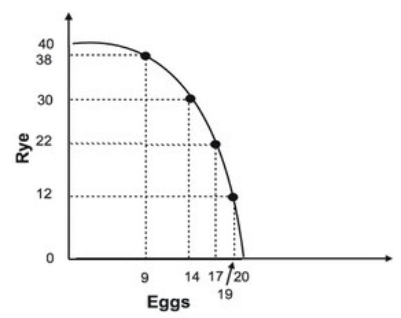
(Multiple Choice)
4.8/5 (78)
(78) In the graph shown, what change would increase production efficiency? 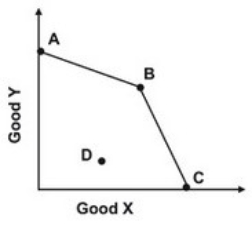
(Multiple Choice)
4.9/5 (66)
(66) Given a production possibility curve for good X (on the x-axis) and good Y (on the y-axis), the opportunity cost of increasing good X is greatest when the slope of the production possibility curve is:
(Multiple Choice)
4.9/5 (81)
(81) Evan can grow both roses and carnations in his garden. His production possibility table is shown below. If he is currently producing 110 roses, his opportunity cost of producing 40 more roses is: Number of roses Number of carnations 0 155 60 135 110 109 150 78 180 0
(Multiple Choice)
4.9/5 (72)
(72) John can clean the house in three hours and do the laundry in four. Jane can clean the house in two hours or do the laundry in two. Can they benefit by specialization and trade?
(Multiple Choice)
4.8/5 (90)
(90) Suppose that in Slovakia one unit of labor can produce either 20 tons of wheat or 40 tons of soy and in Poland one unit of labor can produce either 40 tons of wheat or 20 tons of soy. If each country has two units of labor, which of the following consumption combinations can be attained only with trade?
(Multiple Choice)
4.8/5 (81)
(81) Which of the following factors will help the United States regain comparative advantages in industries in which it has lost comparative advantages?
(Multiple Choice)
4.9/5 (80)
(80) 
Filters
- Essay(0)
- Multiple Choice(0)
- Short Answer(0)
- True False(0)
- Matching(0)