



 Chat with AI
Exam 2: The Production Possibility Model, Trade, and Globalization

Exam 1: Economics and Economic Reasoning121 Questions
Exam 2: The Production Possibility Model, Trade, and Globalization111 Questions
Exam 3: Economic Institutions144 Questions
Exam 4: Supply and Demand151 Questions
Exam 5: Using Supply and Demand136 Questions
Exam 6: Describing Supply and Demand: Elasticities176 Questions
Exam 7: Taxation and Government Intervention169 Questions
Exam 8: Market Failure Versus Government Failure160 Questions
Exam 9: Comparative Advantage, Exchange Rates, and Globalization107 Questions
Exam 10: International Trade Policy82 Questions
Exam 11: Production and Cost Analysis I160 Questions
Exam 12: Production and Cost Analysis II129 Questions
Exam 13: Perfect Competition137 Questions
Exam 14: Monopoly and Monopolistic Competition231 Questions
Exam 15: Oligopoly and Antitrust Policy111 Questions
Exam 16: Real-World Competition and Technology86 Questions
Exam 17: Work and the Labor Market130 Questions
Exam 18: Who Gets What the Distribution of Income100 Questions
Exam 19: The Logic of Individual Choice: the Foundation of Supply and Demand134 Questions
Exam 20: Game Theory, Strategic Decision Making, and Behavioral Economics76 Questions
Exam 21: Thinking Like a Modern Economist67 Questions
Exam 22: Behavioral Economics and Modern Economic Policy87 Questions
Exam 23: Microeconomic Policy, Economic Reasoning, and Beyond111 Questions
Select questions type


Given the production possibility tables for First and Second Bakeries shown, we know that the opportunity cost of producing pies: 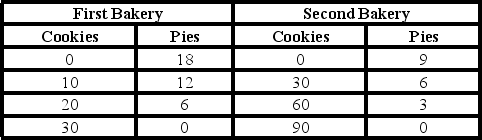
(Multiple Choice)
4.9/5  (83)
(83) Refer to the graph shown. 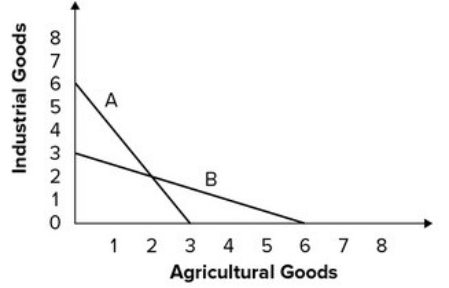 Suppose Country X exports agricultural goods to Country Y in exchange for industrial goods. This pattern of trade increases consumption in both countries only if:
 (Multiple Choice)
4.8/5 (74)
(74) The slopes of the curve at points A and B (maximum and minimum) are: 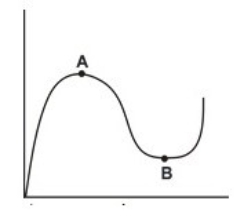
(Multiple Choice)
4.7/5 (80)
(80) Refer to the graph below. 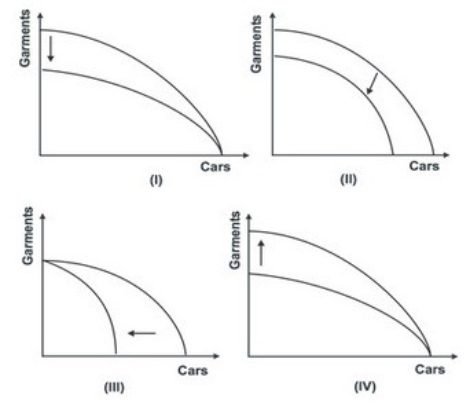 Which of the shifts explains what would happen to the production possibility curve if a cyclone destroys five major garment factories in the Philippines?
 (Multiple Choice)
4.7/5 (78)
(78) An inverse relationship occurs between two variables when as one goes:
(Multiple Choice)
4.9/5 (74)
(74) Suppose each of the following rows represents the choice faced by policy makers given the current set of U.S. institutions and technology. What is the opportunity cost of reducing unemployment from 8 percent to 4 percent? Unemployment Inflation 10 3 8 4 6 5 5 7 4 10
(Multiple Choice)
4.8/5 (78)
(78) Productive efficiency is not achieved at any point inside the production possibility curve.
(True/False)
4.8/5 (82)
(82) If the hourly wage of U.S. workers is $16, the hourly wage of Mexican workers is $2, and U.S. workers produce 5 times as much output per hour as Mexican workers, then, other things equal, it would be efficient to locate production facilities in:
(Multiple Choice)
4.7/5 (75)
(75) Juan works at Texas Burgers in El Paso and earns $8.00 per hour. His twin brother Felipe works in Mexico Burgers in Ciudad Juarez just across the border and earns $3.00 per hour for exactly the same work. An economist looking at this situation sees:
(Multiple Choice)
4.8/5 (73)
(73) Suppose that in Colombia one unit of labor can produce 8 tons of papayas or 2 tons of bananas. In Brazil, one unit of labor can produce either 4 tons of papayas or 1 ton of bananas. Given this information, which of the following statements is true?
(Multiple Choice)
4.7/5 (62)
(62) Consider the table below, in which each production choice represents a point on a production possibility curve. Thuice Eggs Rye A 10 0 B 8 10 C 6 20 D 4 30 E 2 40 F 0 50 This production possibility table could be graphed as a:
(Multiple Choice)
4.7/5 (88)
(88) Increasing marginal opportunity cost means that the production possibility curve is:
(Multiple Choice)
4.9/5 (76)
(76) Refer to the graph shown. 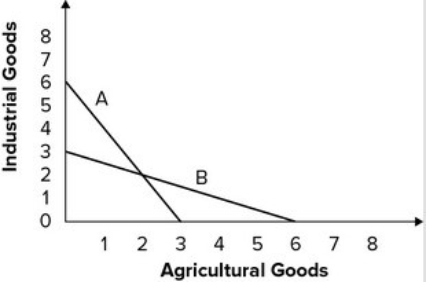 If Countries X and Y face the production possibility curves A and B, respectively, Country X has a comparative advantage in the production of:
 (Multiple Choice)
4.9/5 (87)
(87) Refer to the graph below. 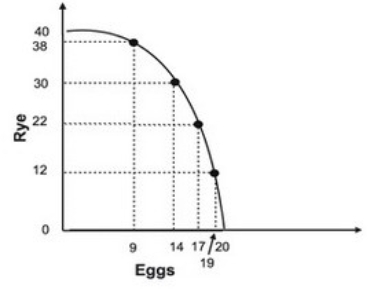 The graph indicates that as more eggs are produced, the marginal opportunity cost of:
 (Multiple Choice)
4.7/5 (77)
(77) Refer to the graph below. 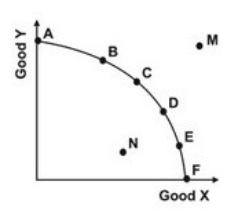 Productive efficiency is achieved at what points?
 (Multiple Choice)
5.0/5 (72)
(72) A downward-sloping line that makes a 45-degree angle with the horizontal and vertical axes has a slope of:
(Multiple Choice)
4.7/5 (68)
(68) Refer to the graph below. 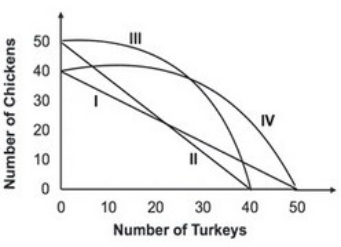 Suppose that the opportunity cost of producing 10 chickens is always 8 turkeys. Given this, the relevant production possibility curve must be:
 (Multiple Choice)
4.9/5 (73)
(73) Refer to the graph below. 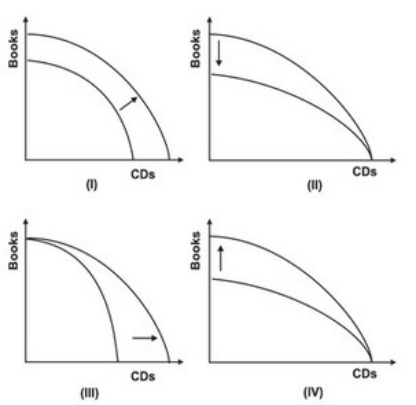 In the 1980s, digital publishing reduced the cost of producing books. Assuming no change in the cost of producing DVDs, which of the shifts reflects this change in technology?
 (Multiple Choice)
4.7/5 (67)
(67) 
Filters
- Essay(0)
- Multiple Choice(0)
- Short Answer(0)
- True False(0)
- Matching(0)