



 Chat with AI
Exam 2: The Production Possibility Model, Trade, and Globalization

Exam 1: Economics and Economic Reasoning121 Questions
Exam 2: The Production Possibility Model, Trade, and Globalization111 Questions
Exam 3: Economic Institutions144 Questions
Exam 4: Supply and Demand151 Questions
Exam 5: Using Supply and Demand136 Questions
Exam 6: Describing Supply and Demand: Elasticities176 Questions
Exam 7: Taxation and Government Intervention169 Questions
Exam 8: Market Failure Versus Government Failure160 Questions
Exam 9: Comparative Advantage, Exchange Rates, and Globalization107 Questions
Exam 10: International Trade Policy82 Questions
Exam 11: Production and Cost Analysis I160 Questions
Exam 12: Production and Cost Analysis II129 Questions
Exam 13: Perfect Competition137 Questions
Exam 14: Monopoly and Monopolistic Competition231 Questions
Exam 15: Oligopoly and Antitrust Policy111 Questions
Exam 16: Real-World Competition and Technology86 Questions
Exam 17: Work and the Labor Market130 Questions
Exam 18: Who Gets What the Distribution of Income100 Questions
Exam 19: The Logic of Individual Choice: the Foundation of Supply and Demand134 Questions
Exam 20: Game Theory, Strategic Decision Making, and Behavioral Economics76 Questions
Exam 21: Thinking Like a Modern Economist67 Questions
Exam 22: Behavioral Economics and Modern Economic Policy87 Questions
Exam 23: Microeconomic Policy, Economic Reasoning, and Beyond111 Questions
Select questions type


The Apple Watch was designed by Apple in the United States, manufactured in factories in Asia, and sold throughout the world. Many other firms, both American and foreign, began to try to develop alternatives to the Apple Watch. The Apple Watch is an example of American comparative advantage in:
(Multiple Choice)
4.8/5  (80)
(80) With the resources available, you can make the combinations of Ums and Umies (trinkets from a place called Bandarban) shown in the table. The opportunity cost of producing 60 Umies instead of 30 Umies is: Number of Ums Number of Umies 60 0 40 30 20 60 0 90
(Multiple Choice)
4.8/5 (76)
(76) Two countries that specialize their production along the lines of comparative advantage and then trade with each other will be able to:
(Multiple Choice)
4.8/5 (80)
(80) The morel is a prized mushroom that is often abundant in the Western United States in years after forest fires. Suppose two companies are buying morels from workers willing to find them. One company offers to pay workers $5.00 per pound, and the other company will pay workers only $4.00 per pound. Economists would say that:
(Multiple Choice)
4.8/5 (84)
(84) Refer to the graph below. 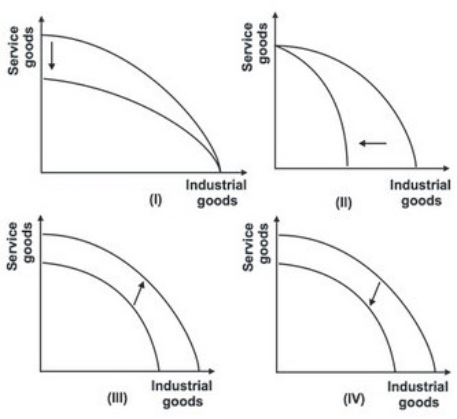 Which of the shifts explains what will happen to the production possibility curve if political unrest and strikes disrupt all sectors of an economy equally?
 (Multiple Choice)
4.9/5 (72)
(72) 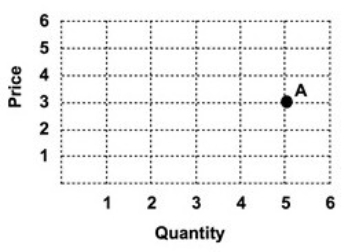 Point A represents a price of:
Which of the following is the best example of an economic precept?
(Multiple Choice)
4.8/5 (81)
(81) The production possibility table below is for growing broccoli and asparagus in a 320-square-foot garden in one season. Praduction Passibility Broccoli Asparagus 30 0 20 18 10 26 0 30 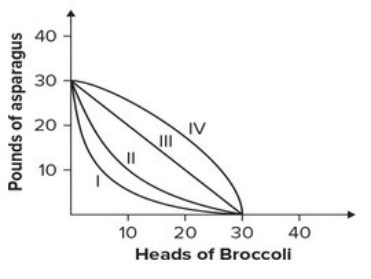 Which curve on the graph on the right corresponds to this table?
 (Multiple Choice)
4.8/5 (80)
(80) The production possibility curves of two countries are given below: 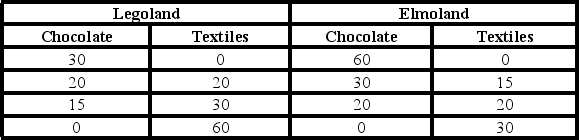 Refer to the production possibility curves of the two countries. If they specialized and traded, which of the following is the largest bundle each country could have?
 (Multiple Choice)
4.8/5 (98)
(98) The principle of increasing marginal opportunity costs states that the initial opportunity costs are:
(Multiple Choice)
4.9/5 (85)
(85) The law of one price means that prices eventually will be the same in all countries and eventually countries will not have a reason to trade.
(True/False)
5.0/5 (82)
(82) Adam Smith argued that greater specialization and division of labor are likely to:
(Multiple Choice)
4.8/5 (83)
(83) Two nations with differing comparative advantages will be able to consume more if they specialize and trade with each other than if they did not specialize or trade with each other.
(True/False)
4.7/5 (76)
(76) Refer to the graph below. 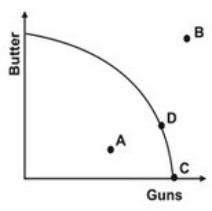 Given the production possibility curve, which point is unattainable?
 (Multiple Choice)
4.7/5 (77)
(77) Refer to the graph shown. Destruction of some of the resources necessary to produce both guns and butter would result in what movement? 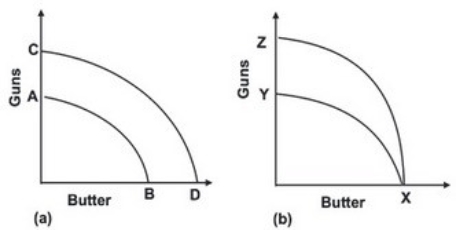
(Multiple Choice)
4.7/5 (86)
(86) Consider the following information, which provides percentage change in GDP per year: Per centuge increase in GDP 2012 -10.0 2013 -5.0 2014 -5.0 2015 4.0 2016 10.0
(Multiple Choice)
4.8/5 (81)
(81) Production possibility curves are upward-sloping because increased production of one good implies reduced production of another good.
(True/False)
4.9/5 (71)
(71) 
Filters
- Essay(0)
- Multiple Choice(0)
- Short Answer(0)
- True False(0)
- Matching(0)