



 Chat with AI
Exam 14: Monopoly and Monopolistic Competition

Exam 1: Economics and Economic Reasoning121 Questions
Exam 2: The Production Possibility Model, Trade, and Globalization111 Questions
Exam 3: Economic Institutions144 Questions
Exam 4: Supply and Demand151 Questions
Exam 5: Using Supply and Demand136 Questions
Exam 6: Describing Supply and Demand: Elasticities176 Questions
Exam 7: Taxation and Government Intervention169 Questions
Exam 8: Market Failure Versus Government Failure160 Questions
Exam 9: Comparative Advantage, Exchange Rates, and Globalization107 Questions
Exam 10: International Trade Policy82 Questions
Exam 11: Production and Cost Analysis I160 Questions
Exam 12: Production and Cost Analysis II129 Questions
Exam 13: Perfect Competition137 Questions
Exam 14: Monopoly and Monopolistic Competition231 Questions
Exam 15: Oligopoly and Antitrust Policy111 Questions
Exam 16: Real-World Competition and Technology86 Questions
Exam 17: Work and the Labor Market130 Questions
Exam 18: Who Gets What the Distribution of Income100 Questions
Exam 19: The Logic of Individual Choice: the Foundation of Supply and Demand134 Questions
Exam 20: Game Theory, Strategic Decision Making, and Behavioral Economics76 Questions
Exam 21: Thinking Like a Modern Economist67 Questions
Exam 22: Behavioral Economics and Modern Economic Policy87 Questions
Exam 23: Microeconomic Policy, Economic Reasoning, and Beyond111 Questions
Select questions type


Suppose a monopolist is at the profit-maximizing output level. If the monopolist reduces output:
(Multiple Choice)
4.9/5  (85)
(85) Refer to the graph shown. The welfare loss of monopoly is: 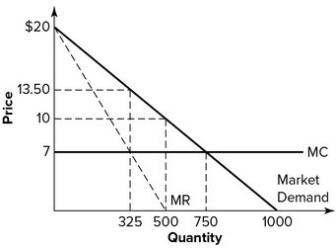
(Multiple Choice)
4.9/5 (83)
(83) Suppose a monopolist is at the profit-maximizing output level. If the monopolist sells another unit of output:
(Multiple Choice)
5.0/5 (57)
(57) Refer to the graph shown depicting a monopolistically competitive firm. The marginal revenue curve is represented by curve: 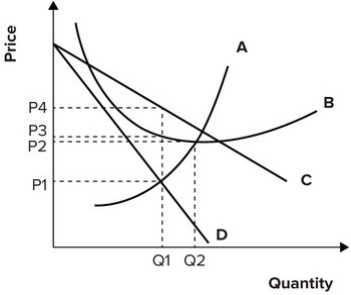
(Multiple Choice)
4.8/5 (82)
(82) In the case of a natural monopoly, as the number of firms in the industry increases, the average cost of producing a:
(Multiple Choice)
4.8/5 (77)
(77) Under monopolistic competition, a long-run equilibrium exists when price equals:
(Multiple Choice)
4.8/5 (88)
(88) Which of the following statements for a monopolistic competitor in long-run equilibrium is true?
(Multiple Choice)
4.8/5 (86)
(86) Of the following, the most likely example of price discrimination is when:
(Multiple Choice)
4.9/5 (89)
(89) Despite the fact that the Quick-Buzz Coffee Company provides a coupon in the local newspaper that can be redeemed for $1 off the price of its best-selling coffee beans, not all buyers actually use the coupon. Assuming everyone has a subscription to the newspaper, from this we know that:
(Multiple Choice)
4.8/5 (91)
(91) Compared with a normal monopolist, an effective price-discriminating monopolist produces a:
(Multiple Choice)
4.9/5 (77)
(77) Refer to the graph shown. If this monopolist were forced to set price equal to marginal cost, in the long run it probably would produce: 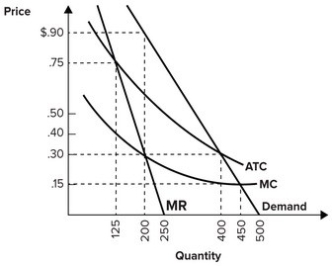
(Multiple Choice)
5.0/5 (81)
(81) If a monopolist produces beyond the quantity where MC = MR:
(Multiple Choice)
4.8/5 (73)
(73) Refer to the graph shown. The profit-maximizing monopolist produces output: 
(Multiple Choice)
5.0/5 (74)
(74) Long-run equilibrium for firms in monopolistically competitive industries is similar to that for firms in perfect competition in that:
(Multiple Choice)
4.9/5 (64)
(64) Why do some stores offer senior citizens discounts on Tuesdays?
(Multiple Choice)
4.8/5 (81)
(81) Refer to the graph shown. Suppose the industry is currently perfectly competitive but then is taken over by a monopolist. Assuming that the monopolist maximizes profit: 
(Multiple Choice)
4.8/5 (71)
(71) Refer to the graph shown. Assuming that this monopolist maximizes profit, the marginal cost of its last unit of output will be: 
(Multiple Choice)
4.8/5 (74)
(74) 
Filters
- Essay(0)
- Multiple Choice(0)
- Short Answer(0)
- True False(0)
- Matching(0)