



 Chat with AI
Exam 14: Monopoly and Monopolistic Competition

Exam 1: Economics and Economic Reasoning121 Questions
Exam 2: The Production Possibility Model, Trade, and Globalization111 Questions
Exam 3: Economic Institutions144 Questions
Exam 4: Supply and Demand151 Questions
Exam 5: Using Supply and Demand136 Questions
Exam 6: Describing Supply and Demand: Elasticities176 Questions
Exam 7: Taxation and Government Intervention169 Questions
Exam 8: Market Failure Versus Government Failure160 Questions
Exam 9: Comparative Advantage, Exchange Rates, and Globalization107 Questions
Exam 10: International Trade Policy82 Questions
Exam 11: Production and Cost Analysis I160 Questions
Exam 12: Production and Cost Analysis II129 Questions
Exam 13: Perfect Competition137 Questions
Exam 14: Monopoly and Monopolistic Competition231 Questions
Exam 15: Oligopoly and Antitrust Policy111 Questions
Exam 16: Real-World Competition and Technology86 Questions
Exam 17: Work and the Labor Market130 Questions
Exam 18: Who Gets What the Distribution of Income100 Questions
Exam 19: The Logic of Individual Choice: the Foundation of Supply and Demand134 Questions
Exam 20: Game Theory, Strategic Decision Making, and Behavioral Economics76 Questions
Exam 21: Thinking Like a Modern Economist67 Questions
Exam 22: Behavioral Economics and Modern Economic Policy87 Questions
Exam 23: Microeconomic Policy, Economic Reasoning, and Beyond111 Questions
Select questions type


When you use a service like Facebook for free, it is likely that:
(Multiple Choice)
4.8/5  (76)
(76) Refer to the graph shown. If this monopolist were forced to set price equal to marginal cost, in the long run it probably would produce: 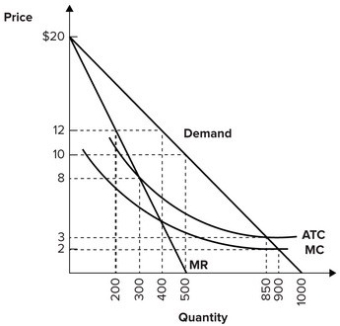
(Multiple Choice)
4.7/5 (84)
(84) A profit-maximizing monopolist will always set price equal to marginal cost.
(True/False)
4.8/5 (81)
(81) Refer to the graph shown. The welfare cost of monopoly is given by: 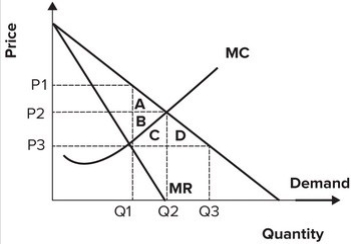
(Multiple Choice)
4.7/5 (92)
(92) Refer to the table shown, which shows the demand schedule for a firm that has a monopoly on the sale of computers in the country of Oz. If the monopolist is currently producing 400 computers per year and it seeks to maximize profit, it should: Price df computer s(t) Quantity demanded per year 5,000 100 4,000 200 3,000 300 2,000 400 1,000 500
(Multiple Choice)
4.9/5 (71)
(71) If MC = Q/15 represents marginal cost for a monopolist and market demand is given by Qd = 500 - 10P, the monopolist maximizes profit by producing:
(Multiple Choice)
4.9/5 (87)
(87) Refer to the graph shown. If this monopolist were forced to set price equal to marginal cost, in the long run it probably would: 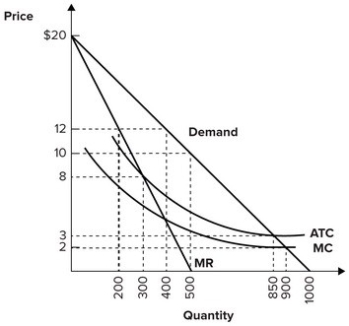
(Multiple Choice)
4.9/5 (72)
(72) Refer to the graph shown. If the government's goal is to eliminate the welfare costs of monopoly, it will: 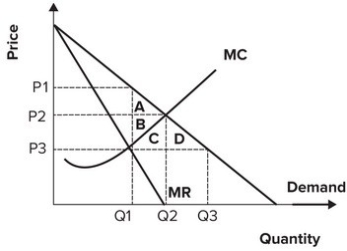
(Multiple Choice)
4.8/5 (88)
(88) If a natural monopoly faces a relatively inelastic consumer demand over the range of the production, it will have an incentive to:
(Multiple Choice)
5.0/5 (85)
(85) Refer to the graph shown of a monopolistically competitive firm. If the firm maximizes profit, it will: 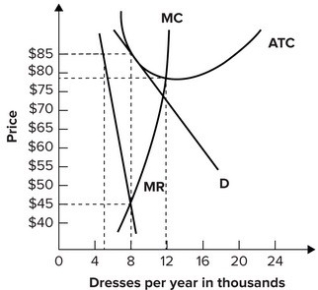
(Multiple Choice)
4.9/5 (77)
(77) A profit-maximizing firm in a monopolistically competitive industry sells its product at a price:
(Multiple Choice)
4.7/5 (86)
(86) Refer to the graph shown. If this monopolistically competitive firm maximizes profit, it will: 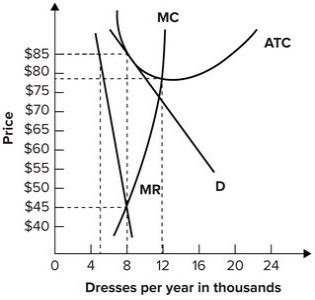
(Multiple Choice)
4.7/5 (80)
(80) Refer to the table shown, which shows the demand schedule for a firm that has a monopoly on the sale of computers in the country of Oz. If the firm were to set the price of computers at $2,000:
(Multiple Choice)
4.8/5 (60)
(60) Refer to the graph shown. If the firm maximizes profit, the marginal cost of its product will be: 
(Multiple Choice)
4.7/5 (73)
(73) Refer to the graph shown. The profit-maximizing monopolist would be: 
(Multiple Choice)
4.8/5 (88)
(88) Refer to the graph shown. If this monopolist were forced to set price equal to average cost, it would charge a price of: 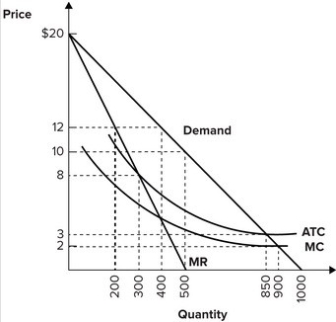
(Multiple Choice)
4.8/5 (78)
(78) Refer to the graph shown. Assuming that the monopoly maximizes profit, the social cost of monopoly will be: 
(Multiple Choice)
4.8/5 (84)
(84) 
Filters
- Essay(0)
- Multiple Choice(0)
- Short Answer(0)
- True False(0)
- Matching(0)