



 Chat with AI
Exam 14: Monopoly and Monopolistic Competition

Exam 1: Economics and Economic Reasoning121 Questions
Exam 2: The Production Possibility Model, Trade, and Globalization111 Questions
Exam 3: Economic Institutions144 Questions
Exam 4: Supply and Demand151 Questions
Exam 5: Using Supply and Demand136 Questions
Exam 6: Describing Supply and Demand: Elasticities176 Questions
Exam 7: Taxation and Government Intervention169 Questions
Exam 8: Market Failure Versus Government Failure160 Questions
Exam 9: Comparative Advantage, Exchange Rates, and Globalization107 Questions
Exam 10: International Trade Policy82 Questions
Exam 11: Production and Cost Analysis I160 Questions
Exam 12: Production and Cost Analysis II129 Questions
Exam 13: Perfect Competition137 Questions
Exam 14: Monopoly and Monopolistic Competition231 Questions
Exam 15: Oligopoly and Antitrust Policy111 Questions
Exam 16: Real-World Competition and Technology86 Questions
Exam 17: Work and the Labor Market130 Questions
Exam 18: Who Gets What the Distribution of Income100 Questions
Exam 19: The Logic of Individual Choice: the Foundation of Supply and Demand134 Questions
Exam 20: Game Theory, Strategic Decision Making, and Behavioral Economics76 Questions
Exam 21: Thinking Like a Modern Economist67 Questions
Exam 22: Behavioral Economics and Modern Economic Policy87 Questions
Exam 23: Microeconomic Policy, Economic Reasoning, and Beyond111 Questions
Select questions type


If the demand for a newly released novel is less price-elastic than the demand for an older novel, which of the following pricing strategies would a price-discriminating publishing firm follow?
(Multiple Choice)
4.8/5  (89)
(89) If a monopolistically competitive market became perfectly competitive, output probably would:
(Multiple Choice)
4.9/5 (73)
(73) Refer to the graph shown. If this monopolist sets the price to maximize profit, it will earn economic profit of: 
(Multiple Choice)
4.7/5 (86)
(86) Refer to the graph shown. The profit-maximizing monopolist would sell its output at price: 
(Multiple Choice)
4.9/5 (86)
(86) Platform businesses often don't charge people for their product. They do this because:
(Multiple Choice)
4.9/5 (68)
(68) Monopolistic competition is similar to perfect competition in that:
(Multiple Choice)
4.7/5 (77)
(77) Refer to the graph shown. Assuming that this monopolist maximizes profit, it will produce: 
(Multiple Choice)
4.8/5 (73)
(73) Refer to the graph shown. If regulators wanted this monopolist to earn only a normal profit, they would set price equal to: 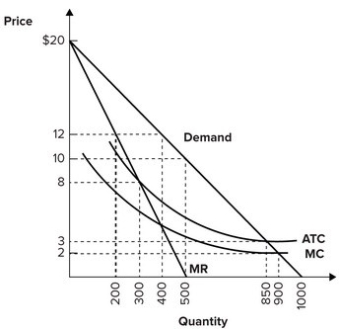
(Multiple Choice)
5.0/5 (72)
(72) The difference between a perfectly competitive firm and a monopolistically competitive firm is that a monopolistically competitive firm faces a:
(Multiple Choice)
4.9/5 (84)
(84) A monopoly firm selling textbooks to students in a small town is currently maximizing profits by charging a price of $50 per book. It follows that the marginal cost of textbooks is:
(Multiple Choice)
4.9/5 (78)
(78) Refer to the graph shown depicting a monopolistically competitive firm. According to the graph, economic profit is currently: 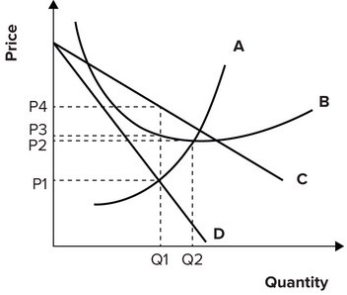
(Multiple Choice)
4.8/5 (75)
(75) Refer to the graph shown of average costs for a typical firm. The lowest per-unit costs for the industry could be achieved if: 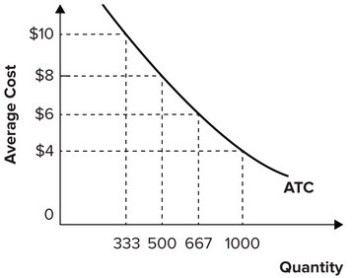
(Multiple Choice)
4.8/5 (67)
(67) Refer to the graph shown. If hamburgers are produced by a perfectly competitive industry with a market demand D, in long-run equilibrium the price will be: 
(Multiple Choice)
4.8/5 (74)
(74) Refer to the graph shown. If this monopolist sets the price to maximize profit, it will charge: 
(Multiple Choice)
4.9/5 (84)
(84) The Wall Street Journal magazine offers a significant discount to students who purchase a one-year subscription. If the reason for the discount is price discrimination, we can conclude that:
(Multiple Choice)
4.8/5 (90)
(90) 
Filters
- Essay(0)
- Multiple Choice(0)
- Short Answer(0)
- True False(0)
- Matching(0)