



 Chat with AI
Exam 18: International Trade and Public Policy

Exam 1: Introduction: What Is Economics144 Questions
Exam 2: The Key Principles of Economics195 Questions
Exam 3: Exchange and Markets135 Questions
Exam 4: Demand, Supply, and Market Equilibrium279 Questions
Exam 5: Measuring a Nations Production and Income161 Questions
Exam 6: Unemployment and Inflation206 Questions
Exam 7: The Economy at Full Employment165 Questions
Exam 8: Why Do Economies Grow203 Questions
Exam 9: Aggregate Demand and Aggregate Supply189 Questions
Exam 10: Fiscal Policy166 Questions
Exam 11: The Income-Expenditure Model265 Questions
Exam 12: Investment and Financial Markets179 Questions
Exam 13: Money and the Banking System184 Questions
Exam 14: The Federal Reserve and Monetary Policy203 Questions
Exam 15: Modern Macroeconomics: From the Short Run to the Long Run176 Questions
Exam 16: The Dynamics of Inflation and Unemployment186 Questions
Exam 17: Macroeconomic Policy Debates143 Questions
Exam 18: International Trade and Public Policy226 Questions
Exam 19: The World of International Finance189 Questions
Select questions type


Under GATT's "Most Favored Nation" provision countries can reduce tariffs only for their allies.
(True/False)
4.8/5  (71)
(71) Recall Application 2, "Protection for Candle Makers," to answer the following questions:
-According to the application, Frederic Bastiat's petition calling for the protection of candlemakers was fictitious.
(True/False)
4.7/5 (83)
(83) 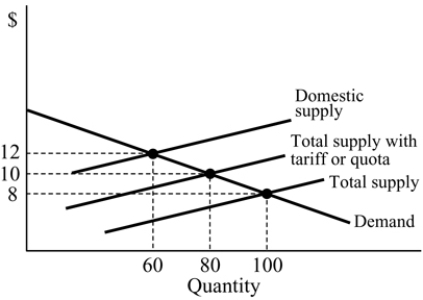 Figure 18.3
-Refer to Figure 18.3. With free trade, the equilibrium quantity is:
Figure 18.3
-Refer to Figure 18.3. With free trade, the equilibrium quantity is: (Multiple Choice)
4.9/5 (67)
(67)  -Refer to Table 18.2. Possible terms of trade between the U.S. and Japan are:
 (Multiple Choice)
4.7/5 (71)
(71) Recall Application 4, "Trade, Consumption and Inequality," to answer the following questions:
-According to the application, examples of non- durable goods include:
(Multiple Choice)
4.7/5 (71)
(71) Which of the following explains why the world market may support only one or two firms worldwide?
(Multiple Choice)
4.7/5 (80)
(80) In 2002, President Bush imposed a tariff on imported steel in order to protect domestic steel producers. What was the reason why the tariff ended?
(Multiple Choice)
4.8/5 (81)
(81) Suppose that the U.S. has comparative advantage on cars while Japan has comparative advantage on TV's. Assume that both countries produce both goods in autarky. If both countries open their economies to trade, identify the workers in each country who will be hurt by free trade.
(Essay)
4.8/5 (85)
(85) 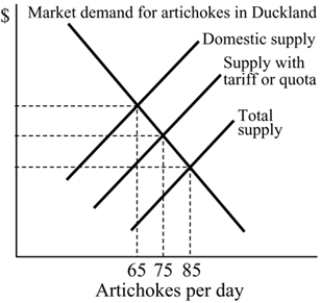 Figure 18.4
-Refer to Figure 18.4. With a tariff or quota, what is the equilibrium quantity of artichokes in Duckland?
Figure 18.4
-Refer to Figure 18.4. With a tariff or quota, what is the equilibrium quantity of artichokes in Duckland? (Multiple Choice)
4.9/5 (84)
(84)  -Refer to Table 18.1. The opportunity cost of an accordion in Poland is:
 (Multiple Choice)
4.8/5 (80)
(80) The equilibrium price under an import quota is above the price that occurs with free trade.
(True/False)
4.9/5 (82)
(82)  -Refer to Table 18.1. The opportunity cost of an accordion in Scotland is:
 (Multiple Choice)
4.9/5 (64)
(64) Suppose Japanese auto manufacturers voluntarily reduce exports to the U.S. Who will benefit from a voluntary export restraint? Who will get hurt from a voluntary export restraint? Explain.
(Essay)
4.9/5 (77)
(77) The consumption possibilities curve shows the combinations of goods that can be:
(Multiple Choice)
4.9/5 (75)
(75) Consider a nation that has a comparative advantage in the production of goods using unskilled labor. What types of workers will benefit from increased trade, and what type will lose?
(Essay)
4.8/5 (84)
(84) 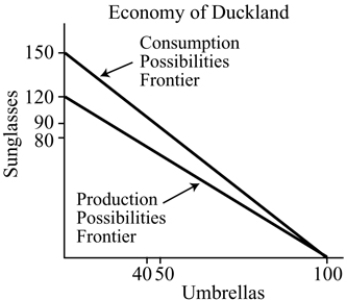 Figure 18.1
-Refer to Figure 18.1. In autarky, the maximum amount of umbrellas that Duckland can produce is:
Figure 18.1
-Refer to Figure 18.1. In autarky, the maximum amount of umbrellas that Duckland can produce is: (Multiple Choice)
4.9/5 (88)
(88) The citizens of a country may prefer a tariff to a quota because:
(Multiple Choice)
4.9/5 (88)
(88) 
Filters
- Essay(0)
- Multiple Choice(0)
- Short Answer(0)
- True False(0)
- Matching(0)